

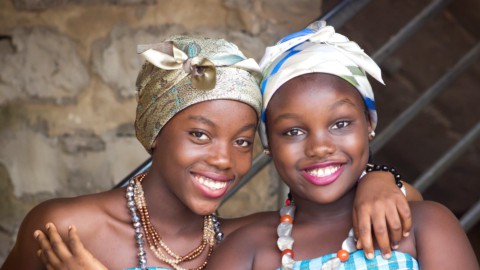
On May 5, 2020, the Italians had 4 hours 42 minutes and 34 seconds for know more about Africa that they weren't the boats of desperate people who alarm, disturb or at the most move. It was about following the video marathon that the Foreign Ministry has organized to celebrate the Africa day, established on 25 May 1963, the day on which the Organization of African Unity was born, since 2002 simply the African Union. A great effort, made in 50 videos, during which the dense color of African culture followed the political declarations of heads of state, foreign ministers, representatives of international and national organizations. Music, literature, art, fashion. This was strongly desired by the Deputy Minister Emanuela Del Re, whose intervention was outside the usual political practice. To greet his African friends, Del Re wanted to sing, intriguing and surprising among other things for the beautiful intonation, "Malaika", a well-known love song made famous by Miriam Makeba, the late "mama Africa".
But how many Italians have tried to find out more about Africa by connecting to the website of the Ministry of Foreign Affairs directly or through Youtube? Over ten thousand contacts, the numbers say. Remarkable figure. Sin that the big press and big news have done very little to enhance the Day and therefore crumble somewhere that wall of ignorance that continues to separate us from Africa.
And yet Africa is a continent that is growing at a rate of 3,8% a year, it is a young land (the average age of Africans, according to official data, is 19, against 45 in Italy). In 2050 it will have 2,4 billion people: it means that one in four inhabitants of the Earth will be African, they will have black skin to be precise, and for some it will always be a problem. Thanks to the exceptional fertility of the women of the continent, which they bring into the world on average 4,6 children (2,1 is the rate that ensures generational turnover). And despite this Africa remains a largely underpopulated continent (33 inhabitants per sq km) and with enormous development potential (it boasts 60% of arable land and 65% of the planet's untapped natural resources).
Italy is a valued partner. We are engaged in 11 countries with projects in agriculture, tanneries and training. Not to mention the giants, such as Eni, which have always been there. Terrorism remains a devastating scourge it is true, and it enlists young people attracted by easy money as well as a presumed adventurous life.
To discuss the continent, we talk to those who have been dealing with it for more than 30 years, the director of sub-Saharan Africa at the Foreign Ministry, Joseph Mistretta. Before taking up his post at the foreign ministry, Mistretta was ambassador to Angola and Ethiopia, worked in the embassies of Libya (while Gaddafi was still living and reigning), Great Britain and the United States. Writing is one of the ambassador's favorite pastimes and he cultivates it along two lines: one linked to his professional experiences in Africa; the other to the composition of light stories, fairy tales in truth, in which he likes to face the contradictions of everyday life. Just in these days two books by him are arriving in the bookstore, almost simultaneously due to the problems related to Covid: "La Bottega degli Alibi-Non bureaucratic tales" (edizioni Luogonteriori), illustrated among other things by another diplomat, Nicolò Tassoni Este; and the essay “The ways of Africa: the future of the Continent between Europe, Italy, China and New Actors” (Infinito editions), whose preface is by Romano Prodi.
Director, are you satisfied with the video marathon at the Farnesina?
“Frankly yes, and above all we hope that the viewers of the images are, including many young people and also members of the diasporas in Italy. It was an innovative initiative to celebrate Africa Day despite the medical and health situation. After a day of broadcasting, the four videos received thousands of views, and numerous acknowledgments from the public; among other things, it will remain accessible for a few days, and can therefore still be seen. In the end, the limitations imposed by Covid allowed us to reach a larger audience than a normal, usual ceremony, also taking into account that the video is broadcast on the websites of our diplomatic offices in Africa".
Everyone expected a massacre in Africa at the appearance of the Corona virus. Fortunately, the numbers of contagion and deaths have been low. According to official data from the African Union, there were 3.348 dead, 111.348 infected, nothing compared to Italy for example, with its over 32 dead and 230 infected: how do you explain this African resilience?
“Indeed, so far in Africa the virus has hit less violently than in other parts of the world. Among the many explanations that have been read, I would believe that the young average age of the African population may have been the determining factor. The particular crowded conditions in which most people live on the continent are instead the riskiest element. Despite these at least partly positive notes, the economic repercussions of the pandemic appear worrying. Already many continental leaders, together with the African Union, are demanding from the international community a strong deferral of interest on debts, a cancellation of the debt itself, and an injection of new loans amounting to around 100 billion euros, to deal with the effects of the coronavirus on local economies. This request is being examined by the G20 countries, of which Italy will have the Presidency in 2021".
SWe often refer to Africa as if it were one huge country. Instead the continent is not a monolith. What are the main differences between the various regions?
“The continent includes 54 states, and it is obvious that there are political, economic, social and cultural differences within it. However, there is also a certain homogeneity between the regions, for example in those of the Mediterranean and the Maghreb; in West Africa; in the particularly critical area of the Sahel at this time; in the Horn of Africa; in Central Africa; and in Southern Africa. And these peculiarities are the basis of the existence of as many regional organizations, such as for example Ecowas in West Africa, Eas in East Africa, Sadcc in the Southern area, Igad in the Horn of Africa, etc. Generalizations, in such a broad and varied context, are always wrong, as is the use of easy-to-use slogans, which do not help to deeply understand the challenges, difficulties, but also the ambitions of the continent. At the same time, it is also true that there is a common thread that connects African atmospheres, customs, traditions and populations together”.
While Covid 19 broke out in "French" Africa, as 15 countries of West and Central Africa are still often defined, they abandoned the currency born of decolonization, the CFA franc, so to speak, to ferry it towards the Eco, a new currency and entirely African. In your opinion, will France's weight in Africa also change?
“Undoubtedly in recent years there has been a growing dislike of the CFA franc countries towards this currency, and the limits it places on the development of local economies, such as, for example, the payment of 50% of the currency reserves to the Treasure of Paris. The launch of Eco by 15 African states is an element of significant innovation in the continental economic panorama, as is the approval, in 2019, of the Continental Free Trade Agreement (Cfta), for the progressive abolition of customs tariffs and free trade in Africa. In both cases, however, the media clamor tends to obscure the numerous difficulties of economic and financial adaptation and harmonization still to be overcome, before both important reforms actually enter into force, and in the case of Eco, for example, the necessary process of convergence of the economies of the area. As for the French peso, with or without the CFA franc, France will in any case remain a leading country, especially in West Africa, mainly for cultural reasons".
This year is also celebrating the end of colonization for most African states: what has changed since 1960 and what hasn't worked?
“The achievement of independence by many African states in 1960 (and its surroundings) was greeted with great enthusiasm by the continental leaders of the time, and it is logical that it was like this: the Africans finally accessed power, never to give it up again, since then. But if it is true that 1960 was a fundamental year, it is also true that many African countries achieved independence many years later, and often after tragic conflicts. For example, former Portuguese colonies such as Angola in the mid-70s, Zimbabwe in the 1980s, Namibia in 1990, Eritrea in 1993, South Africa with the end of apartheid in 1994, and South Sudan even in 2011. These dates remind us that African states, as we know them today, are a very recent and young phenomenon, and that this youth explains a large part of the fibrillation that the continent has periodically experienced and continues to experience. Although it is difficult to select what worked and what did not work, in extreme synthesis I would say that 7 causes certainly did not help the African take-off. The first was the lack of training by the former colonial countries on the future native ruling classes, on the eve of the independence processes. The second is the consequence of the first, namely a general political and administrative unpreparedness of the new leaders. In third place I would put a strong Soviet-inspired ideological charge of numerous continental leaders, who ventured into economic projects that proved to be bankrupt in the end. The fourth can only be the context of the Cold War. On the fifth, corruption, a poison widespread in most of the ruling classes of the continent. Sixth is the series of civil wars, coups d'état, and conflicts between countries that has never stopped. And finally, but not in order of importance, the persistence of practices of economic exploitation for their own benefit by the former colonial countries, for the first years after the attainment of independence, but not only. Today, as with all young countries, there are still problems of "governance" in many African countries, but others have achieved considerable stability and considerable annual rates of development. Among the latter are Rwanda, Ghana, Ethiopia, Kenya, Senegal, Angola, Mozambique, the Ivory Coast, Nigeria, to mention only the most relevant cases. In short, Africa is growing, economically and politically mature and aspires to a leading role in the international arena. This is a more than legitimate request, faced with which, for example, the European Union launched in 2017, on the occasion of the EU-AU summit in Abidjan, Nigeria, an advanced and modern equal partnership project, which remains a cornerstone for the future of relations between the two continents”.
A Marshall Plan is often invoked for Africa as well. Is this the way to finally push the great continent out of the crises?
“Any so-called Marshall Plan for Africa cannot disregard the central role of the professional training sector, preparation for specific operational capabilities (capacity building, as they say in the jargon), university and postgraduate education. A growing continent must be able to count on well-prepared managers and cadres, on better health care than at present, on experts in finance, economics, telecommunications, and so on. It is not just a question of investing in infrastructure or services, but above all of making strategic investments in the young people and women of the continent, who rightly aspire to a future of stability and prosperity. This is why Agenda 2063 was born, that is, the set of projects that the African Union and the United Nations Economic Commission for Africa have put in the pipeline. There is also a place for Europe in this Agenda: if we want to eliminate the problems that sometimes materialize in boats of desperate people, we should support and support this process with a long-term strategic vision”.
A CONTINENT OF UNDERDEVELOPED, WHERE THERE IS NOT A PITTY REVOLUTION MOVEMENT, THE ONLY ROAD THAT LEADS ANY PEOPLE TO EXISTENTIAL DIGNITY, WITH YOUNG COWLES WHO ESCAPE INSTEAD OF OPPOSING THEIR PUPPET GOVERNMENTS AND CLOWNS, TO FIGHT AGAINST THE VERY CORRUPT MULTINATIONALS, MI TELL WHO PASSES YOU THE COVID DATA OF THE POTATO SACKS THAT LIVE THAT CONTINENT ??????
BUT LET ME LAUGH, THEIR REPRODUCTION COWS ARE ALWAYS WITH A HIGH BELLY, THEY ARE DYING OF HUNGER OF STANTIES OF DISEASES OF INFECTIONS, SAY THAT BY 2050 THERE WILL BE 2,5 BILLION AND YOU WORRY ABOUT COVID. THEY DON'T EVEN KNOW HOW MANY THEY ARE. BUT COME ON.