La Spring è painted on wood and would have been too cumbersome to transport from Rome to Florence, but on the other hand, Botticelli returned to Florence after Lorenzo di Pierfrancesco's marriage. In a letter dated 18 October 1481 and sent by Ficino to Lorenzo di Pierfrancesco de' Medici we find the explanation of the meaning of the Three Graces. This missive has been correctly linked to Spring by Botticelli and seems to indicate that the painting was completed before Botticelli's departure for Rome, but another letter from Ficino addressed to Lorenzo Bonincontri, the astrologer who taught at the University of Florence between 1475 and 1478,15 is passed hitherto unnoticed. The letter is undated, but Ficino placed it with the other letters from 1476.
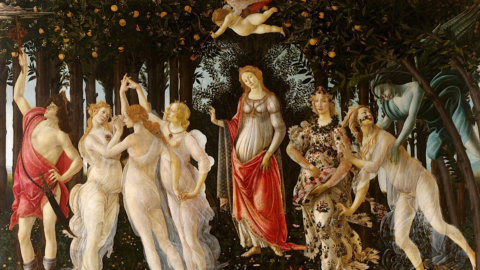
Based on the Glories and Metamorphosis of Ovid, ofAeneid of Virgil, del Fiesole nymph of Boccaccio, of the idyll Ambra of Lorenzo the Magnificent and, above all, of Rooms for the Carousel by Angelo Poliziano who celebrated the love of Giuliano dei Medici for Simonetta Vespucci who died in 1476, it was believed that in the complex layout of the Spring Botticelli had depicted, in the first decades of the 1480s, the garden of Venus in which some figures followed one another, segmented into individual groups. On the right, the Wind Zephyr who attacks the nymph Cloris who transforms into Flora, the deity who presided over the plant world; Venus, the goddess of love, dominates the center of the scene, symbol, according to Lucretius (theeditio princeps di Rerum Natura of 1472/3 was well known in Florence), of the life that is renewed in the spring months, followed by the three Graces. The last character on the left is Mercury, while Cupid hovers above his mother.
Fiore-Fiorenza a different reading perspective
But regardless of the extraordinary stylistic results and the complex mythological-philosophical meanings inherent in the painting and precisely because the work imposed itself for the novelty and variety of the plant species individually differentiated from each other and meticulously depicted in real dimensions, a another reading perspective that recovered the traditional equation "Fiore-Fiorenza” already proposed by Cristoforo Landino in the preface to the commentary on the Divine Comedy
In the second book Lucia T. Tomasi on the various examples reproduced in history, a should be added topos iconographic that recurs in the Florentine pictorial tradition of the fifteenth century: the flowering meadow, witnessed in some Annunciations dell'Angelico, in the tables of Filippo Lippi, among which inAdoration of the Child (formerly in Palazzo Medici) and in the panel of the same name, now attributed to the pseudo Pier Francesco Fiorentino who replaced it in the Palace, all works that present a large number of flowering plants. These paintings can also be compared to the grassy surface hit by the wind produced by the sudden appearance of the Angel, painted by the young Leonardo inAnnunciation. Furthermore, the richness of medicinal plants is then documented by the incunabula of Florentine recipe book, the city's official pharmacopoeia. A magical-astrological value was traditionally implicit in the therapeutic virtues of some plants, because, in a mix of science and magic, it was believed that the celestial bodies exerted positive or negative influences on them. Far from medieval demonic conceptions, humanistic thinkers had in fact identified in the figure of the "magician" that of the "wise man" who knows the secrets of nature well and is capable of dominating it in a correct relationship between macro and microcosm.
The floral species present in the painting
A significant contribution to the understanding of Spring Botticelliana was provided in 1982 da a careful restoration which not only allowed us to overcome the monochrome effect caused by the patina that had deposited on the surface over time and clarified some fundamental aspects (the figure of Zephyr, for example, turns decidedly blue, a color in harmony with the nature of a Wind), but it has also allowed a more precise reading of the vegetal component, expertly conducted by the botanist Guido Moggi.
The species that occur most frequently are daisies (Bellis perennis), violas (Scented violet), the Composites, the Ranunculaceae, the Rosaceae, the Orchidaceae. The background of the painting consists of a real forest, where citrus trees can be distinguished (Citrus sp.), mixed with myrtle (myrtle common), while on the right side of the painting there are two laurel trees (Laurus nobilis). Also on the far right, behind the figure of Zephyr, two cypress strobili (cuddles) are depicted (Cupressus sempervirens), although the corresponding branches are not identifiable. Moggi also notes a lesser characterization in the flowers that form the garland and wreath of Spring, where strawberries, white hyacinths and cornflowers prevail, while those collected in the figure's lap are mostly roses full flora, respond to cultivated varieties. In the hair and on the clothes of the same character the artist painted other daisies with cornflowers, strawberries, violets and, perhaps, anemones.
Now all we have to do is read this "fragrant" volume.