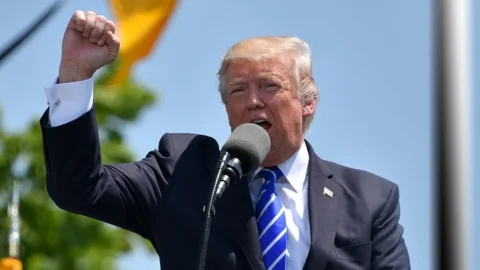
The tension between United States e Iran has entered a critical phase after theultimatum launched by Donald Trump, who warned Tehran of a possible military intervention in the absence of a nuclear agreement, while the Islamic Republic promises a reaction “total and unprecedented” in the event of attack.
At the heart of the US military deployment is the aircraft carrier USS Abraham Lincoln, currently deployed in the Middle East. According to the US Central Command (CENTCOM), the strike group is operating to "promote regional security and stability" and, according to the New York Times, would be ready to conduct potential operations against Iran within a day or two. To strengthen the system, the United States is also considering deploying Thaad missile defense systems, as reported by the CNN, although no final decision has been made at the moment.
Trump's threats and Washington's hard line
Trump has repeatedly reiterated that “time is running out” and that Iran should quickly sit down at the negotiating table to reach a nuclear agreement. Otherwise, the US president warned, a new attack American could be “much worse” than those already conducted in the past, explicitly recalling the precedent of the Venezuela, where Washington had deployed a naval fleet as an instrument of political and military pressure, ready to act "with speed and violence" if necessary. This position was shared, albeit with more cautious tones, by the Secretary of State. Marco Rubio, who emphasized the need to prevent threats to American interests and those of its allies in the region, while hoping to avoid military action. According to Rubio, the Iranian regime is "weaker than ever," partly due to the economic collapse and internal protests, which have been harshly repressed by the authorities.
American conditions for an Iranian nuclear deal
Behind the threats, the White House would have formulated specific requests in Tehran to open negotiations. According to the NYT, the United States is calling for a permanent cessation of all enrichment ofuranium, stringent limits on development and to the range of the ballistic missilesie the end of the support Iranian to militias allies in the region, such as Hamas, Hezbollah and HouthiSignificantly, there was no reference to the internal Iranian protests, even when the president had promised his assistance.
Tehran's response: "No negotiations under threat."
For its part, Iran rejects American pressure. The Foreign Minister Abbas Araghchi He reiterated that there are no direct contacts with Washington and that "diplomacy through military threats cannot work." Tehran affirms that it is ready for dialogue only in a climate of mutual respect, warning that, in the event of an attack, the response would not be proportionate but "adequate," with regional consequences that are difficult to control.
Even more explicit are the words of Ali Shamkhani, advisor to Supreme Leader Ali Khamenei, who spoke of possible attacks against Israel and against the American bases in the area.
Europe: Sanctions, Diplomacy, and Fears of Escalation
In Europe the debate is increasingly heated.European unionhe is discussing new fines for human rights violations and the possible inclusion of Guardians of the Revolution on the list with organizations terrorists of the EU. A move supported by Italy, but still facing resistance among some member states due to the potential diplomatic and security repercussions.
At the same time, several European countries continue to call for de-escalation, fearing that an open conflict between the United States and Iran could further destabilize the Middle East and have direct consequences on the energy and economic fronts. On the regional front, Qatar, Turkey, Saudi Arabia ed Egypt are stepping up efforts to Mediation to avoid a military escalation and promote a resumption of talks.
Human rights, internal protests, and economic collapse in Iran
The external crisis is intertwined with an increasingly unstable internal situation. protests The protests, which broke out at the end of December and were initially linked to the collapse of the rial, have turned into an open protest against religious power. According to human rights organizations, the repression has caused thousands of deaths and tens of thousands of arrests, amid information blackouts and widespread population control. The economic collapse is also taking its toll: the rial has hit a new all-time low, around 1,6 million to the dollar, fueling social discontent and the country's isolation.