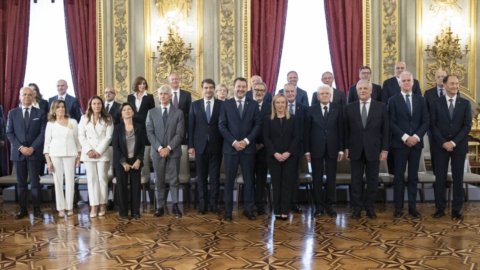
Giorgia Meloni is rightly proud of the record length of his government and recalls some positive effects that the stability of the Italian Government, in a moment of great political uncertainty in almost all Western countries, has brought about both in foreign policy and in our own financial reliability. And yet one cannot help but remember that political action was not brilliant as the Prime Minister herself had announced in her inaugural speech.
It's hard to say whether the glass is half full or half empty. What cannot be disputed is that no real reforms of the economic system have been made. Some delicate matches starting from that of theenergy (with the urgent relaunch of the nuclear) have been handled in a lacklustre manner, not to mention the industrial crises with the emblematic case of theex Ilva of Taranto where we can now write off the hot area as lost. Little or nothing has been done to streamline bureaucracy, introduce meritocratic criteria in the public sector, or invest in research, especially in the new frontiers of technology. Perhaps the consensus for real reforms is lacking in the country, and Salvini's League has always emphasized this.
There has been some activism on the tax system when at each Budget law some resources have been found to give some bonuses for workers, especially to those below a certain income threshold. And yet this tipping policy They do not appear to have been particularly appreciated by workers and businesses because they were generally measures of limited duration and therefore subject to the need for renewal with each new financial law.
And this also restricts the opportunities for political choice in the budget laws because the items that are due must first be settled. Last year, for example, the budget sought to support workers' incomes by granting a facilitated taxation (5%) for salary increases resulting from contract renewals, and a 15% tax reduction for night work and overtime. These benefits are now expiring. What can be done? Not renewing them means raising taxes for workers, but renewing them means using scarce resources for "old" measures that people already take for granted. Politically, a boomerang.
In addition to all these measures, together with many other bonuses, the flat tax andexcess of deductions, are making the tax system more confusing and even unfair. Anything but organic reform! In reality, progressivity is weakened by too many assets taxed at flat rates at source, while the opposition talks nonsense about a wealth tax, which alone does not serve to restore progressivity.
The Government will soon have to present its budget bill for next year which, as we know, it will be an election year and therefore there will be a push from all parties, both majority and opposition, to spend more and try to to gratify one's electoral clienteleThe Government will have to first of all to pay off the expiration dates of gifts granted in the pastBut in doing so, he could try to introduce some structural policies in the hope that citizen voters will tire of the fake gifts and want to see something more solid and long-lasting.