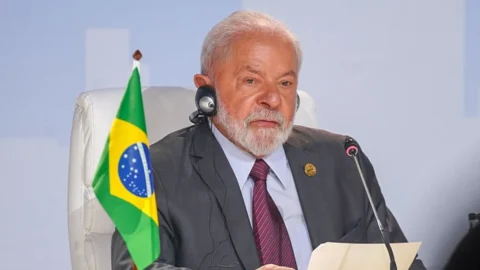
Il G20 of the leaders in the program Monday 18th and Tuesday 19th November a Rio de Janeiro will be the first in history to be chaired by Brazil. The host in a city under lockdown for security reasons (Santos Dumont airport closed during the event) is therefore President Lula, who came out battered from the October local elections and with his popularity at an all-time low. He is not the only weakened leader: the Russian president Vladimir Putin he won't even be there, "so as not to be a disturbance", while his American counterpart Joe Biden, who the day before visited the indigenous tribes of the Amazon in Manaus, is in fact an ex, given that he is about to hand over the reins of the White House to Donald Trump, who has repeatedly made it clear that in the coming years he will snub this type of appointment. Several European leaders are also not doing well: the French Emmanuel Macron he had a tough time in the summer with the legislative elections and the German Olaf Scholz was forced to vote early. From Italy comes Giorgia Meloni, fresh from hosting the G7 in June and from speaking a few days ago at Cop29 in Baku. The Prime Minister has a bilateral meeting with Lula scheduled today, Sunday 17 November, on the eve of the first day of work.
G20 in Rio: 55 delegations, big challenges and a bit of entertainment
In the Carioca city they are 55 delegations expected: 40 member and guest countries, including the European Union and the African Union, plus international organisations such as UN, FAO e Unesco. The assembly represents 80% of global trade and is now a mix of the Euro-Atlantic axis and emerging old and new countries such as China, India, Russia, Saudi Arabia, Qatar and the Emirates. The Holy See will also be present but not Pope Francis himself, and Southeast Asia will have an increasing weight with the participation of Indonesia (destined to become the world's fourth largest economy by 2050), Vietnam and Singapore. On the sidelines of the meeting, Saturday 16 and Monday 18 are scheduled. two pro-Palestine demonstrations: the second one is of particular concern, as it will take place right in the center, not far from the Museum of Modern Art that hosts the leaders and is organized by the PCO, Workers' Cause Party, a far-left group allied with the Lula government but accused of flirting with the far right in a sort of Brazilian "red-brownism". Rio de Janeiro has hosted 140 events linked to the G20 in the last year, which in these days will stimulate the city's economy for over half a billion reais (100 million euros), almost double the money allocated by the government for the organization, not without controversy given that the first lady Janja insisted on organizing a maxi concert Live Aid style, spending resources not initially foreseen for the artists' fees.
G20 in Brazil: Fight against hunger, taxes on the super-rich and the issue of wars
The Brazilian G20 comes at a delicate stage in the international context, marked by conflicts in Ukraine and the Middle East, From 'climate emergency and by inequalitiesThe Brazilian presidency, which has an ambiguous position on wars and is not in line with NATO, is focusing everything on social and environmental issues: the document on which the sherpas are working and which they will try to share puts in the foreground plan to fight hunger, taxation of the super rich, gender equality and green transition. Italy has already made its skepticism known, through the words of the Minister of Economy Giancarlo Giorgetti, about one of the central proposals of the meeting, the one inspired by the study of the economist Gabriel Zucman, that is, a global tax of 2% on assets exceeding one billion dollars, which could generate up to 250 billion dollars a year to finance the fight against the effects of climate change. The one who is clearly opposed to this proposal, risking not making it into the final document, is the Argentine President Javier Milei, who in recent days met Trump in Florida and who will somehow act as his representative in the Carioca city. On poverty Lula will instead propose the creation of a Global Alliance against Hunger, which has already been joined by countries such as Germany, Norway and Paraguay. Finally, there is the issue of global governance, which touches on that of wars, on which the host is embarrassed being also a member of the BRICS, now become an enlarged anti-Western club to 23 countries: an attempt will be made to propose a reform of the UN, to give it more power in an increasingly complicated geopolitical context.