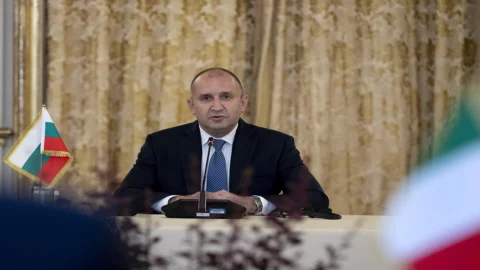
The pro-Russian Rumen Radev wins Bulgaria's snap parliamentary elections, redrawing the political balance of a country worn down by years of institutional paralysis. His party, Progressive Bulgaria, Has exceeded 45% of the consents and won 129 out of 240 seats, achieving the best result recorded in Bulgaria in the last thirty years. More than a simple electoral victory, that of the former president is a full political turning point.
The vote certifies first of all the end of the Boiko Boriso erav, the man who with Gerb dominated the Bulgarian scene for over a decade and who had become the main target of Radev's campaign. Conservatives stop between 12 and 13%, in the worst result in their history, after having led the country for eleven years between 2009 and 2021. They also enter Parliament the liberals with 11,4%, the Dps of the Turkish minority with 6% and the nationalists of Vazrazhdane with 5,1%.
Radev's success comes at the end of the eighth early election in five years and has its roots in long credibility crisis of traditional forces. In a Bulgaria that is tired, impoverished and has long been unable to express stable governments, the former head of state has built his advance on promise to overthrow the “oligarchic model” which, he says, is suffocating the country. The vote therefore rewards his ability to simultaneously embody protest, a demand for order, and aspiration for change.
However, the political issue that worries Brussels the mostRadev's victory raises fears in the European Union about his Eurosceptic positions and for its line deemed too soft towards MoscowFollowing Orbán's departure from Hungary, Radev-led Bulgaria now risks becoming a new thorn in the eastern flank of the Union and NATO.
Who is Rumen Radev?
Radev, 62 years old, former general and former commander of the Air Force, he was President of the Republic from 2017 until January 2026, when he resigned early to directly lead his own political creation. His public image is built on a highly recognizable mix of military discipline, anti-corruption rhetoric, and the image of a strongman called upon to restore order to a weakened country.
He founded Progressive Bulgaria just a month ago and in a few weeks he managed to transform the personal consensus he had accumulated over the years into a winning electoral machine. He presented himself as the leader determined to destroy the oligarchic system, to fight the corruption that has penetrated the state's core and to dismantle the influence of Delyan Peevski, one of the country's most powerful and controversial oligarchs, sanctioned in 2021 by the US Treasury for influence peddling and bribes.
But Radev's profile does not stop at the battle against the system. The former president is also the politician who has given more than any other voce in Bulgaria to a skeptical line towards Brussels, cool on military aid to Ukraine and in favor of resuming dialogue with Moscow. He rejects the label of pro-Russian, but his positions continue to place him in a highly ambiguous position in the eyes of European governments.
"We have defeated apathy"But distrust in Bulgarian politicians remains, and there's still a lot of work to do," Radev commented after his victory. "We expected to come first, but we're waiting for the final results. Many parties have declared that the Supreme Judicial Council needs to be replaced, and I hope that, together with the PP-DB coalition, we will move in the same direction on this issue. We will do everything possible to avoid new elections."
A success that comes from the crisis
Radev's race was pushed by promise to bring stability in a country that has been experiencing an almost permanent political crisis for years. Bulgaria reached this vote after eight elections in five years, a sequence that has eroded trust in institutions and made the relationship between citizens and politics increasingly fragile. This time, however, turnout rose to 48,5%, without counting the votes from abroad, a figure that indicates a higher than usual turnout in a country that seemed to have stopped believing in the power of the polls
The result of Progressive Bulgaria is son of long decomposition of the Bulgarian political landscape. For years, Sofia has endured fragile governments, anti-corruption protests, precarious majorities, and early elections that have become almost routine. Radev stepped into this vacuum, transforming his institutional profile into an openly political candidacy.
The decision to resign early from the presidency in January marked an unprecedented transition. With that move, the former head of state stopped playing the role of referee and decided to enter directly into battle for power, presenting himself as the leader called upon to cleanse Bulgaria of corruption, oligarchies, and mafia infiltration into the state. A powerful narrative, crafted to tap into social anger and distrust, has allowed him to attract support far beyond the traditional confines of the left.
Moscow's shadow behind the anti-corruption banner
Radev's victory, however, cannot be interpreted solely as the success of an anti-corruption platform. The leader of Progressive Bulgaria comes to power accompanied by a political line that openly worries EuropeDuring the election campaign he reiterated that military aid should not be provided to Ukraine, he ccontested the choices made on Kiev and has claimed a “pro-Bulgarian” and “realistic” position, a formula with which he attempts to reject the pro-Russian label without, however, truly distancing himself from that realm of ambiguity.
It is precisely this ambiguity that is the heart of the problem. Radev has often assumed cold positions towards Brussels, criticism of the euro (of which Bulgaria has been a part since this year) and wary of the European line on the Ukrainian conflict. His statement is thus also interpreted as the possible emergence of a new disturbing factor within the Union, at a time when Europe cannot afford any more internal fronts. Its rhetoric against the Mafia State It speaks to the frustration of Bulgarians, but beneath that surface lies a political vision that could shift Sofia toward more nationalist coordinates, more skeptical of integration and much less reliable on the Atlantic side.
For Brussels the fear is evident. After Orbán's defeat in HungaryRadev's Bulgaria risks becoming a new thorn in the side of the Union and NATO in the East. His victory does not only represent the success of an anti-corruption platform. It brings with it the risk of a more nationalist political twist, more Eurosceptic and more inclined to reopen channels with Moscow at a time when Europe is instead seeking unity.
The decline of the old masters
The vote also marks the downsizing of GERB's conservative bloc and its leader Boyko Borisov, a key figure in Bulgarian politics for over a decade. Its strength remains intact, but it emerges defeated in a vote that confirms its attrition. For Radev, this result has symbolic as well as numerical significance, because his campaign was fueled precisely by a frontal attack on the old power elite, accused of having transformed Bulgaria into a closed, corrupt system and dominated by shady interests.
The rest of the political picture is also shattered.The Liberals retain some influence, but not enough to challenge the winner for centrality. The nationalists and other minor forces remain in the background, within a Parliament that continues to reflect the entire dispersion of Bulgarian consensus. Radev's victory is clear, but it doesn't automatically deliver a more orderly system. On the contrary, it risks accentuating the tensions between the winner's political mandate and the difficulty of building a credible majority.
Winning does not mean governing
Radev claimed to have "defeated apathy," but did not hide the fact that distrust towards Bulgarian politics remains profound. He thanked his supporters, his staff, and Bulgarians abroad, emphasizing voter turnout as the first sign of a possible reversal of the trend. Among his priorities, he indicated: judicial reform, leaving open the possibility of parliamentary convergence on one of the most sensitive issues in Bulgarian public life.
Ma Winning does not automatically equate to governing well. Radev comes to power with a strong mandate and with the promise to clean up a discredited system from years of corruption and instability. It is on this ground that its credibility will now be measured. No longer in denouncing the old order, but in its ability to replace it with a more stable and credible institutional framework.
The vote, in short, does not end the Bulgarian crisis. Rather, it redefines its contours. Citizens have rejected the establishment that has dominated the last decade and have entrusted Radev with the task of ushering in a new era. However, the winner's political ambiguity remains intact, and his rise has also been fueled by an increasingly critical stance toward Brussels, cold on military support for Kiev, and inclined to reopen dialogue with Moscow.
For this reason, Sofia's move goes far beyond the national plan.European Union observes Bulgaria not only to understand if the country will finally be able to give itself a stable government, but also to measure strategic direction which will take one of its most fragile links. Radev has achieved a resounding victory. Now he must demonstrate that he will not simply benefit from Bulgaria's chaos, but be the leader capable of managing its exit.