Il October 2, 2024 will be remembered as one of the most disastrous days for the Italian railway network and a serious technical failure occurred during maintenance work in Rome the entire railway system was blocked of the country, paralyzing the main stations of the capital, Termini and Tiburtina. The fault interrupted circulation on many routes, forcing the cancellation of over one hundred trains and leaving thousands of passengers stranded, with delays that exceeded four hours.
Today, the day after, the damages are counted and the first measures are taken. Although the overall balance of the damage has not yet been quantified, it is estimated that hundreds of thousands of passengers across Italy have suffered inconvenience. Many commuters have lost entire working days and stations have filled up with long lines of people waiting for refunds or alternative solutions.
Meanwhile, Rfi, the FS company that manages the railway network, has announced the opening of an internal investigation and has communicated the termination of the contract with Str92, the maintenance company involved in the accident.
But, in the meantime, even today, we are reporting further problems on the rail network: a tarpaulin, probably dragged by the wind, ended up on the power line of the trains along the Rome-Civitavecchia route, at the height of Santa Severa, causing delays of up to two hoursThe Railway Police intervened to carry out the necessary investigations.
The fatal mistake of the Str92 company
The fault that paralyzed traffic yesterday was therefore attributed to the company Str92, a private company in charge of maintenance. According to the Minister of Infrastructure and Transport Matteo Salvini, the error was caused by a worker of the company "who hammered a nail in the wrong place", damaging a crucial electrical cable. This small error triggered a domino effect that sent the Italian railway system into a tailspin.
Salvini harshly commented on the incident: “It is not possible to invest billions of euros in new carriages, commuter trains, intercity trains and TAV, and then see everything blocked because someone hammers a nail in the wrong place, ruining the day of thousands of people”.
Rfi, already, yesterday evening, immediately terminated the contract with Str92 and has an internal investigation has been launched to shed light on the incident, While the Railway Police has, instead, opened aadministrative investigation to identify responsibilities and determine if there were other errors that contributed to the extent of the blockage.
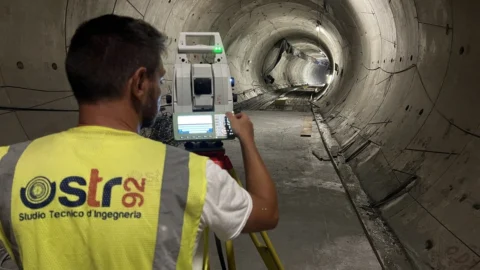
Str92, a company based in Fontana Liri in the province of Frosinone, has established itself over the last twenty years with numerous contracts throughout Italy. Specializing in topographic services and railway surveys, the company is involved in important projects like the Rome Metro line C and the M4 in Milan. The company, 99% owned by surveyor Giuseppe Proia, has a turnover of just over 1,5 million euros.
The administrator of Str92, Joseph Proia, said the company is still reconstructing exactly what happened: “We are trying to get a clear picture before we talk.”, he said, adding that no decisions have yet been made regarding the suspension of the contract with RFI.
A vulnerable system and a chain of failures
The accident occurred around three in the morning, when the nail hit a cable that powered the control panel at Termini station. The system has continued to operate until 6:30 thanks to the continuity batteries, but once they ran out, chaos broke out. The electrical cabin involved should have activated backup systems to avoid blackouts, But a series of anomalies, including the fact that the cable had not been cut cleanly, prevented the safety systems from intervening.
Gianpiero Strisciuglio, CEO of Rfi, declared: “The technical redundancies that should safeguard the functioning of the plant have been nullified by this chain of failures”. Strisciuglio also promised a thorough investigation to understand how such a trivial error could paralyze the entire network.
The economic repercussions and doubts on the Italian railway system
The economic damages of “Black Wednesday” are enormous. According to The print, The failure caused damages of between 20 and 40 million euros for Rome passengers alone, considering the time lost, often more than four hours. To this figure are added the costs deriving from missed connections, replacement tickets and forced stays. The repercussions then extended beyond the Capital, involving almost all the main cities of the Peninsula.
The incident raised doubts about the management of Italian railway infrastructures. Salvini has called for a complete check of the power supply units along the entire national network to prevent future failures. Experts underline the need to reform maintenance management, improve staff training and implement advanced technologies to ensure service continuity.
A black summer for the Italian railway network
The disaster of October 2nd is only the'the latest in a series of problems that have afflicted the Italian railway network in 2024. The year was marked by frequent delays and cancellations, with approximately 1.400 construction sites open throughout the country. The train punctuality index dropped from 80% to 61,1% during the summer months, with frequent cases of slowdowns and suspensions of circulation. The Railway Transport Authority reported a increase in line interruptions, which went from 17.913 hours in the first half of 2022 to 22.904 hours in 2024.
According to the Codacons, the situation worsened dramatically during the summer, with 74 incidents of suspension of circulation between 16 and 25 July alone, and 104 cases of slowdowns in August. These data highlight the need for a change of direction in the management of the Italian railway system, with a greater focus on infrastructure maintenance and breakdown prevention.