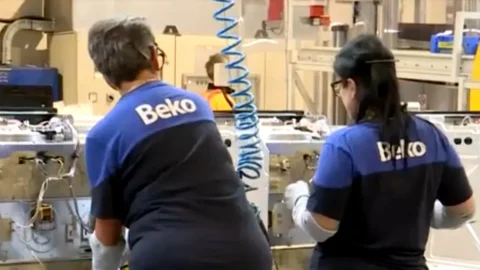
Akin Garzanli (Akàn Garzanlà with Turkish spelling), from 1 October, and the new CEO of Beko Europe, in place of Mehmet Ragıp BalcıoğluThe manager had followed the complex in January 2023 Whirlpool EMEA transition to the Turkish family group Aries, managing seven months of negotiations with the union representatives of the Italian factories of Whirlpool EMEA-Indesit in Rome, at the MIMIT. The new structure of Beko Europe was announced to the international press by Arçelik's global board. Balcıoğlu has been appointed Deputy General Manager - Marketing and Strategy of the group.
Garzanli, who began his career in 2002, has held key global positions, including sales, product management, marketing, and customer service. In 2018, he was appointed Global Customer Care Director, and since 2020, he has also assumed responsibility for Global Brand Director. He studied at St. George's Austrian High School in Istanbul, earning a bachelor's degree in Management from Istanbul University. He subsequently completed an MBA from Koç University and various programs at Harvard Business School and the Kellogg School of Management.
Akin Garzanli leads Beko Europe through sustainability and market challenges
Garzanli represents the new cosmopolitan generation of the giant holding company Koç family, with in-depth knowledge of global markets and above all a strong commitment to the transformation of what was a predominantly OEM company into a multinational that Time has – for the second year – recognized as one of the most sustainable companies in the worldA particularly ambitious program, at the heart of the management of Beko's visionary CEO, Hakan Bulgurlu.
Garzanli, however, arrives at one of the most dramatic moments in the history of the sector. numerous acquisitions which have marked the growth of the Group in the last ten years have required significant resources, while the joint venture with Whirlpool Corporation, which owns 25% of Beko Europe, together with the chiusura e renovation of some European production sites, has had a significant impact on the once healthy balance sheets of the ARÇELİK, with a reduction in profits and sales.
Entry-level Chinese appliances in Europe: sales down
But even more worrying is the invasion in Europe of entry-level appliances, of uncertain energy label, made in China, diverted due to the duties introduced by the administration Trump, which have slowed down the enormous American imports. For two years, European companies have been asking the European Commission to address this rampant dumping. Unheard, they had to suffer the growth of Asian shares to the detriment of European factories and brands. Nielsen-GfK announced that the sales in Europe of majaps, which have been stagnant or declining for a long time, have recorded only slight positive variations: in Italy, for example, in the January-June period they recorded a +1,7% compared to the same period in 2024 (which still closed with a -0,6%), but with a reversal of the positive sign because already in April-June sales fell in value by 0,5%.
Of particular note is the reversal of the post-Covid trend, which had rewarded the most expensive, efficient, and high-quality appliances on average.
50% furniture tariffs hit built-in
Furthermore, forecasts are pessimistic due to Trump's declared war with the announced 50% super tariffs on imported kitchen furniture. These tariffs will certainly affect the flood of low-priced, high-quality cabinets from China and Vietnam, but also high-quality, eco-friendly, Italian-designed furniture. This would, in fact, represent an unsustainable price increase, even for high-spending Americans.
It should be noted that fewer kitchen furniture pieces are being sold and fewer mid- to high-end and premium built-in appliances are being exported. This is precisely the segment on which Italian and European companies have concentrated their production, now focusing primarily on the premium segments, for which the market is becoming increasingly limited.
The consequences? Everyone in China.
European factories maintain a decidedly low—and fluctuating—level of plant saturation (averaging around 50%). The revitalization plans for Beko's Italian plants are at risk, and Electrolux itself, which had maintained a healthy level of investment, is investing in Asia, particularly amid ongoing changes in its shareholder structure (increasingly investor-dependent) and the surge in entry-level appliances, and above all, adapting to the most worrying trend.
In the absence of effective action by the European Commission against dumping and unfair trade practices, many European manufacturers, including Beko, rely on Chinese OEMs, such as Oma, to import entry-level products under their own brands.
Mandelson, Epstein's friend, enemy of European industry
As for the correspondence of these devices to the rigid e expensive European regulations Concerns about labeling are growing. This is a disastrous situation for Made in Europe products, similar to the one that, in the early 2000s, characterized the avalanche of very low-priced appliances arriving from Korea, often with labels that only apparently complied.
Il Sun-24 Hours reported that an illegal device, the “Counterfeit device”, was able to recognize the conditions of control tests and adjust consumption accordingly. The revelation prompted the European Union to intervene with limited tariffs on Made in Korea products, while the European leaders of the Korean chaebols were recalled.
Following these measures, Korean companies invested significantly in R&D, becoming key players in innovation in the sector. The dumping phenomenon continued also because, at the time, the European Commission for Industry was chaired by Lord Peter Mandelson, then UK ambassador to Washington, recently at the centre of controversies linked to personal relations with Jeffrey Epstein.
Mandelson, known as the "Prince of Darkness," was at the center of discussions over the management of controls on imported Asian household appliances. Founder of one of Europe's most influential lobbies, the Global Counsel, with clients such as JP Morgan, Barclays and Big Tech, for a long time prevented, between prolonged stays in Korea and Asia, any controls on imported Asian household appliances, cutting the funds allocated for controls and causing enormous damage to the European household appliance industry.
Today, operators in the sector – shopkeepers, managers, CEOs and importers – report that the “Counterfeit device” is present in the entry level devices of many brands, in particular with regards to the expensive decibel standardBut thanks to the Prince of Darkness and the Northern European countries, the controls are at zero.