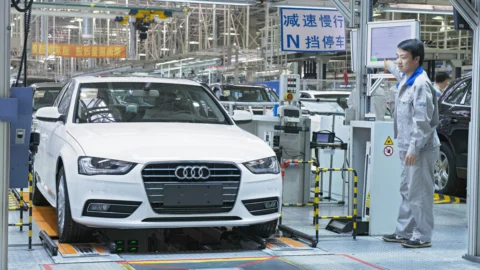
No landing in the USA for thousands of cars Porsche, Bentley and Audi. The cars of the three brands, belonging to the Volkswagen group, are blocked in US ports after a supplier of the parent group discovered a Chinese subcomponent in vehicles that violated anti-forced labor laws. The news was reported by Financial Times, explaining that the German automotive group, according to two sources of the newspaper, will have to delay the delivery of vehicles until the end of March, at most, to replace an electronic component from Western China.
Sources clarified that Volkswagen was not aware of the origin of the component, supplied by an indirect supplier further down the supply chain, until the problem was reported. The group then immediately notified US authorities as soon as it was informed of the component's origin. The discovery of the component prohibited by US law occurred around mid-January.
Increase presence in the United States
The blockade involved around 1.000 Porsches, several hundred Bentleys and several thousand Audis. Volkswagen is trying to compensate for the decline in sales in China increasing its presence in the United States, despite tensions between Washington and Beijing.
US customs authorities they have already given the green light to the company to purchase replacement electronic modules and the process of repairing the cars has begun, two sources said. Although some cars have already been repaired in the past week, the backlog is not expected to be resolved until at least next month. Replacing the modules is relatively simple and does not require disassembly of the vehicles, although some more complex models can take several hours to repair, according to sources familiar with the process.
Law on the Prevention of Forced Labor of Uyghurs
The United States prohibits the importation of products manufactured with forced labor of Uighurs, an ethnic minority in the western Xinjiang region and other areas of China, under the Uyghur Forced Labor Prevention Act of 2021.
The Uyghurs are one minority of Turkish-speaking Muslim origin which resides in the Xinjiang region of northwest China. I have been for a long time persecuted by the Chinese authorities for their religion. They are often subjected to detention in "re-education" centers (to change their religious and cultural identity) or to repression and forced labor.
However, the FT's sources did not confirm whether the piece in question had been produced in Xinjiang itself.
“As soon as we have received information about allegations regarding one of our sub-contractors, we have launched an investigation into the matter. We will clarify the facts and then take appropriate measures. These may also include termination of your relationship with the supplier if our investigations confirm serious violations. Volkswagen takes allegations of violations very seriously of human rights, such as the accusation of forced labor both within the company and in the supply chain" explained the German Group in a note.
The criticism of Volkswagen
Volkswagen is criticized by human rights associations for a plant that it owns together with its Chinese partner, Saic, in Urumqi, the capital of Xinjiang, where, according to Human Rights Watch, "crimes against humanity" occur. An accusation that the Group did not want to comment on.
- Chinese officials have defended the work programs in the Xinjiang region as a form of employment assistance. A Human Rights Watch report released this month warned of the risks for automakers buying aluminum produced by victims of forced labor in the region.
On Wednesday, the Wolfsburg-based German automaker announced it would discuss the "future direction of business" in the Xinjiang region with its Chinese partner SAIC, in response to new allegations of forced labor reported by German media.