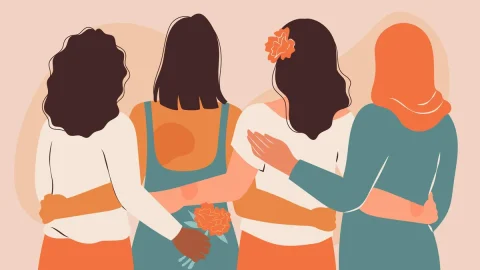
In many countries of the Global South, Being a woman still means not being able to decide about your own life. In these areas, the gender inequalities continue to hinder women's access to education, health, and social protection. Without systemic change, millions of girls and young women will remain excluded from the possibility of building a free, safe, and dignified future. And it is precisely from this awareness that the urgency of a structural and comprehensive approach tofemale empowerment.
The pillars of women's empowerment: education, health, work, participation
To effectively promote women's empowerment, it is important to intervene simultaneously on various fronts. Among these,education undoubtedly plays a fundamental role: guaranteeing girls access to school means offering them not only an educational path, but a space in which to develop awareness, critical thinking and autonomyIt is in the school context that many girls can begin to learn about their rights and imagine a future different from that imposed by customs or family ties.
Furthermore, attending school allows girls and young women to avoid child labor or early marriagesThis phenomenon carries serious and often irreversible consequences, such as high-risk pregnancies, social isolation, economic dependence, and exposure to domestic violence. The inability to choose whether, when, and with whom to marry compromises any prospect of self-determination. For this, ActionAid, the independent international organization that has always been committed to the protection of rights, has recently launched “I Will Marry When I Want", the campaign against early marriages which brings to the screen the power of the young poet's poetry Eileen Piri, a thirteen-year-old from Malawi who is forcefully demanding her rights.
Through the film, shot in the Namutumba district by the director Zee NtuliActionAid launches a clear and universal message: no social transformation is possible without the freedom of choice of women and girls. access to health This is another essential prerequisite. In many countries in the Global South, the lack of adequate health services exposes young women to early pregnancies, obstetric complications, and systemic violations of their integrity. The lack of health care profoundly impacts the very possibility of self-determination.
On the economic level, emancipation is built starting from theaccess to decent work, professional training and creditIn the absence of their own resources, many women remain trapped in conditions of dependence that limit every other form of freedom, both personal and social. Promoting economic independence means making it possible to build an autonomous, stable, sustainable life.
Finally, full participation in public life represents the political dimension of empowerment. The presence of women in decision-making processes – whether it's school boards, local communities, or institutions – cannot be limited to a question of formal representation. It's a necessary condition. so that public policies are truly inclusive, respond to collective needs and help transform the power relations that fuel inequality.
ActionAid's commitment to promoting women's empowerment
ActionAid's commitment to promoting women's empowerment is carried out concretely thanks to the long distance adoption, a form of ongoing support which is also deductible and tax deductibleThanks to these programs, ActionAid can in fact, promote access to education for girls, building or improving schools, providing materials, uniforms, water, equipped classrooms and everything needed to make the school a safe, inclusive and functional environment.
At the same time, thanks to distance adoptions, ActionAid carries out awareness campaigns involving local communities, promoting a cultural change essential to combating early marriage and gender discrimination. At the same time, girls and young women are informed of their rights, encouraged to participate in school and community life, and involved in creating student groups to prevent school dropouts.
From the Individual to the Collective: The Systemic Impact of Women's Empowerment
When a woman gains greater autonomy, the benefits are not limited to his personal sphere. Female empowerment has a direct impact on the well-being of the entire community. First of all, the increased awareness gained through the study pushes women to invest more in children's education, in family health and in caring for the environment, generating a virtuous circle that extends well beyond the domestic nucleus.
Women's economic participation strengthens local economies and contributes to sustainable poverty reduction. Where women have access to credit, land, or vocational training, communities prove more resilient to economic crises and climate, more cohesive and more cooperative. Solidarity networks develop, productive activities become more diverse, and human development indicators improve.
Even on an institutional level, a greater female presence in decision-making processes affects the quality of public policies, making them more attentive to the concrete needs of the population and oriented towards equity. Female empowerment therefore constitutes a real lever for social transformationPromoting women's autonomy means addressing the very roots of inequality, with positive effects on education, health, and employment.
A question of justice, a choice for the future
Promoting women's empowerment is therefore, nowadays, a real priority, which concerns social justice, the protection of fundamental rights, and the concrete possibility of building more equal, inclusive, and resilient societies. When women and girls can access education, healthcare, employment, and political participation, it doesn't just change their lives: it changes the entire balance of the communities in which they live.
Ensuring equal opportunities means break the mechanisms that fuel poverty, discrimination and violence, and invest in a development model that puts people at the center, starting with the most vulnerable. Women's autonomy is not just a right: it is an essential condition for collective progress. And supporting it is everyone's responsibility.