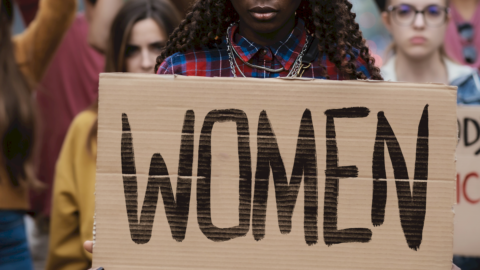
The last of the men has an advantage over the first of the women, since birth. The conviction has the strength of a dark brush stroke on the day of March 8th. In fact, with numbers in hand, the picture of social, economic and political conquests continues to be sadly clear in its interpretation. Certainly, a celebration - today's, traditionally dedicated to women - is not enough to valorize the female role in society. Some figures? Let's take for example the work: in recent years the growth ofoccupation dedicated to gender has mainly concerned professions traditionally dominated by women. Such as: carers, clerks, cleaners.
Again: in the scientific professions (to be clear, engineering with technology and mathematics) only one fifth is represented by women. Not only that. In Italy the so-called "vertical segregation” is still relevant (despite there being a female prime minister), in local politics the female presence remains particularly low, and in boards of directors of listed companies women continue to be largely underrepresented in corporate leadership positions. Not least: access to bank loans is also more complicated. Hence, Lagarde and Panetta's appeal for better financial literacy among women.
March 8: Women and Employment
According to the Cnel-Istat report entitled “Women’s work between obstacles and opportunities” – released shortly before a pre-March 8 Council of Ministers gave the green light to anti-violence bill so the femicide becomes autonomous crime punishable by life imprisonment – the growth of female employment in recent years has mainly concerned professions that were traditionally dominated by women: carers, clerks, cleaners. The so-called horizontal gender segregation has thus become more accentuated. Approximately half of thefemale employment is concentrated in just 21 professions, while for men the range expands to 53. Among the most frequent professions among women we find general affairs clerks and secretaries, shop assistants, carers, housekeepers, nurses and social health workers, cleaners and primary school teachers. Among the specialist/intellectual professions, we find only those related to the field of training. In general, compared to the panorama of female employment, the male one is much more varied.
Among those employed in the professions of STEM area (science, technology, engineering and mathematics) only a fifth – the Report highlights – are women (19,1%). The younger generations are also very far from parity, although the share of women aged 25-39 employed in the STEM area is almost 10 points higher than in the 55-69 generation (22,3% compared to 13,2%).
March 8: Women and the Glass Ceiling in Politics
Italy is one of the few countries with a female Prime Minister. However, overall, vertical segregation is still a very significant reality. It is the so-called glass ceiling, which blocks or at least slows down the professional growth of women. Female parliamentarians in Italy are 33,6%, in line with the EU27 average of 33,2 percent.
Looking to local politics, the female presence – the Report continues – is even more limited compared to the national level and the delay with the rest of Europe is more evident. The share of women elected to regional councils stops in 2023 at 24,5%, placing our country more than 10 points away from the European average (35,7%) and in 13th place in the ranking of the 19 European countries for which this data is available. In October 2024, of the 19 regional presidents only one is a woman. Among the mayors female representation stops at 15,4%: only two of the 20 provincial capitals have female mayors. However, no woman is guide to one of the 9 metropolitan cities, where even among the councilors the female presence drops to 30,6%.
March 8: Women on the boards of listed companies
Although it has consolidated thegender balance on the boards of directors of listed companies (the female presence stands at 43,1% compared to a European value of 34,2%), the statistics – as indicated in the Report – paint a picture sadly clear picture: women continue to be widely underrepresented in corporate leadership positions. And this despite the fact that several studies demonstrate the financial advantages of female leadership. Remaining among large companies listed on the stock exchange in Italy, only 2,9% of CEOs are women compared to an EU27 average of 7,8%, 21,1% in Lithuania (which leads the ranking) and, to give another example, 8,3% in France.
March 8: Women and Corporate Management
Le disparities remain huge even if you look at the company directors. Italy – the Report highlights – is at the bottom of the EU countries ranking with 15,6% of female managers, at a considerable distance from the EU27 average of 22,7%, but above all from countries such as Latvia or France, where women who lead a listed company represent 32,1% and 29,9% respectively. Finally, in 2024, no woman will hold the role of governor of one of the European central banks.
March 8: Women and Business
Quasi 7 out of 10 businesses are male-owned. The parity ones, in which the ownership is equally divided between men and women, represent – explains the Report – a completely residual component, equal to 1,6%. Female-owned businesses are on average younger than male-owned businesses: 41,6% are at most 5 years old, compared to 34% of male-owned businesses. The difference remains 5 percentage points even among newly-established businesses, up to 2 years old: 25% and 20% respectively. On the contrary, 21% of female-owned businesses are over twenty years old, compared to 29,1% of male-owned businesses.
Numbers, overall, that still today just don't add up. A inequality which, in fact, prevents us from making the most of all our talents. Just think that – another fact – for the first time since 2018, the growth of female presence in Directions of Italian health companies (source Fiaso): a temporary accounting phenomenon? The hope is such, for sure, advantages inherent from birth or not.