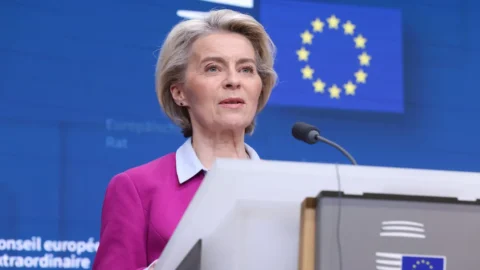
I Russian drones in the skies over Poland they are just another test of Moscow to verify the speed of response of the countries Ue e NATO. But they also represent a message a few hours from the speech by the President of the European Commission, Ursula von der Leyen, on the State of the Union before the plenary session of the European Parliament in Strasbourg.
In one hour of speech, the President of the Commission received 15 rounds of applause, especially when she reiterated her support for Poland and the support for Kiev, but has also received criticism from the far right over the suspension of the bilateral agreement with Israel and in the passages dedicated to automotive, vaccines e freedom of the press.
Von der Leyen between political unity and the shadows of war
Von der Leyen asked to keep theunity among the pro-European democratic forces in the Assembly and said she was “ready to strengthen the pro-European democratic majority” because “it is the only one that can deliver results for European citizens”.
However, these are the scenarios of war This concerns the president, who is convinced that "Europe will defend every inch of its territory; we will build a wall of drones with Kiev." A Europe, therefore, that must "fight for its independence, rediscover its role and its identity." But she herself, speaking to MEPs, asked: "Do we have the stomach to fight? Do we have the will to unite, the political will to do so? Or do we just want to fight among ourselves?"
The challenge of leadership and support for Ukraine
It is difficult to say whether von der Leyen will be the person capable of uniting the 27 on objectives that mark a radical change in Europe's DNA: from a continent of peace and prosperity to a potential battlefield. Although aware of not having leadership necessary for this purpose (as almost all polls confirm), the president is trying to resist and, to support Ukraine, she is announcing a contribution of 6 billion euros to Kiev using the liquidity of frozen Russian accounts in Europe.
But the Europe envisioned by von der Leyen isn't just about defense and security. The Commission intends to liberalize and integrate energy and telecommunications services, and for the environment, Brussels wants to impose "Made in Europe" certification on public procurement for clean tech. The president confirmed the goal of cutting harmful emissions by 90% by 2040, while emphasizing that "the transition must support people and strengthen industry."
Fragile majority and tensions with the EPP
Von der Leyen wants to turn the page and, with the new challenges on of your digital ecosystem. e defense, to overcome the decline in consensus and the difficulties in the majority that supports it, with a EPP who has repeatedly voted alongside the right. The pro-European majority (EPP, S&D, Renew Liberals and part of the Greens) that re-elected her last year had agreed on a "political platform" that was repeatedly "betrayed" by the EPP, which chose to vote with the sovereignist and Eurosceptic far right on several amendments. Socialists and Liberals insist that the EPP clarify whether it intends to respect the "platform" and guarantee its support for von der Leyen and her Commission's upcoming legislative proposals.
"I want to work with this Assembly and with all pro-European democratic forces," the Commission President stated, "to achieve our goals. I am preparing legislative packages to strengthen this pro-European majority. And I am truly happy that we have managed to renew the framework agreement between the Commission and Parliament: this will only strengthen our cooperation."
During the debate in the chamber there was no shortage of tensions and mutual accusations between the leader of the EPP group, Manfred Weber, and the leaders of the other groups of the "pro-European majority". The Social Democratic group leader, Irate García, told von der Leyen that “today it is clear that her worst enemy is Weber, it is the EPP”.