Sotheby's celebrates Mickey Mouse's 90th birthday with an online “Mickey Mouse Posters” auction – with bidding ending on November 26 – featuring rare examples of animated film posters dating back to the 30s.
From a young age Walt Disney was interested in drawing. He took art lessons while still in school, and practiced tracing the cartoons found in his paper journals. At 18 he got a job as a commercial illustrator drawing illustrations for catalogs and advertisements. After being fired from this job, he borrowed a book on animation and a camera and began a lifelong experimentation with animation.
In 1923 the "Disney Brothers Cartoon Studio" was founded by brothers Walt and Roy. From the beginning the studio pioneered American animation. Disney served as a training ground for the greatest entertainers of the day and pioneered the founding techniques and principles of the discipline. Disney Studios were, for example, the first to introduce the "storyboard".
In 1928 Walt began work on the character called Mortimer Mouse. In November of that year, Mickey Mouse was introduced starring in Steamboat Willie. The animated short was a huge success. Not only was it the first appearance of Mickey Mouse, but it was also the first animated film to have a fully synchronized soundtrack. Only a year earlier, the first sound film, The Jazz Singer, had been presented. And on January 13, 1930, the first Mickey Mouse comic appeared, and later that same year, the first Mickey Mouse book was published.
In the years following Mickey's debut, as Disney Studios grew, they routinely produced and were most famous for their Silly Symphonies.
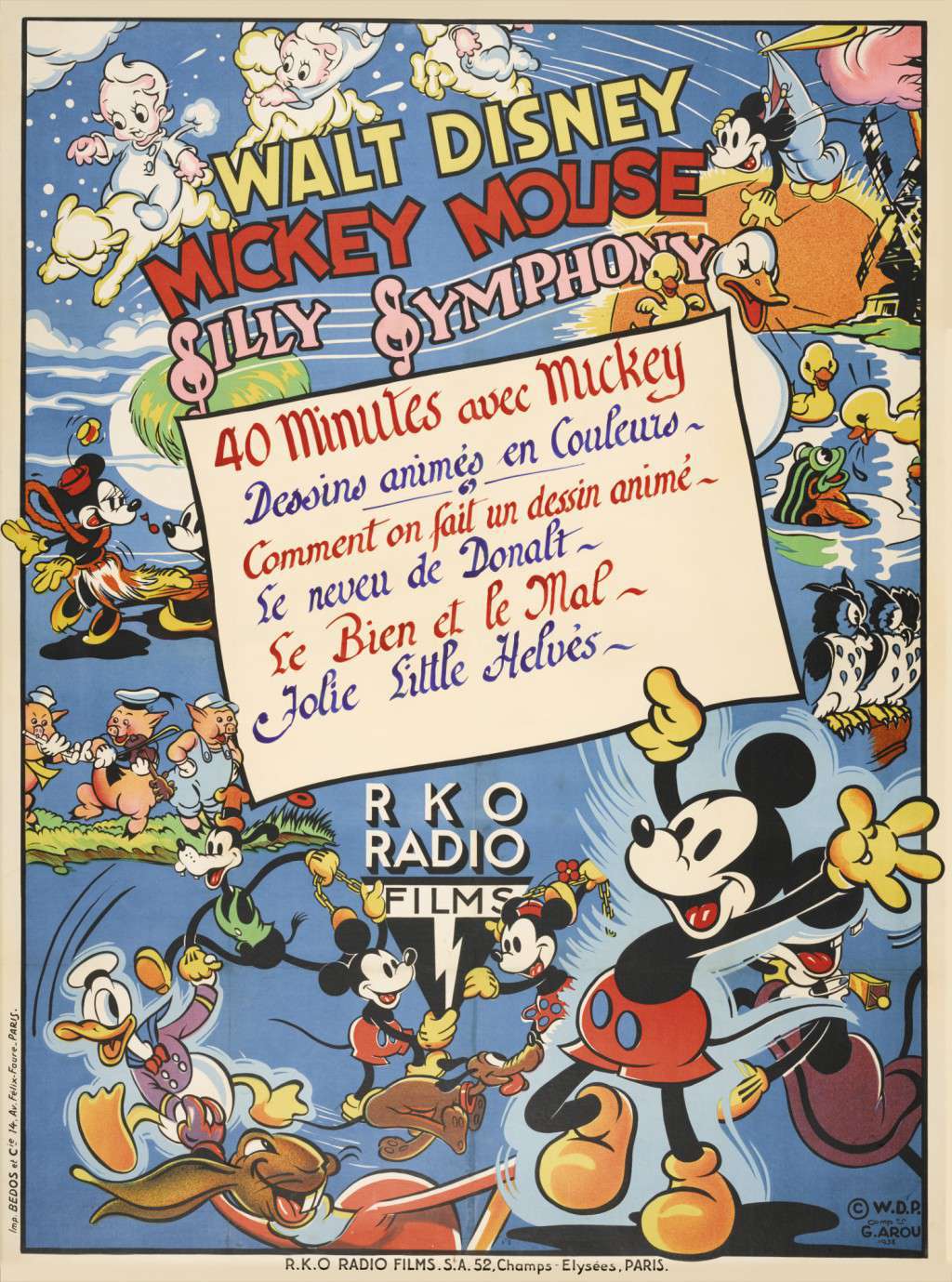
Estimate: 16,000 – 24,000 GBP The Silly Symphonies were a series of seventy-five short animations produced by Walt Disney that began in 1929 and finished in 1939. The Silly Symphonies were originally intended as animated accompaniments to music. The first animations were in black and white and then continued to use the newly invented Technicolor. The series also introduced Donald Duck to the big screen in The Wise Little Hen in 1934. It was a hugely popular series, launching a Disney media franchise, including a comic strip and a series of children's books. This poster was purchased in 1995 and has been in a private collection since that time. This magical poster depicts many of the characters from Disney's Silly Symphony shorts, including several images of Mickey and Minnie Mouse, Donald Duck, Goofy, Three Little Pigs, Wynken, Blynken and Nod, along with Max Hare. In the 30s it was common for French cinemas to allocate a certain amount of time to their features. This would allow them to choose a number of shorts to show before the main feature. This is a stock poster, which allowed individual cinemas to add their own text in the blank box in the center of the piece, to advertise what would be shown. In the case of this particular poster the program was forty minutes with Mickey Mouse, color animation – how to make cartoons, Donald's Nephew, The Good and the Bad and Pretty Little Elves. To conclude, this is believed to be the only known surviving example.
This series of animated shorts quickly became the platform where studio artists were allowed to experiment with processes and techniques. Corresponding published comics were often where Disney and his animators introduced and experimented with new characters. (Silly Symphonies also serves as the inspiration for the Looney Tunes name, format, and animation.) Mickey himself has changed over time.
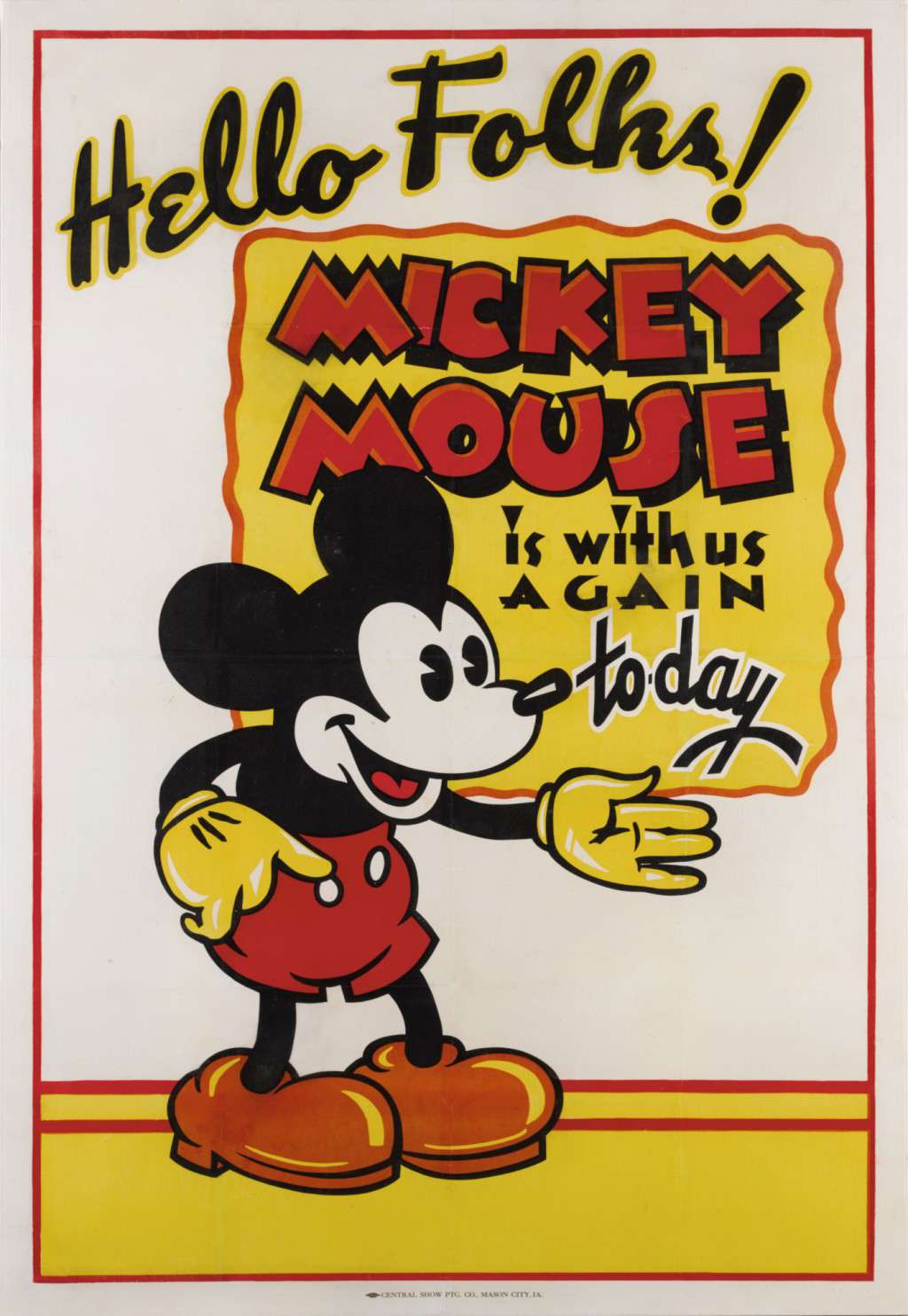
Estimate: 26,000 – 35,000 GBP Mickey's eyes have come in various styles. Before 1933, Mickey had his original "pie eyes." These eyes were black and circular with a small triangular shape cut out of the circle, resembling a piece of cake. It is therefore possible to date this piece before 1933. In 1930, distribution of Walt Disney cartoons moved from Pat Powers' company, Celebrity Productions, which had distributed Disney cartoons for only one year to Columbia Pictures. Distribution moved again in 1932 to United Artists. This very early poster was printed for distributors by Central Show PTG. Co., Mason City, Iowa, USA, and was sold to theaters that were showing Mickey animation shorts before the main motion picture. Show central PTG. The Co. and other similar companies printed movie posters for distributors when a studio poster was not available. To date only two such posters have surfaced.
In the summer of 1934, Disney announced they would produce the studio's first feature film.
The rumors and issues surrounding Snow White led to the production being derided as "Disney's Folly." Walt mortgaged his house to finance the film. Considerable training and development went into the production of the film, and because of this, Disney Studios expanded with animators, teachers and artists from all fields.
In 1937, Snow White made its debut at the Carthay Circle Theater. She received a standing ovation upon its completion. The New York Times magazine ran the headline “Thank You Very Much, Mr. Disney” and six days later Premier Walt Disney and his Seven Dwarfs appeared on the cover of Time. Fifteen years after the creation of his studio, Disney had changed the film industry, elevating animation to the big leagues. The third animated feature film was Fantasia, which was released in 1940 and was the first commercial film to be shown in stereophonic sound.
In 1939, Disney was awarded an honorary Academy Award for the film for "a significant innovation of the screen which has captivated millions and pioneered a great new field of entertainment." In 1989, it was selected for preservation by the Library of Congress.
In the years that followed, Disney quickly established itself as the leader in American animation. The core group of entertainers at this time were known fondly as "Disney's Old Men." Together they were the artistic forces behind Snow White, Bambi, Sleeping Beauty, 101 Dalmatians, Peter Pan, Cinderella, Pinocchio, The Jungle Book, Alice in Wonderland, Lady and the Tramp, and more. They perfected the 12 basic principles of animation and created a legacy so great that most American animators today can directly trace their legacy to one of these nine men.
Over 50 feature films later, Disney is a multinational media and entertainment conglomerate. On October 27, 1954, Walt Disney pondered a television program, “I just hope we never lose sight of one thing – that it all started with a mouse."