The public will be able to access the halls of the Capitoline Museums from 20pm to midnight (last admission at 24pm), visit the permanent exhibitions and collections and participate in the activities with the symbolic ticket of one euro. Also scheduled is a sensory test with traditional Castelli Romani cured meats created in collaboration with Agro Camera (from 23 pm until availability lasts).
Until Sunday 26 March, the weekend entertainment appointments also continue in the small museums with free admission during ordinary opening hours.
On Saturday 18 February at 11.30 the Museo delle Mura will host the concert "Mozart and the French" by Roma Tre Orchestra, while on Sunday 19 February at 11.30 the concerts "Dimitri Shostakovich: continuity in music, responsibility in tyranny" are scheduled with an introduction by Valerio Vicari at the Carlo Bilotti Museum and “A tutto Bach” with MuSa Classica (Sapienza University of Rome) ? at the Barracco Museum.
CAPITOLINE MUSEUMS
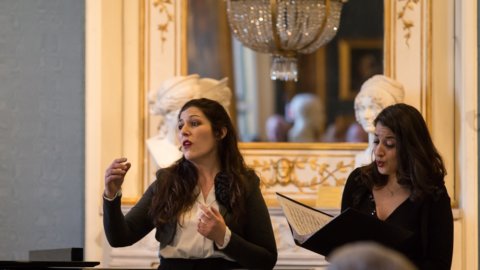
A highly evocative appointment in which art meets opera music thanks to the collaboration of the “Fabbrica” Young Artist Program, a professional start-up project for young artists of the Rome Opera House. The following will perform: Valentina Varriale (soprano), Erika Beretti (soprano), Roberta Mantegna (soprano), Reut Ventorero (mezzo-soprano), Sara Rocchi (mezzo-soprano), Aleandro Mariani (tenor) and Timofei Baranov (baritone) accompanied by Niccolò Donini (bass) at the piano by Alessandro Stefanelli.
MUSICAL PROGRAM
20.15 and 21.45 and closing at 23.15
Exedra of Marcus Aurelius
Cosi fan tutte, trio "Soave sia il vento"
Maria Stuarda: final act I
Closing bis at 23.15 pm
Maria Stuarda: Final act II
20.45 and 22.15 hours
Peter of Cortona Room
From Maria Stuarda Maria Stuarda's aria "O cloud that light"
Cosi fan tutte, aria by Dorabella “Relentless cravings”
Cosi fan tutte, aria by Fiordiligi “Come scoglio”
21.15 and 22.45 hours
Hall of the New Palace
Cosi fan tutte: aria by Despina “in men in soldiers”
Maria Stuarda, aria by Elisabetta “Ah! Quando all'ara scorgemi” (with interventions by Cecil and Talbot)
THE MUSEUM COLLECTION AND CURRENT EXHIBITIONS
The extraordinary evening openings of the Capitoline Museums are a unique opportunity to stroll through the splendid rooms of the oldest public museum in the world, admiring masterpieces such as the Capitoline Wolf, the Spinario, the equestrian statue of Marcus Aurelius, the paintings in the Pinacoteca of Guercino and Caravaggio or the Capitoline Venus and the dying Gaul and to visit the current exhibitions: Leonardo and the Flight. The original manuscript of the Codex is a multimedia and 3D experience which brings for the first time to Rome the manuscript which contains the summa of Leonardo's intuitions on flight and, on the ground floor of Palazzo dei Conservatori, the Annunciation of the great Cretan artist El Greco.
TASTING
A sensory test with traditional Castelli Romani cured meats is scheduled from 20 pm until availability lasts, carried out in collaboration with Agro Camera (max 150 people).
The events will continue every Saturday until 25 March with a series of appointments organized in collaboration with: Accademia Nazionale Santa Cecilia (25 February and 11 March), Teatro di Roma (4 and 18 March) and Fondazione Musica per Roma (25 March).
SMALL MUSEUMS WITH FREE ADMISSION
MUSEUM OF THE WALLS
Saturday 18 February 11.30 hours
“Mozart and the French”
Rome Three Orchestra
WA Mozart: Divertimento n.8 in F major K 213
WA Mozart: Ouverture from the opera "The Marriage of Figaro"
M. Ravel: Peace for a deceased infant
G. Bizet: Suite from the opera “Carmen”
Bianca Maria Fiorito, flute
Ambra Guccione, oboe,
Alice Cortegiani, clarinet,
Paolo Lamagna, bassoon
Stefano Berluti, horn
Wolfgang Amadeus Mozart was many things. A bit of all things. There is, among others, a lively, playful, jaunty Mozart: he is the Mozart of childhood, of early youth, of the time of travels in Italy, but also the Mozart of the Da Ponte trilogy, who in many moments knows how to keep the same smile . This serenity of writing goes well with Ravel, a master of harmonic impressions and suggestions, but also the author of beautiful and relaxed melodies, such as the one that opens the famous "Pavane pour une infante defunte". The program closes with a fantasy about "Carmen", a sort of female Don Giovanni from the late XNUMXth century, a character who, like Mozart's model, prefers death rather than giving up her lifestyle.
GIOVANNI BARRACCO MUSEUM OF ANCIENT SCULPTURE
Sunday 19 February hours 11.30
“To all Bach”
MuSa Classica (Sapienza University of Rome) ?
JSBach: Partita in G minor for oboe solo BWV 1013
Flutist: Alessandro Avallone
JSBach: Prelude, Allemande and Gavotte from suite number 6 in D major for solo cello BWV 1012
Cellist: Simone Chiominto
JSBach: Chaconne, from Partita No. 2 in D minor for solo violin BWV 1004
Violinist: Daniele Gorla
CARLO BILOTTI MUSEUM VILLA BORGHESE ORANGE HOUSE
Sunday 19 February hours 11.30
“Dimitri Shostakovich: Continuity in Music, Responsibility in Tyranny”
Rome Three Orchestra
The life and work of one of the most extraordinary authors of the twentieth century analyzed by Piero Rattalino, narrated by Valerio Vicari.
D. Shostakovich: Quartet No. 8 in C minor op. 110
Henao Quartet
William Chiquito, violin
Kim Soyeon, violin
Stefano Trevisan, viola
Giacomo Menna, cello
Valerio Vicari, narrator
Dimitri Shostakovich was born a subject of the tsar into a family of leftist intellectuals. He trained as a musician in the years following the October Revolution and which saw the outbreak of civil war. He asserted himself as a composer during an ideological battle between supporters of opposing visions of what had to be done to create the new Soviet music. Accused of deviationism on Pravda, he was later rehabilitated and, during the war, became the musical spokesman of the armed nation. He is accused again, together with many colleagues and rehabilitated again. He is then awarded the highest honors of state. He joined the Communist Party only at the age of 44 and became a prominent element in the officialdom of the regime. He dies at the age of 69 after a long illness and is exalted in death as the most perfect representative in music of Soviet homo novus. Difficult to find a more turbulent life than this, even more difficult to interpret it.
The entertainment events in the small museums with free admission will continue until Sunday 26 March with a calendar of concerts organized in collaboration with the RomaTre Orchestra and MuSa Classica and EtnoMuSa (Sapienza University of Rome).
Image: Yasuko Kageyama