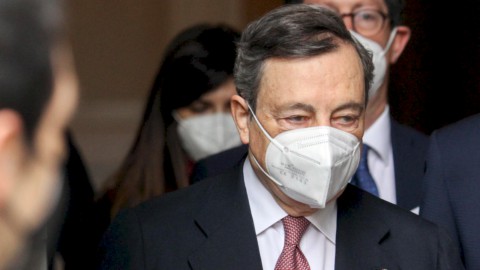
The Prime Minister, Mario Draghi, uses clear words in presenting the Recovery and Resilience Plan to the Chamber, which will be sent to Brussels by Friday 30 April. It's not just about figures and numbers, but from this plan they will depend "the fate of the country, its credibility and reputation within the international scene”. “Put the lives of Italians into it, the expectations of those who have suffered from the pandemic, the aspirations of families, the just claims of those who do not have a job or those who have had to close their territories, the anxiety of disadvantaged territories, the awareness that the environment must be protected”, said the Premier as he opened his speech. "It is a question not only of income and well-being, but of civil values and feelings that no number and no table can ever represent" he continued, underlining that “Delays and inefficiencies, myopic biased visions placed before the common good will weigh directly on our lives and perhaps there will be no possibility of remedying it”. However, Draghi has no doubts: "I am sure that honesty, intelligence, a taste for the future will prevail over corruption, stupidity, vested interests".
The Recovery and Resilience Plan, approved by the Chamber with 442 votes in favour, 19 against and 51 abstentions, goes in two distinct but parallel directions: on the one hand, investments, on the other, reforms. And therefore 70 billion for the energy transition, 18 for the superbonus, 31 for infrastructure, 32 billion for education and research, 22 billion for work, 18,5 for health. However, the "emphasis on reforms" is fundamental. Reforming justice, taxation, public administration and competition will not only make it possible to "make investments effective and rapidly implemented" - explained the Prime Minister -, but also to overcome the structural weaknesses that have slowed growth for a long time and determined unsatisfactory employment levels, especially for young people and women. The reforms and investments are – he added – accompanied by quantitative objectives and intermediate goals and are organized into six missions”.
THE OBJECTIVES OF THE PLAN
“Recovery has 3 objectives. The first, with a close horizon, is repair the damage of the pandemic, which has affected us more than our European neighbours", explained the Premier, listing the catastrophic consequences that the pandemic is having in our country: "We have reached the number of almost 120.000 deaths from Covid-19, to which must be added many never registered. In 2020, GDP fell by 8,9 percent, employment fell by 2,8 percent, but the drop in hours worked was 11 percent, which gives a measure of the seriousness of the crisis” . Draghi then spoke of young people and women "who have suffered a much higher than average drop in employment".
The second objective of the plan, with a more medium-long term perspective, is to address “certain weaknesses affecting our economy and our society for decades: the persistent territorial gaps, gender disparities, weak productivity growth and low investment in human and physical capital – observes Draghi -. Finally, the resources of the Plan contribute to to promote a complete ecological transition".
THE ESTIMATES
The future of the country will depend on the implementation of the plan, Draghi reiterated. According to Government estimates, the plan “has significant effects on the main economic variables: in 2026, GDP will be approximately 3,6 percentage points higher than in a reference scenario that does not take into account the implementation of the Plan. Employment also benefits, which will be higher, by 3,2 percentage points compared to the base scenario in the three-year period 2024-2026″, specified the premier.
THE NUMBERS OF THE PLAN
They amount to 248 billion total resources that the Government will make available for the restart and the reforms. “The resources provided through the EU Recovery and Resilience Facility amount to 191,5 billion to which are added those of the React Eu program for a further 13 billion”. “The government then decided to allocate additional 30,6 billions for the financing of a complementary national plan to complement the European device - explained Draghi - This complementary plan finances projects consistent with the strategies of the Pnrr, which however exceeded the ceiling of resources obtainable from the European device. The Pnrr and the Complementary Plan they have been designed in an integrated way: the projects of the second will also have the same implementation tools”.
Finally, the resources of the Pnrr and the complementary plan will be added a further 26 billion for the construction of specific works, including “the Salerno-Reggio Calabria high-speed railway line – which will become a real high-speed railway – and the crossing of Vicenza on the Milan-Venice high-speed line. Furthermore, the replenishment of the resources of the Development and Cohesion Fund, used in the context of the European mechanism for the strengthening of the projects envisaged therein for 15,5 billion is foreseen", said Draghi, then moving on to the 6 missions that the Government promises to carry out. “The projects of each mission” of the Pnrr “aim to address three structural nodes of our country, which constitute horizontal objectives of the entire Plan. It's about bridging the regional disparities between the South and the Center North, le gender inequalities and generation gaps“, the premier said.
DIGITIZATION
“The first Mission concerns the issues of digitalisation, innovation, competitiveness and culture. Overall, the resources allocated to this Mission are almost 50 billion, of which 41 are financed with the European system and 8,5 with the national complementary plan, equal to 27% of the total resources of the plan. The main objective is to promote and support the digital transformation and innovation of the country's production system”, declared the Premier.
ECOLOGICAL TRANSITION
“The second mission, called the Green Revolution and Ecological Transition, deals with the major issues of sustainable agriculture, the circular economy, the energy transition, sustainable mobility, the energy efficiency of buildings, water resources and pollution. It is particularly important for Italy, which is more exposed to climate risks than other countries - Mario Draghi said in the Chamber of Deputies - The mission improves the sustainability of the economic system and ensures a fair and inclusive transition towards an impact society zero environmental. The overall budget for this mission is the largest of the 6 proposals: almost 70 billion, of which 60 billion financed with the European mechanism. There are also investments to support the ecological transition in other missions as well".
SUPERBONUS
Among the most anticipated passages of Draghi's speech is the confirmation of the Superbonus 110%, for which "over 18 billion will be allocated between the Pnrr and the complementary fund", the same resources allocated by the previous government. There is no cut. The measure is financed until the end of 2022, with extension to June 2023 only for social housing. It is an important provision for the construction sector and for the environment. For the future, the government undertakes to include in the Draft Budget Law for 2022 an extension of the eco-bonus for 2023, taking into account the data relating to its application in 2021, with regard to the financial effects, the nature of the interventions carried out , to the achievement of energy saving and building safety objectives”.
SOUTH
Another mission to be completed aims to favor "the growth of the South" which represents the other priority aspect transversal to the Plan. The potential of the south in terms of development, competitiveness and employment is as large as its gap from the rest of the country. It's not a matter of bell towers: if the south grows, Italy grows too”. “The Plan allocates 82 billion to the South of Italy out of 206 billion which can be divided according to the territorial criterion, therefore for a share of 40 per cent”, highlighted the Premier.
EDUCATION AND RESEARCH
Allocated 32 billion euros for education and research. The funds will be used to "strengthen the education system throughout the education process, support research and encourage its integration with the production system". The projects to be completed include "the quantitative expansion of education services, starting with the strengthening of the supply of nursery schools, nursery schools and early childhood education and care services", but also "the development and strengthening vocational education and “teacher recruitment and training”. Important will be “the strengthening and modernization of school infrastructures, for example with the internal wiring of about 40.000 school buildings”.
WORK
“The fifth mission is intended for active employment and training policies, social inclusion and territorial cohesion. The funds earmarked for these objectives total over 22 billion. A further 7,3 billion interventions will benefit from React-EU resources”. Draghi added: "Measures are introduced to support female entrepreneurship and a gender equality certification system that accompanies and encourages companies to adopt adequate policies to reduce the gender gap".
HEALTHCARE
18,5 billion euros are planned for the "Health mission", resources that will serve to "strengthen prevention and health services in the area and modernize and digitize the health system, in order to guarantee fair access to effective treatments", he declared Dragons.
REFORMS: JUSTICE AND COMPETITION
Draghi finally mentioned the justice reform, central to the Recovery and Resilience Plan. The Government's aim is to “reduce the unacceptable backlog present in the courtrooms, and create the conditions to prevent it from forming again. This is one of the most important and explicit commitments we have made to the European Union," he says. "The final goal we are proposing is ambitious, to reduce trial times by 40 per cent for the civil sector and by at least 25 per cent for the criminal".
On competition however, “The Plan also intends to commit the government and Parliament to a continuous and systematic work of repeal and modification of the rules that curb competition, create positional rents and negatively affect the well-being of citizens. These principles are essential for the success of the Plan: we must prevent the funds that we are about to invest from ending up only with the monopolists", underlined Draghi, adding that "To this end, the annual law on competition - envisaged in the national law since 2009, but implemented only once in 2017. We intend to launch regulations aimed at facilitating business activity in strategic sectors such as digital networks and energy. Some of these rules are already identified in the Plan, for example the completion of the tender obligations for the concession regimes or the simplification of the authorizations for the construction of waste management plants ”, she concluded.
(Last update: 15.05 am on 27 April).