Il May Day it is universally known as the day dedicated to celebration of work in many countries around the world. His choice is not random, but is rooted in significant historical events. Its origin dates back to general strike movement of 1886 in the United States which culminated in the obtaining of eight hour working hours. This date also commemorates the victims of the incidents that occurred in Chicago, which represented a crucial moment in the workers' struggles of the time.
Labor Day today is celebrated in more than 130 countries around the world. Typically, it is observed on May 1st, but in some countries the date may vary. It is a common occurrence in numerous countries in different regions of the world, including the United States, Canada, much of Europe, Latin America, Africa, Asia and other regions.
The origins of May 1st
Labor Day originates in demonstrations for workers' rights during the Industrial Revolution in the United States, led by the Knights of Labor. There fight for the eight-hour workday, started on May 1, 1867 only in Illinois, gradually spread throughout the United States. In 1882, a significant protest was held in New York on September 5, while in 1884 the Knights of Labor passed a resolution to make the protest event annual, but did not set an official date in Illinois.
Il 1 May 1886Coinciding with the 19th anniversary of the enactment of the eight-hour law in Illinois, the Federation of Organized Trades and Labor Unions declared this date as the deadline for extending the law throughout the United States. Otherwise, one would have been called all-out general strike.
The General Strike and the Haymarket Riot
The eight-hour movement gradually spread across the United States, culminating in the 1886 protest in Chicago, known as the Haymarket riot. The demonstration turned into tragedy when police fired on protesters at the McCormick reaper factory, killing two people and wounding many others. In response to law enforcement violence, the local anarchists organized a demonstration in Haymarket Square, where a bomb thrown by an unknown individual on 4 May caused the death of six policemen and the wounding of approximately fifty people. The police responded by opening fire on the protesters. The attack represented the first use of dynamite as a weapon in the United States. The identity of the person responsible has never been revealed.
May 1st around the world
News of the tragic events in Chicago they spread throughout the American continent and in Europe. Since then, May Day was adopted as workers' day in many countries around the world, both those with socialist traditions and others with different political and economic perspectives, becoming a day of commemoration, solidarity and reflection on the conditions of workers and the struggles for their rights.
In Canada, the date of May 1 was adopted in 1894, referring to earlier labor marches in Toronto and Ottawa in 1872. International Congress of Paris of 1889, May 1 was officially declared International Workers' Day, adopted by many countries around the world. In Australia, the commemoration resembles the “Eight Hours Festival”, with variations in the date of celebration, such as the first Monday of May, March or October in different regions. In the Catholic world, Pope Pius XII established the feast of St. Joseph the Worker on May 1, 1955 to be shared by Catholic workers.
Labor Day in Italy
In Italy, outrage over the execution of Chicago anarchists in 1888 led to riots in Livorno against US ships and the Police Headquarters, where the US consul was thought to have taken refuge. In 1919, Fiom signed a agreement with the Confederation of Industrialists to reduce working hours to eight hours a day and 48 hours a week.
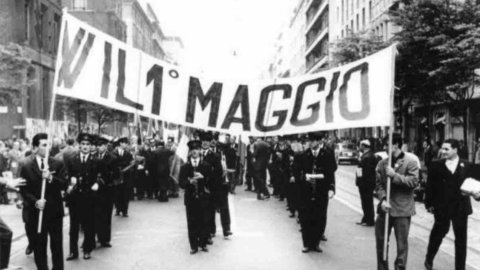
The European decision to celebrate May 1, ratified by the Second International in Paris in 1889, was adopted in Italy only two years later. Magazine The Claim of 1890 described May Day as a slogan that united workers around the world: “May 1st is like a magic word that passes from mouth to mouth, that cheers up the spirits of all the workers of the world, it is a password that is exchanged among those who are interested in their own improvement.".
During the fascist regime, from 1923 Labor Day was brought forward to April 21st and associated with Rome's Christmas, becoming a public holiday. In 1946, at the end of the Second World War, the celebration returned to May 1st and was included among the holidays in 1949.
Since 1990, the CGIL, CISL and UIL unions, together with the municipality of Rome, have organized an annual great concert to celebrate May Day. Also held in Piazza di San Giovanni in Laterano, in 2024, for the first time, the "concertone” will be held at the Circus Maximus. The event, which usually attracts mainly young people and offers performances by numerous musical groups and singers, is followed by hundreds of thousands of people and broadcast live on television by Rai.