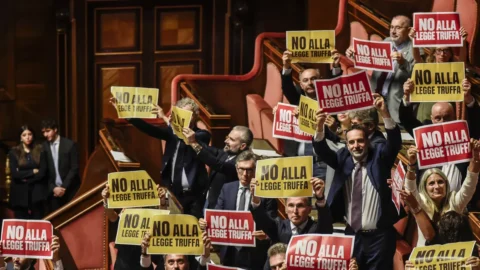
The outcome of the referendum (from the still provisional data of the Ministry of the Interior of 14 June) on nuclear energy is unequivocal: 54,79% of those entitled to vote; YES, or against nuclear power, 94,05%. An even more clear-cut result than that which occurred in 1987, when a higher percentage voted, 65%, but with a much lower percentage of those against, 80%, so that, also taking into account invalid votes (8 %), only 45% of those entitled could say they were against nuclear power.
Beyond the numerical outcome of the two referendums, their political meaning is very different above all. Then the refusal of nuclear power, also due to the abrogating nature of the questions, would not in itself have led to an immediate exit of our country from this technology. If this happened it was because the whole range of parties, in government and in opposition, gave a completely broad political interpretation of the referendum response, going beyond the extreme positions of the anti-nuclarists themselves, who considered the generalized blockade of the plants almost impossible in operation and the one under construction (Montalto di Castro). In the referendum of 12-13 June there is nothing to interpret because the questions were clear: YES/NO to nuclear power. A closure, therefore, grave of nuclear energy in our country which highlights the extreme political and social fragility on which its presumed 'rebirth' in our country was based. Rebirth started in May 2008 and declaimed, in a (only apparent) chorus of acclaim until after the Japanese tragedy of Fukushima last March 11th.
I argued in unsuspecting times that in the botched way in which we were proceeding we would have gone nowhere: due to the lack of a minimum bipartisan political consensus, due to the lack of awareness of the many difficulties that would have had to be overcome, because many of the premises The promises with which the return to nuclear power was motivated (flat reduction of costs/prices, the ability of companies to 'go it alone', the convenience of nuclear power and so on) rested on nothing. Just a lot of propaganda and a lot of hoaxes. A fragility that was embarrassingly revealed in the face of the referendum and the growing expectations of a quorum being reached. Regardless of the amateurish way in which the government tried to prevent the referendum, it is striking that almost none of the many supporters of returning to nuclear power have decided to support the reasons for it. So it was for the whole world of politics who preferred to remain silent and, in his goodness, leave 'freedom to vote' to the voters; for the industrial world (electricity and manufacturing) starting from Confindustria itself; for the many commentators who also appeared enthusiastic about it.
In the absence of any public debate and any comparison of positions between those in favor and against, the outcome of the referendum could be said to be taken for granted, even if the numbers went beyond what could have been hypothesized. That said, what is happening now in our energy landscape? I think essentially nothing for several reasons. First: because the prospect of a return to nuclear energy in our country would have occurred in any case - in terms of electricity production - in the most optimistic hypothesis, not before 15-20 years and certainly not in the few years advertised (2013 opening of the first construction site, 2008 start of production). Second: because looking at the real and not the virtual reality that was depicted, the electricity generation capacity in our country is, today and in the future, largely suitable for satisfying a demand profile that is projected to be substantially stable. There is therefore no need to scramble to 'fill a non-existent void'. Third: because the decision to support renewables with incentives estimated at 120 billion euros in the current decade will lead to their development largely exceeding needs.
Therefore, contrary to what is claimed, there is no 'desperate need for a new energy plan' but rather the need to rationalize the existing one, rather than expand it quantitatively, strengthening and modernizing the infrastructure system, both electricity and methane; by adopting a policy on the demand side that takes advantage of the considerable potential for improving energy efficiency, with benefits in economic, industrial and environmental terms; attempting to finalize the incentives for renewables towards the birth of robust national production chains. And what about nuclear power? While it is true that the referendum response leaves no room for the possibility of reopening the way for its use with the construction of new plants, I also believe that it would be erroneous to eliminate all our presence in this technology, especially in terms of knowledge: yes traits of scientific research, of academic education, of connection to the progress that is being made elsewhere. And especially about nuclear safety.
If there is one lesson we should draw from Fukushima, it is that nuclear power has a global dimension that does not remove us from the risks of other plants. In essence, one is not a nuclear-free country just because there are no power plants in one's own territory. We are, alas, all of us. The safety of other plants is our safety. Hence the conclusion that our country, no less than the nuclear ones, must be able to fully claim that in Europe, as elsewhere, the greatest safety conditions are guaranteed for the populations. But to be credible in such requests we need to have institutions (National Security Agency) and therefore the professional skills and knowledge (and whoever generates it) on which their activity must necessarily be based. To give it up is to disregard the referendum results themselves.
* economist, former Minister of Industry