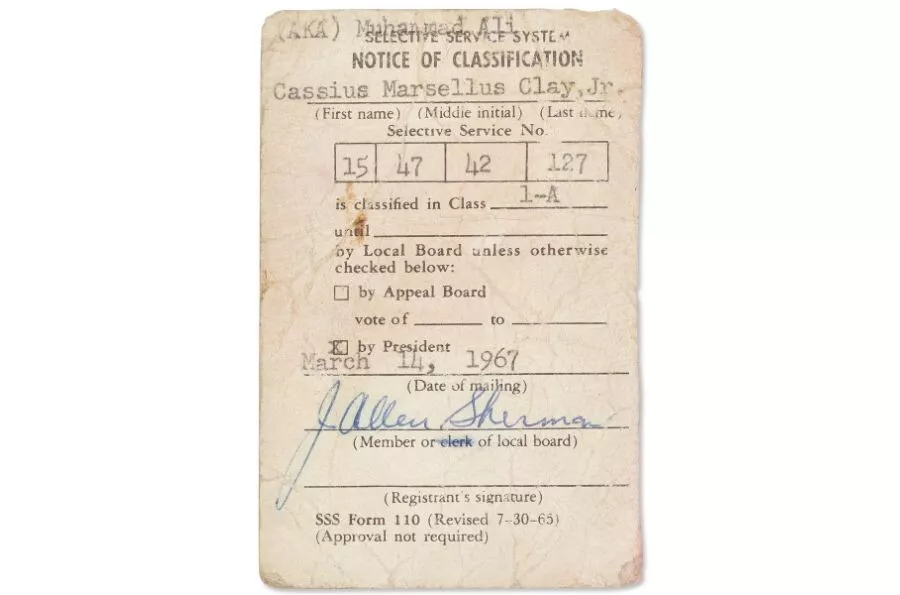
This conscription card or postcard – which Ali allegedly carried with him for years, as required by law – comes from his descendants and is a relic of a crucial historical moment. Ali's refusal, in April 1967, to enlist in the U.S. Army resonated widely around the world and helped galvanize the anti-war movement in the United States. This episode elevated Ali from sports legend to civil rights leader and paved the way for other black sports stars of the era., allowing them to express themselves on social and political issues in a new and more incisive way than the previous generation. It also had repercussions throughout Ali's life. Stripped of his titles and his boxing license, he lost the best years of his career, as well as the opportunity to earn a living. Ultimately, in 1971, Ali's conviction was overturned by a unanimous 8-0 decision of the U.S. Supreme Court (Justice Thurgood Marshall recused himself), a decision many historians attribute to the growing climate of opposition to the war in the nation.
Muhammad Ali (1942-2016) is generally considered the greatest heavyweight boxer in history.
A gold medalist in the light heavyweight division at the 1960 Rome Olympics, Ali turned professional that same year. He went on to win the heavyweight title a record-breaking three times, in 1964, 1974, and 1978. The sale of Muhammad Ali's draft card comes half a century after two of his most important fights: "The Rumble in the Jungle," on October 30, 1974, in Kinshasa, Zaire, in which Ali regained the WBA, WBC, and Ring heavyweight titles; and "The Thrilla in Manilla," on October 1, 1975, in the Philippine capital, in which Ali successfully retained those titles in the third and final edition of Ali's epic bouts with Joe Frazier.
Rasheda Ali Walsh, daughter of Muhammad Ali, said: “Remembering my father's message of courage and conviction is now more important than ever, and the sale of his conscription postcard at Christie's is a powerful way to share this legacy with the world.”.
The sale will take place online from October 10–28, 2025, with an extended exhibition at Rockefeller Center from September 18–October 28.