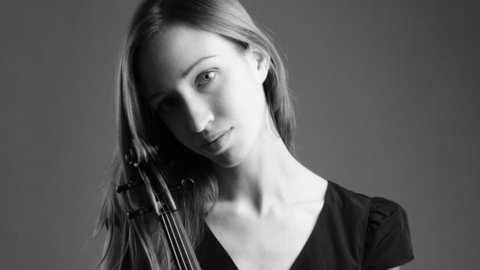
Protagonists of the appointment will be Ariadne Dotto (violin) e Aska Carmen Saito (piano) who will propose the Sonata in A major K 526 by Wolfgang Amadeus Mozart and the Sonata in A major “Gran Duo” D 574 by Franz Schubert.
The violin was a fundamental instrument in the first part of Mozart's life, the one linked to Salzburg. A few months before Wolfgang's birth, his father Leopold had published one of the main treatises on violin teaching in the eighteenth century and gave his son an excellent education also on the violin, convinced that it would have been an indispensable working instrument. In fact Mozart was employed in the music chapel of Salzburg as Konzertmeister, a sort of first violin and conductor. In fact, the most important solo works for the violin are linked to the Salzburg years, even if Mozart's relationship with his father's instrument has been controversial. After moving to Vienna Mozart will devote himself exclusively to the piano, an instrument linked not only to virtuosity but also to composition. However, the violin was not completely abandoned, but transformed into an instrument in dialogue with the piano thanks to a series of great and magnificent Sonatas. These works, unlike the Italian sonata of Baroque and virtuosic inspiration, were based on the language of the piano and represented a moment of equal comparison and dialogue between the two instruments, in the spirit of chamber music intended for an audience of amateurs. The Sonata in A major K526, written in 1787 close to the first performance of Don Giovanni, illustrates very well this dialectical relationship between violin and piano, in a work of great formal breadth, especially in the central Andante, which has a very extensive development for a slow movement of the classical period.
For a musician of the early 574th century, knowledge of the violin, i.e. the melodic instrument par excellence, still represented an essential element of training. This also applied to Schubert, who however was never a concert virtuoso even on his own instrument, the piano. A musician with such a generous melodic vein as Schubert could only dedicate works of irresistible charm to the violin, such as the Sonata in A major D.1817, written in XNUMX and published posthumously under the title of Gran Duo. The Sonata follows the group of three so-called sonatinas for violin and piano by one year, this time giving the form a wider breadth and a more unified architectural structure. The four movements, modeled on the example of Beethoven's works, overflow with musical ideas, which Schubert develops in a fluid writing and already marked by the original style of the great chamber music of recent years.
Musica e Arte offers enthusiasts eight occasions in which the fusion between the pleasure of listening to music and that of viewing works of art becomes reality in some of the most significant treasure chests of the city.
On Saturdays, at 17.30 pm, from January to March, young performers - all rooted in Milan - will perform intriguing and refined musical programs "in tune" with the artistic specificity of the different places. At the Diocesan Museum a program linked to early Viennese Romanticism is proposed, at the Poldi Pezzoli Museum there is a place for the classic style and Italian instrumentality of the early nineteenth century, at Villa Necchi Campiglio the French and Italian repertoire of the early twentieth century is privileged and finally at the Gallerie d'Italia works from the early XNUMXth century in Europe.
The concerts will be preceded by a brief introduction by the musicologist Francis Gala.
Music and Art is part of the project "Quartet Society: from our roots, let's invent the future", supported by the Cariplo Foundation.