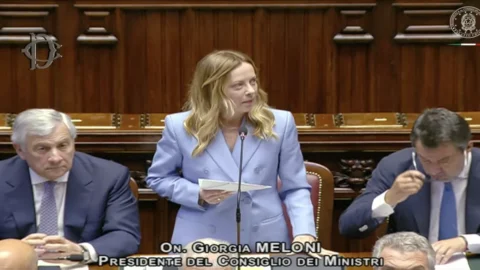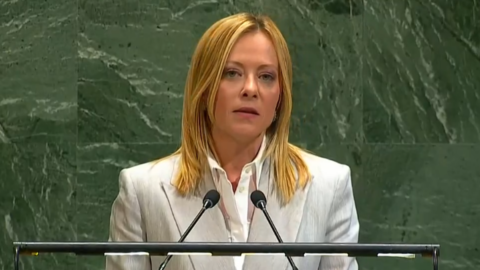
“We are suspended between war and peace”: this is how the speech of the Italian Prime Minister Giorgia Meloni in front of the United Nations General Assembly in New York, when it was 2:20 a.m. in Italy. "Peace and dialogue cannot prevail," Meloni continued, taking stock of the 80 years of the United Nations and its objectives, recalling that many changes are currently underway in the world. 56 conflicts, the highest number since the end of World War IIThen the Prime Minister moved on to the expected comment on the two areas of tension that are attracting the most attention and concern from the international community, namely Ukraine and Gaza: “Russia trampled on the treaty of the United Nations”, Meloni limited herself to saying about Moscow, while the part of her speech dedicated to Israel was a little more substantial, from which perhaps for the first time she openly and publicly distanced herself, albeit with some distinctions.
"Israel has exceeded the limit of proportionality in Gaza – she said -. The Jewish state is breaking humanitarian norms in Gaza, but we do not join those who place all the responsibility on Israel. It is Hamas that could free the hostages and put an end to hostilities." The Prime Minister then reiterated what had emerged on the eve of her speech, namely the official position of the Italian government on the issue of recognition of the State of Palestine, which "will only be possible under two conditions: the release of the hostages" and that Hamas no longer be considered the interlocutor. Therefore, Italy's participation in an initiative that now involves practically the entire world, the USA, Germany, and a few others aside, is suspended. In her speech at the UN, Meloni then international rules on the right to asylum attacked, "think of an era in which mass migration and human traffickers did not exist." and which can be exploited "by the politicized judiciary." Finally, in the wake of Donald Trump's words, the criticism of environmentalism "is unsustainable, which is leading to deindustrialization rather than decarbonization."
Zelensky's statement: "The UN must not remain silent; international law is collapsing."
A few hours before the Italian Prime Minister Giorgia Meloni had also spoken at the United Nations General Assembly in New York Ukrainian President Volodymyr ZelenskyZelensky launched his usual impassioned appeal to the international community to stop the Russian attack on his country. "International law is collapsing; weapons decide who survives," he bitterly stated, while urging the UN "not to remain silent. Support us. Stopping Putin now is cheaper than containing a more aggressive Russia in the future." For Zelensky, failing to stop Russia now means running the risk of the conflict spreading in the future, and perhaps this future isn't even that far away, given the recent and repeated violations on European soil, of which Moscow is highly suspected.
On the sidelines of the meeting, Zelensky also met with US President Donald Trump for the umpteenth time, this time perhaps less embarrassingly than some of his previous ones. Strengthened by the renewed American support, which he himself said he was "a little surprised by," Zelensky delivered a wide-ranging speech, not limited to his country alone. He, in fact, mentioned in Georgia, Moldova, Palestine and SyriaThese crises demonstrate the difficulties of international institutions, which for decades have offered only "statements and declarations" to peoples at war. "There is no single institution that can truly stop" an aggression, he said, urging Europe "not to lose Moldova" to Russian interference. The examples offered served Zelensky to reinforce his thesis that the world is grappling with "the most destructive arms race in history," for which Russia bears responsibility.
Between drones and artificial intelligence applied to weapons, rules are needed immediately because National security must "be a right, not a privilege for the few", he thundered from the stage. And even membership in a long-standing military alliance doesn't automatically mean safety, he added in an implicit reference to NATO. "Ukrainians are peaceful people who had no choice but to fight," he explained to those in the chamber, describing the country's heavy investments in underground schools and hospitals and in weapons for self-defense. "We don't have the large missiles that dictators like to display in parades, but we build drones to protect our right to life," he said, offering Ukrainian weapons "developed and tested against Russia" as a bargaining chip for the indispensable support his country needs.
Von der Leyen to China: "Convince Moscow to negotiate."
A support that sees Europe and the United States as two essential partners, also to put pressure on those third countries that fuel the Russian war machine with oil purchases. In this regard, European Commission President Ursula von der Leyen asked China, during a meeting with Chinese Prime Minister Li, to use its influence to "encourage Russia to come to the negotiating table." On the Chinese front, as on the Indian one, Washington can also play a decisive role. "It can help us," Zelensky admitted to Fox after receiving an unprecedented support from TrumpZelensky publicly thanked the American president at the UN for his efforts. And as if to please him, he perhaps recalled the attempted assassination of Trump, and cited the killing of Charlie Kirk and that of the young Ukrainian woman on the subway in the United States.
Condemning Russia for refusing to call a ceasefire and describing Vladimir Putin as "scared" of having a face-to-face meeting with him, Zelensky finally addressed the leaders present in the chamber: "Do not remain silent while Russia continues to drag out this war. Condemn it, join us in defending international law. Because, in the end, peace depends on all of us".