José Guadalupe Posada was born on February 2, 1852 in Aguascalientes, in the heart of Mexico, in a simple family, where talent was the only wealth. From childhood, between pencils and dreams, he showed an instinctive passion for drawing: he didn't copy reality, he narrated it. He studied at the Municipal Academy of Arts and Crafts, where he learned the secrets of lithography and engraving, tools that would transform his art into the voice of the people. At just sixteen, he began working in a local printing shop, publishing his first political caricatures. From then on, his hand traced more than simple lines: it traced complaints, bitter smiles and uncomfortable truths, facing social injustice, poverty, and the corruption of the powerful. In 1872 he moved to León, where he opened his own printing shop. It was here that he honed his engraving art, creating the famous “flying leaves” —popular illustrated sheets accompanied by verses or ballads, sold in squares and markets. His images spread from hand to hand, speaking to those who could not read, making visible what was often ignored. In 1888, a terrible flood destroyed his laboratory. Posada, undaunted, moved to Mexico City, where he began to collaborate with the publisher Antonio Vanegas ArroyoTogether, they created a vast production of engravings—on crime, politics, celebrations, miracles, and daily miseries—which ended up hanging on walls, sold for a few cents, read and loved by the people. José Guadalupe Posada died the January 20 1913, poor and almost forgotten, buried in a mass grave. But as happens with great spirits, his voice did not fade: it was rediscovered by Mexican muralists, who recognized him as the father of modern folk art.
The Calaveras, dancing skeletons
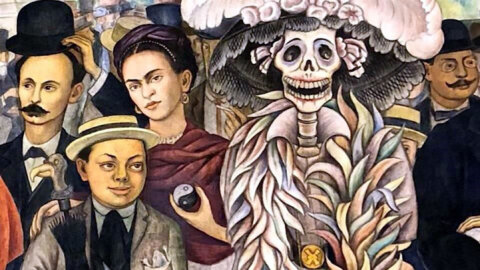
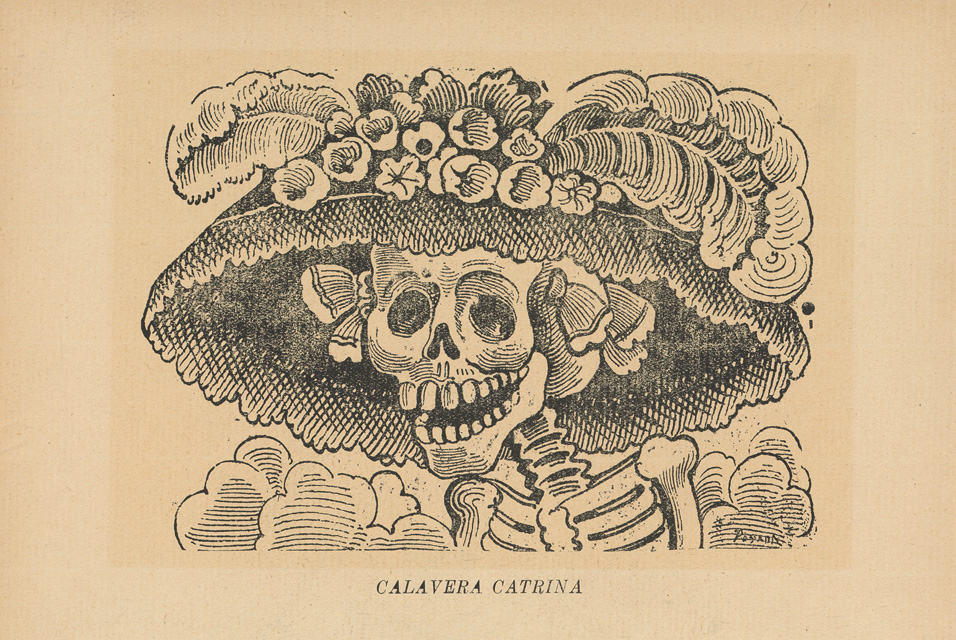
It was during this period that his most famous works were born: the “Calaveras”Dancing skeletons that laid bare, with irony and depth, Mexican society. Behind those bones sculpted in black and white, Posada spoke of human frailty, equality in death, the eternal mockery of fate. Among them all, one figure became immortal: “La Calavera Catrina”, the skeletal lady with an elegant hat, symbol of bourgeois vanity and the illusion of power. The Catrina, made famous decades later by Diego Rivera in his mural Dream of a Sunday afternoon in the Alameda Central, it is today the icon of Día de los Muertos, but also the most universal portrait of Mexican identity: ironic, poetic, indomitable in the face of death.
La Catrina: Death Smiling at Life
Of all the creations of José Guadalupe Posada, none has had such a universal destiny as The Catrina, the elegant skeletal lady with a large hat decorated with feathers and flowers.
Born as social satire, the Catrina was not initially a symbol of death, but of hypocrisy and vanityPosada called her The Garbancera Skull, to mock indigenous and mixed-race women who tried to appear European, denying their roots. Under their elegant clothes, Posada said, “we are all the same: just bones”. Over time, however, the figure of La Catrina went beyond caricature and became a deep cultural symbolDeath doesn't frighten, but accompanies. In his irony, Posada recounted an ancient Mexican truth: that death is not the end, but part of life itself, a return and a celebration. When Diego Rivera captured it in his famous mural Dream of a Sunday afternoon in the Alameda Central (1947), La Catrina definitively became a national icon. Rivera dressed her in a feather boa and placed her at the center of the scene, alongside Posada himself and a young Frida Kahlo: a dialogue between art, life, and eternity. Today, La Catrina is the face of Día de los Muertos, the most emblematic celebration in Mexico, where death is not mourning, but memory and rebirth. His skeletal smile reminds us that life is only worthwhile if accepted in its entirety, light and shadow, laughter and silence. José Guadalupe Posada was not just an engraver: he was a poet of the people, a visionary of life and death, an artist who knew how to transform fear into beauty and satire into eternity. His style was direct, cutting, and profoundly human. In an age dominated by the elite, he spoke to the people and did so with a force that no official newspaper could match. His art was news, theater, and philosophy, an art “democratic”, made for those who lived, loved, and suffered on the streets of Mexico. Today, his engravings are exhibited in museums around the world.