Last June the Peggy Guggenheim Collection has initiated a very important study and conservation project of ten works by Jackson Pollock, built between 1942 and 1947, now owned by the Venetian museum. The canvases were acquired by Peggy Guggenheim herself, a patron of the American artist who exhibited Art of This Century in her New York gallery during the 40s. Collectively, the ten works represent a crucial moment in Pollock's work, namely the transition from a relatively traditional and figurative/abstract pictorial language, to that distinctive technique of pouring, splashing and dripping paint onto the canvas stretched out on the ground.
The investigations conducted so far through non-invasive scientific analyzes have brought out important information on the technique and materials used by Jackson Pollock with the identification of the pigments and binders used by the artist. The first phases and revelations of this study were presented on October 10 at the symposium “Science and Innovation in the Study of Modern and Contemporary Art,” organized by the Accademia Nazionale dei Lincei and the US Academy of Sciences at theItalian Cultural Institute in New York.
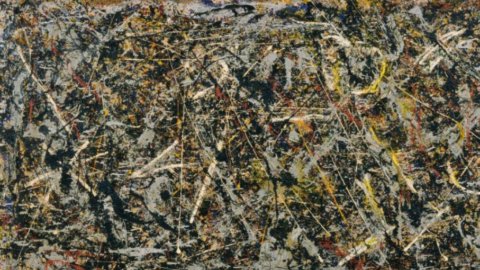
During this second crucial phase of the project, she was chosen Alchemy, one of Pollock's best-known and best-loved works, as well as among his earliest dripping, which the painter created in 1947 in his Long Island studio, for an intervention of analytical analysis and conservation at the Opificio delle Pietre Dure in Florence. On 2 December the canvas arrived in the Workshop Paintings Workshop where the working group will have full access to all the equipment and make use of the skills of the Workshop itself. Here Alchemy will be subjected to further analyzes and tests in preparation for the meticulous cleaning of its complex pictorial surface made up of several layers of enamel, alkyd resin and oil paints, combined with a complex combination of different materials such as strings, sand and pebbles, all combined into a thick slurry, paint clumps, splashes and drips. Cleaning is necessary to remove the layer of dirt accumulated over the years, which has compromised the aesthetic quality of the painting, dulling the colors and reducing the three-dimensional space created by Pollock's innovative technique.
This research project, the first ever in Italy, is made possible thanks to an important scientific group coordinated by the conservation departments of the Peggy Guggenheim Collection in Venice and by the Solomon R. Guggenheim Museum in New York, with the fundamental contribution of the Opificio delle Pietre Dure, of the MOLAB (of the CNR Institute of Molecular Science and Technologies and of the SMAArt Center of Excellence, of Perugia), of the CNR National Institute of Optics of Florence and of the Diagnostic Laboratory of Spoleto. The project also involves American scientists, conservators and curators who have already carried out research on Pollock's techniques. The intervention will be carried out by Luciano Pensabene Buemi, Curator of the Peggy Guggenheim Collection, in collaboration with Carol Stringari, Chief Curator of the Guggenheim Museum in New York and with the Painting Laboratory of the Opificio delle Pietre Dure, institute of excellence in conservation and restoration of works of art. The prestigious Florentine institution will host Alchemy, at the same time he is restoring another icon of art history, The Adoration of the Magi, the Leonardo altarpiece commissioned by the Augustinian monks of San Donato a Scopeto and since 1670 belonging to the Uffizi Gallery in Florence.