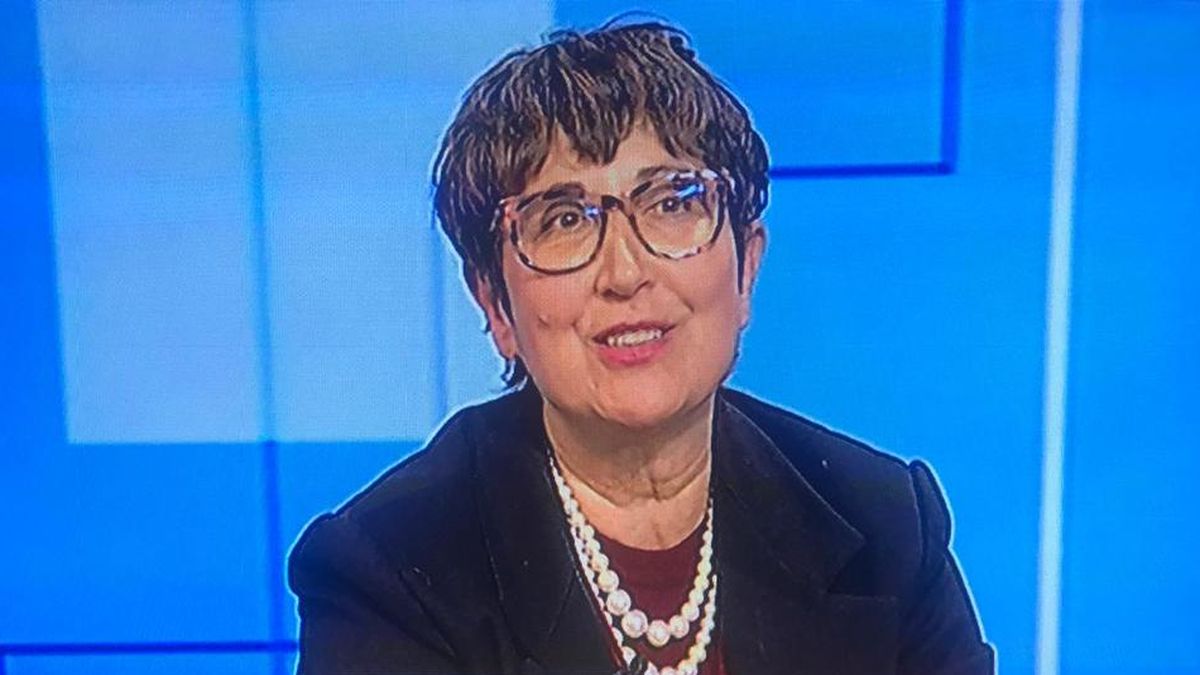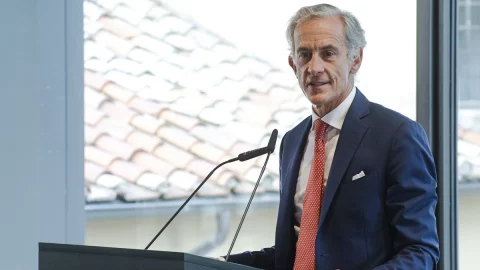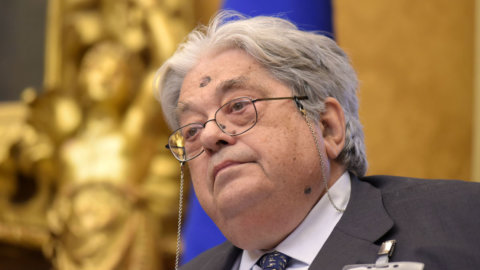
What exactly is hybrid warfare, which has so forcefully emerged onto the scene in these troubled times? The dictionary definition is this: “The hybrid war It is a conflict strategy that combines traditional military actions, cyber attacks, sabotage, disinformation, and economic pressure to destabilize a country without resorting to a formal declaration of war. But not everyone agrees on the term "hybrid warfare." Let's try to understand more by listening. Stefano Silvestri, former president of the Institute of International Affairs, an expert in geopolitics and military affairs, appreciated by specialized circles and the media for his consistently original analyses, which never limit themselves to the current trend, but always tend to broaden the scope of the debate. For example, regarding the topic he proposes to him FIRST online, hybrid warfare, Silvestri has some conceptual objections and refers us to seeking the key to understanding it in the end of the Soviet empire. Here is his interview.
Professor Silvestri, is this something new in the history of wars and peace?
Absolutely not, it's nothing new. Wars have always been hybrid, in the sense that humans have always used means other than weapons to wage conflict; the difference lies only in the quality of those means. Drones are new, for example, but disinformation, provocations, propaganda—these weapons have always been used. However, I would like to say that the very term "war" shouldn't be used; we're overusing it. We should be talking about hybrid "aggressions," hybrid "attacks." If we continue to misuse words, on the one hand, we diminish the very meaning of "war" (which means death, destruction, horror), trivializing it; on the other, we overvalue every conflict, even if it doesn't involve military mobilization. The only consequence is that this creates confusion, apprehension, and fear.
Very clear, professor. But what does the end of communism have to do with the current disorder?
"It certainly has something to do with it. Because it all began there, with the end of the Cold War, a war that ended without a Peace Treaty, which, as is done at the end of every conflict, should have established new rules for coexistence between states. In short, we didn't have something like the Congress of Vienna, which would have designed a new system of international relations that would be recognized by all the protagonists at the end of the Cold War. That's how today's troubles began, because, perhaps unintentionally, perhaps just out of vainglory (the West emerged victorious in its confrontation with the communist East without moving a tank), the old spirits of national and nationalist egoism, with all that goes with it, were unleashed."
Fatal error?
Yes, because on the one hand, the rush to expand the West eastward began, without even knowing what to do with it; on the other, all of this first sparked nationalist fever and then Russia's wrath, which we began to experience starting in 2014 with the annexation of Crimea. In short, the old rules (for example, the one prohibiting the invasion of another country) were being torn up in the void of the new ones. I'm not embracing Putin's narrative of encirclement; I'm just saying that it was the absence of shared rules that led to today's chaos. A chaos that today leads the world's leading power to threaten friends and enemies economically (tariffs), to issue proclamations of annexation of independent countries (Canada, Greenland, Mexico), to unleash wars against enemies without credible objectives (Iran), to allow massacres and other horrors (Gaza), to reach an agreement with certain factions of a state to kidnap its president and seize its main wealth, oil (Venezuela). ».
Of course, stacked one after the other, Trump's "achievements" are truly impressive. Was this how the president imagined he could make America great again?
“Rumor has it in the Pentagon that in his quest to make America great again (Donald Trump’s slogan, Maga), the President has gone too far, especially in his ill-fated stage-by-stage war against Iran, and has ended up weakening the American superpower.
Criticisms focus on the extremely high consumption of some of the most sophisticated weapons systems, such as the Pac-3 Patriot and Thaad missile defense systems, some drone interception systems, the long-range, high-precision ATACMs surface-launched missiles, and some precision munitions such as the AGM-154 glide bombs. Not only would this have entailed a cost of over $30 billion, but it also led to the relocation of systems normally based in Europe to the Middle East, for NATO use, and to the Pacific region, to counter the Chinese threat, particularly against Taiwan. Of course, this doesn't mean the US no longer has military options: its immense arsenal includes many other, slightly less sophisticated, systems that nonetheless have great potential. However, the most technologically advanced range is also the one under the most pressure, and this concerns the Joint Chiefs of Staff, both American and allied.
Let's return to the dangers of "hybrid attacks," as we'll call them from now on. What are the aspects that should concern us most?
The most obvious and important case that Europe needs to worry about is the Russian one. Because the bulk of Moscow's efforts seem to be channeled into influencing the political behavior of European public opinion, taking advantage of the fatigue and growing fears of populations that are not at war, but are called upon to show solidarity with Kiev, which is at war. The array of arguments used is vast and includes the pure and simple threats of a possible widening of the war, although it is difficult to see how Moscow could gain anything from this, given that this would only worsen the already critical situation of its armed forces. And it also includes vague threats of nuclear weapons use, which, although lacking credibility, nevertheless fuel fear and unease. Also effective is the assertion that Russia will win in any case and that Ukraine is therefore merely postponing the inevitable, a claim that has so far been unfounded. But perhaps the most poisonous insinuation, at a time of looming economic crisis, is that reopening economic and energy relations with Russia would be a Great benefit. An argument that, moreover, has a divisive effect because only some European countries could benefit from it. Here too, of course, we are faced with exaggerations and distortions.”
Professor, you recently highlighted another danger, the one you believe is more serious for us stretched out in the Mediterranean, and that is the possibility that the two "real" wars, Ukraine and Iran, could merge.
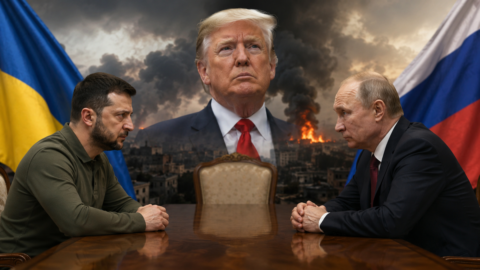
Yes, I fear that the real risk of a first bridging of the two wars, in the Gulf and in Ukraine, is emerging after Ukrainian drones last July struck an Iranian ship anchored at the mouth of the Volga, on the northern shore of the Caspian Sea, accused of supplying weapons to Russia. This is true, because since 2022, Tehran has been supplying Moscow with drones and other war material, in addition to functioning as one of the major gateways for Russian foreign trade, despite sanctions.
Why is this so worrying?
This is worrying because Russia is directly engaged in a war against Ukraine and the United States is directly engaged in a war against Iran. If the two wars were to merge, the risk of a direct military confrontation between Washington and Moscow would increase. But even more serious is that it could escalate the scale of this war: that is, a generalized conflict to alter the international status of the strategic Straits. As we know, Iran has already challenged freedom of navigation through the Strait of Hormuz, and would like to extend a similar claim to the Bab el-Mandeb (Red Sea and Indian Ocean).
And there is another protagonist in the Middle East waiting for his moment…
We're talking about Turkey, of course, which has long advocated revising the 1922 Treaty of Lausanne, which, after Kemal Ataturk's victories in Anatolia, replaced the 1918 Treaty of Sèvres, which liquidated both the Ottoman Empire and Turkey. Ankara seeks recognition of its sovereignty over the seas, from the Sea of Marmara, through the Aegean Sea, to the Mediterranean, to the part of Cyprus it has militarily occupied, and to its military presence in Africa, starting with Libya. Needless to say, many disagree.
And so we are back to the Peace Treaties.
"Exactly. The balances established at the end of the two World Wars are not perfect, but it would be wrong to tamper with them without first clarifying where we're headed. Just as it was wrong, as we've said, to do absolutely nothing after one of the main players, the Soviet Union, disappeared. The law of the strongest, which seems to support the choices of the major players, has repeatedly proven to be deceptive, precisely in these wars."