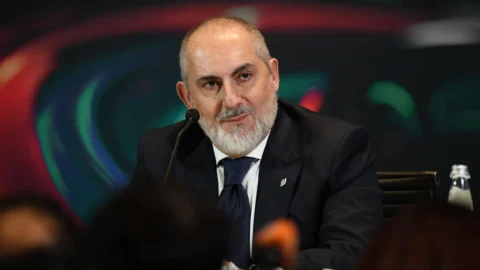
The projects related to the Pnrr will not end with the end of the Plan, but will have to be supported until their completion. This is the message that emerged from the speech of Stefano Antonio Donnarumma At the General Assembly of the Social Security of Freelance Professionals promoted by Adepp at the Barberini Cinema, the CEO of the FS Group described the goal of advancing major infrastructure projects as "strategic, but directly industrial," noting that the Group is the implementing body of the National Recovery and Resilience Plan (NRRP) for approximately €25 billion.
Donnarumma emphasized that the program is at an advanced stage and close to reaching its pre-established goals, but clarified that "the PNRR projects are not conclusive." Hence the need to ensure continuity of interventions already underway, with adequate planning and financing capacity for projects that will still require several years of work.
The country's major strategic works
Among the infrastructures mentioned are the Naples-Bari, intended to connect Rome and Bari in approximately three hours, the closure of the TAV on the connection Turin-Venice, Third Pass of the Giovi , Salerno-Reggio Calabria, with a reduction in travel times of more than an hour.
These are, Donnarumma explained, interventions that "represent billions in investments," including resources already employed and to be mobilized, and which require shared direction between the company, the entities involved, and public finances.
Infrastructure as a lever for economic growth
In his speech, the CEO of the FS Group reiterated that the infrastructure They represent a central lever for the country's growth: "a backbone of the Italian economy," with direct impacts on industrial development, employment, and quality of life.
Infrastructure has been described as “an ecosystem” that includes ports, airports, highways, roads, railways, energy networks, aqueducts and telecommunications.
Employment, investment and sustainability
The first objective remains to ensure continuity to the investments and to the supply chain, already experiencing strong growth. Without new tenders in the coming years, he warned, "many tens of thousands of workers would no longer have jobs."
On the sustainability front, the focus is onelectrification of the railway network energy transitionFS is the largest consumer of electricity on the national grid (around 2% of demand) and aims to play an active role in the development of renewables.
To support this vision, approximately €12,5 billion is earmarked for the railway network and at least €4 billion for roads with Anas. The group employs approximately 100 people and supports a broad supply chain spanning construction, plant engineering, and engineering, with significant benefits for skills and innovation. Investing in infrastructure, the CEO emphasized, means activating a complex production system with benefits for skills, jobs, and innovation.
The crucial issue of financing
Finally, Donnarumma addressed the issue of financing infrastructure, a central issue for the future of the sector. Given the nature of the FS Group, controlled by the State through the Ministry of Economy and Finance, he highlighted the need to support increasingly significant investments in a context where new projects must be constructed and infrastructure built decades ago must be maintained efficiently and safely.
For over a year, he explained, alternative financing models have been under consideration with institutions. Among the options is a structure similar to an asset company, capable of valorizing part of the railway assets and attracting long-term capital flows. This model could guarantee "fairly low, but secure and long-term returns," supporting investments with a twenty- or thirty-year horizon.