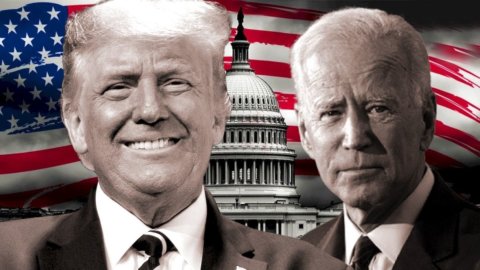
According to a recent Gallup survey a quarter of the American electorate doesn't like it neither candidate who will compete next November for the conquest of the White House. The investigation also shows that Trump it more or less maintains the approval ratings of 2020 with only one of these exceeding 50 percent. Biden instead, it is faced with a significant decline in voter approval compared to 2020 levels.
It may also be that theAmerican electorate, unlike in sport, you don't really like rematches either match, that is, the repetition of a confrontation between two candidates that has already occurred and resolved. The fact is, however, that two thirds of the Republican electorate believes that the 2020 electoral result was distorted and therefore a rematch is, so to speak, due and right.
The Democratic Party, for its part, believes that Biden is the best candidate to beat Trump, given that he has already done so. Therefore the match may have seemed inevitable to most of the bases of the two parties. There weren't many match in American history, but there have been some. We asked the professor Stefano Luconi, professor of History and institutions of the Americas at the University of Padua and author with goWare of a guide book to the next American presidential elections, to tell us about them.
We begin with two rematches that show some unexpected similarities to what we are witnessing today. In the story there is already everything. Maybe we should learn it a little better.
The Republican and Democratic primaries have now established that next November's elections will be a match, that is, a new challenge between Donald Trump and Joe Biden, who have already faced each other in 2020. This is an unusual but not unprecedented event in the history of the United States. Which was the match most sensational in American history?
“Already the fourth presidential elections of the United States, held in 1800, were a repeat of those of 1796. In both years the federalist John Adams and the democratic-republican Thomas Jefferson faced each other. In 1796 Adams won, thanks to the prestige of the position of vice of the outgoing president and "father of the country" George Washington, in 1800 Jefferson".
So in 1800 there was a reversal of the outcome of the 1796 elections. What happened?
“In addition to the consequences of the increase in tax pressure and the supposed weakness of Adams' foreign policy towards France (some federalist voters of 1796 would have wanted to declare war on it because it did not respect the commercial rights of the United States), Jefferson's victory contributed in part the heated denunciations of the Democratic-Republicans against the alleged authoritarian involution of Adams' presidency, which they accused of having made use of laws that it had itself promoted, the Alien and Sedition Acts approved by Congress in 1798, to target political opponents and steal potential voters from them."
What did they predict? Alien and Sedition Acts?
“One of these provisions, in particular, extended to fourteen years the minimum period of residence for requesting US citizenship and consequently acquiring the right to vote because it was part of the most recent immigrants – Englishmen forced to leave the country because they were against the monarchy and radical Frenchmen who emerged defeated from the various phases of the revolution, as in the case of the Jacobins - had an ideological orientation close to that of the Democratic-Republicans and therefore, if naturalized within the five years foreseen by the previous legislation, they could have brought votes to Jefferson's party".
A sort of law ad personam. But that wasn't the only illiberal measure, was it?
“Another measure made it a criminal offense to spread false and biased statements about the federal government, a way to gag especially journalists who were critical of Adams' work and aligned with Jefferson, in open violation of the protection of freedom of expression enshrined by the First Amendment of the Constitution. It is no coincidence that the first person to be indicted, tried and sentenced to a fine ($1.000, equivalent to over $24.000 today) and a prison term (four months) for defaming the federalist administration was a Democratic-Republican member of the Chamber, Matthew Lynch, who on Vermont Journal he had accused Adams' presidency of "ridiculous pomp, foolish flattery, and selfish avarice."
Jefferson was vice president at the time, right? For him it wasn't worth it Sedition Act?
“The fact that the Sedition Act whether it was a law designed to benefit Adams is attested by the observation that the provision did not punish anyone who contested the actions of the vice president who, in those years, was Jefferson himself. At the time there was no separate vote for president and vice president and this second office was assigned to the second most voted candidate who, in fact, in 1796 was Jefferson".
Adams also confronted the judiciary. It seems like history tends to repeat itself, somehow.
“Adams' alleged use of the judiciary to attack his adversaries and in particular the directors of pro-Jeffersonian newspapers as part of a match for the presidency seemed to anticipate by more than two centuries the strategy that Trump is adopting in this year's election campaign, namely his attempt to attribute the 91 charges hanging over his head to politicized judges of democratic orientation who would be playing the game of Biden."
Are there also other similarities between the two rematches?
“Actually yes. The similarities between the Trump-Biden clash and the Adams-Jefferson clash do not stop here. Like today, the electoral campaign of 1800 was highly conflictual and took place with no holds barred. Adams responded to the accusations of the Democratic-Republicans by anticipating the setting up of a Trumpian mud machine which, through the press close to him, circulated what was perhaps the first fake news of US electoral history, that is, the inference that Jefferson was an atheist, a libertine and a mestizo, the son of a Native American and a mulatto”.
A devastating accusation for the time, right?
“Yes, it was a potentially devastating conjecture because the electoral base of the Democratic-Republican party was in the slave states of the South (Jefferson himself resided in Virginia), where indigenous people and Afro-descendants were considered inferior beings and it would therefore have been inconceivable to support a presidential candidate who had indigenous and African blood. If you then consider that after his defeat in the 1800 elections, Adams did not attend Jefferson's inauguration, but left the capital at the first light of dawn so as not to meet his successor, one can only think of Trump's refusal to participate. at Biden's 2020 commencement ceremony."
Speaking of analogies with the current state of affairs, we can go to the elections of two centuries ago which saw the challenge between John Quincy Adams and Andrew Jackson.
“Il match more similar to what is expected for next autumn was, in fact, the one that pitted John Quincy Adams, John's son, and Andrew Jackson in 1828. What these two challenges have in common, in fact, is the refusal of the candidate defeated in the previous elections (Trump in 2020 and Jackson in 1824) to recognize the vote's response to alleged unproven fraud and, therefore, his determination to take revenge four years later."
What happened in the 1824 election?
“The elections of 1824 took place at a time of political transition, after the dissolution of the Federalist party, and saw four main candidates in the field, all of Democratic-Republican orientation: John Quincy Adams, Andrew Jackson, William Crawford and Henry Clay. The multiplication of presidential aspirants meant that no one achieved an absolute majority of the electoral votes. As required by the Constitution, the nomination of the president then passed to the House of Representatives with a runoff between the three most voted: Jackson, who had obtained 99 electoral votes, Quincy Adams, who had received 84, and Crawford, who had obtained 41 The latter immediately left the scene because he suffered a stroke and, therefore, would not have been in a position to hold the position. It was expected that the House vote would be just a formality and that the choice would fall to Jackson as the winner of the relative majority. Furthermore, as the son of the Federalist president, Quincy Adams did not even seem like a true Democratic-Republican.”
And instead there was an unexpected event, a sort of turnaround?
“Clay, who was constitutionally excluded from the ballot because he had placed in fourth place, thanks to the authority that came from his role as president of the House, invited his supporters in the lower branch of Congress to pour their preferences on Quincy Adams, allowing him to win the White House. One of the new president's first decisions was to nominate Clay as secretary of state."
Did all this make political sense or was it simply a vote exchange?
“Jackson and his acolytes cried foul and considered Quincy Adams an illegitimate president, alluding to a sort of buying and selling of offices and a secret agreement – the proof of which, however, was never found – with Clay to gain access to the White House, overthrowing the will of the majority, even if relative, of the popular electorate and of the electors. In reality, Clay's choice had its own political logic because the president of the House shared with Quincy Adams a program of strengthening the powers of the federal state and encouraging manufacturing growth through customs protectionism and the integration of the internal market through development of infrastructure for trade”.
And what happened in 1828?
“In the 1828 elections Jackson presented himself as the defender of the needs of the American people against the prevarications of the political class, linked to the interests of the world of finance and business, which had brought Quincy Adams to the White House. Anticipating the contents of Trump's inauguration speech in 2020, he considered his election as the return to the people of that power that the clique of Washington politicians had previously taken away from him. Jackson was in fact the first populist president of the United States and, on the first day of his mandate, he wanted to open the doors of the White House to the crowd of his voters. Not surprisingly, his portrait would be placed in the Oval Office upon Trump's taking office."
Next week we will publish the second and final part relating to rematches relatively closer to us in chronological order (Harrison v. Cleveland, Eisenhower v. Stevenson etc.)
Stefano Luconi teaches History of the United States of America in the Department of Historical, Geographical and Antiquity Sciences at the University of Padua. His publications include The “indispensable nation”. History of the United States from its origins to Trump (2020) US institutions from the drafting of the Constitution to Biden, 1787–2022 (2022) and Lthe black soul of the United States. African Americans and the difficult path to equality, 1619–2023 (2023).
Books:
Stefano Luconi, The race for the White House 2024. The election of the president of the United States from the primaries to beyond the vote on November 5, goWare, 2023, pp. 162, €14,25 paper edition, €6,99 Kindle edition
Stefano Luconi,US institutions from the drafting of the Constitution to Biden, 1787–2022, goWare, 2022, pp. 182, €12,35 paper edition, €6,99 Kindle edition