Cities have changed, they are no longer complete, static realities, with well-defined spaces and hierarchical organizational systems. Today cities are increasingly an intricate and changing set of connected networks and subjects who make interdependent decisions necessary to keep an increasingly complex and customized system in balance.
The current social, cultural and economic dynamics, also a consequence of the polarization and erosion of the middle class, have an impact on growing demand for social housing in metropolitan areas.
Data from the last five years indicate that approx 1,7 million households are in a state of severe economic and often, consequently, housing hardship.
The system public housing, which represents almost all of the social housing supply in Italy, is in the condition of exhaustion of a historical phase. With the regionalization and the closure of the purpose tax that financed the sector (Gescal), the conditions maintained since 1998 no longer meet current needs. It is therefore up to the public decision-maker to redefine a vision and structure of this sector.
The volume edited by Christian Iaione, Monica Bernardi and Elena De Nictolis was released in November 2019 with the Mill "The home for everyone. Innovative and sustainable management models for adequate housing“, which collects the results of the survey work carried out by the research unit of Luiss LabGov.City, coordinated by prof. Christian Iaione, within the project House Common Good. From collaborative housing to community housing.
The research, carried out with the support of Federcasa, had as its object a legal and empirical analysis carried out at national and international level in order to identify innovative and sustainable management models in the public and social housing sector.
The book highlights the tension towards urban spaces that are more equitable, welcoming and safe, but also democratic and collaborative, capable of fueling lifestyles and functional models that contribute to “implement quality of life”. Objective that should be indispensable for those who govern the city and its transformations.
Today the new building strategies and visions must necessarily take into account the structural changes in society, changes that necessarily pass from "regeneration of the suburbs"real frontiers where the challenge for a more livable, just and democratic city is played out. Reasoning that applies to construction in general and even more to the social one.
A regeneration that goes beyond the merely infrastructural aspect, however necessary for the increase in the number of lodgings to respond to real demand, and which focuses "themes of redesign and co-design of spaces and governance models" (sharing in use, collaboration in management, polycentrism in ownership). A road that sees citizens no longer just as passive users of a good but as active agents of change.
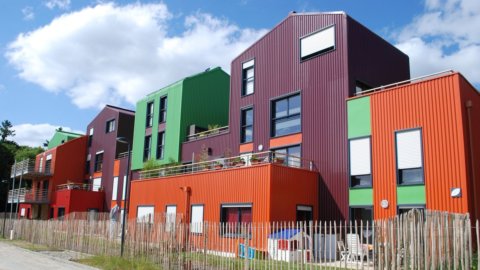
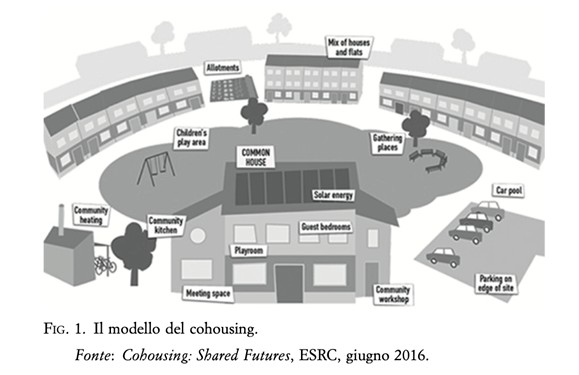
In recent decades, a wide range of resident-led and managed forms of housing have emerged across Europe in which, alongside private housing, common spaces and services are shared between residents and with the neighbourhood. These "alternative forms” of residential construction are characterized by greater attention to social values, such as environmental sustainability, social inclusion and cohesion, urban regeneration.
They can fall into that category a great variety of forms and initiatives: cohousing, habitat participatif, resident cooperatives, ecological residential communities (eco-villages), recovery initiatives for vacant or abandoned properties (self-help housing), community asset ownership, Community Land Trust (CLT).
Still today in Italy subsidized housing, i.e. the leasing of public housing involving costs borne entirely by the State, would seem to be the only instrument through which the protection of the weakest sections of the population is guaranteed, or should be able to be guaranteed.
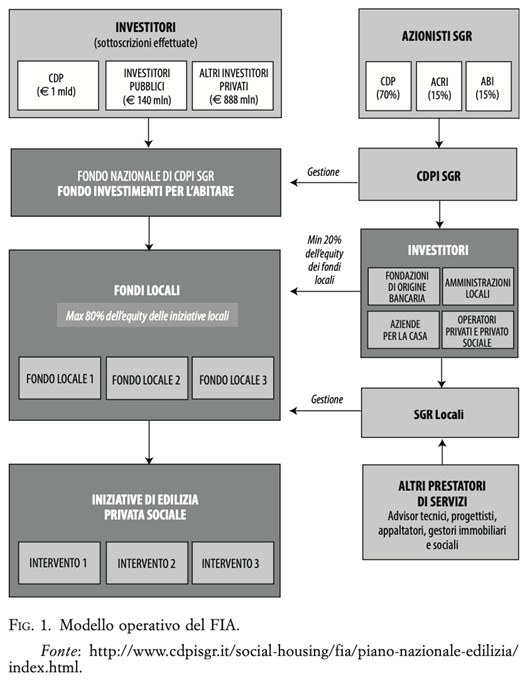
Il House plan and National housing plan provide for the possibility of using closed-end real estate funds as an instrument for financing the construction of social housing. To date, there are about 30 approved investments and local real estate funds created with the support of the FIA (Fondo Investimenti per l'Abitare).
Taking into consideration the various possible forms, procedural and financing, they have been analyzed further in the text 73 housing trials present or to be launched soon in Italy.
In most cases, the recipients of the interventions are subjects of the so-called gray band. The young target is the one most intercepted. Less frequently the projects are aimed at individuals who live in situations of greater fragility, or in any case the quotas reserved for them are very small out of the total available housing.
A large numerical gap persists between the projects launched in Centro and in North part of the country and those put in place at South.
In the field of urban regeneration, the recirculation of public properties in disuse or private properties sold under concession it's not the norm. Some projects provide the construction from scratch of the property.
The analysis of the case studies confirmed this "the existence of five principles of institutional design elaborated in the analytical approach of the Co-City":
- co-governance (sharing, collaboration, polycentrism)
- the role of promoter and subsequently of facilitator played by the public authority
- the creation and/or connection with forms of economy and enterprise produced as a result of co-governance, economies in turn characterized by a collaborative approach and above all by sustainability objectives such as the circular economy or the social or solidarity economy
- la technological justice (technological advances and digital transition in the housing sector)
- experimentalism, towards new public decision-making or management processes suitable or adaptable to the “constant and impetuous change that the ecological and digital transition requires"
Public housing management companies (from autonomous institutes for social housing, to companies, up to spas) administer a heritage of 836 social housing in Italy.
From the analysis conducted, the need for these actors to rediscover a new centrality in the "complex and articulated architecture of public policies that deal with housing problems" is evident. deeming The excessive privatization of public bodies is also problematic in this sector and the divestment of public assets and functions that continued over the years on the basis of "unproven postulate” that the private individual, any type of private individual, is in itself more efficient and suitable for responding to a need of the community.
The presence of the public entity (social housing company or local authority) in the function of promotion, support, facilitation, moderation, monitoring, as a platform enabling the actors involved in housing projects, appears instead as a key element to ensure a greater degree of success and sustainability of the different forms of sharing, collaboration and polycentrism in living.
At the conclusion of the survey, it transpires that the trend in the coming years has yet to be verified, to what extent and under what conditions it will be possible or not to guarantee scalability and replicability, as well as social and economic-financial sustainability of the co-governance models in the sector of 'inhabit.
It also turns out It is necessary to involve patient or long-term investors, such as pension funds and pension funds, to strengthen existing social housing infrastructures and go beyond the system of real estate funds, through a model that guarantees the profitability of investments but also social and climatic sustainability, thus minimizing risks normally associated with this type of project.
Reference Bibliography
The home for everyone. Innovative and sustainable management models for adequate housing, edited by Christian Iaione, Monica Bernardi, Elena De Nictolis, ilMulino Publishing Company, Bologna, 2019