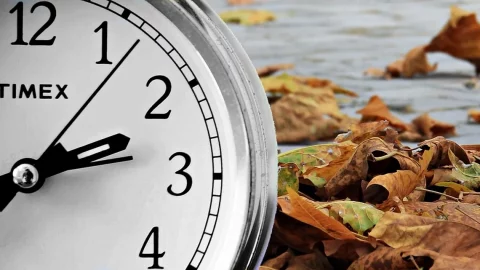
When does solar time return? In the night between Saturday 28th and Sunday 29th October we will say goodbye to summer time, thus gaining an extra hour of sleep but for five months it will get dark earlier. From Sunday onwards we will therefore return to natural time: there will be an hour more light in the morning, and the sun will set an hour earlier in the evening. Standard time will remain in effect until the last weekend of March 2024: thedaylight savings time will come back in night between Saturday 30th and Sunday 31st March, but shouldn't the time change have been abolished?
Changing the clock: the debate to eliminate the solar clock
But what are the advantages of changing the time? The underlying logic is the reduction of consumption, favoring natural lighting at times of peak consumption. In spring and summer, to make the most of the hours of light during the summer, great advantages are obtained in guaranteeing an extra hour of lighting during the evening. In autumn and winter, on the contrary, it is more advantageous to favor natural morning light. However, for several years some countries have complained of little benefit from the adoption of double time: in particular those in Northern Europe which do not enjoy great benefits in terms of natural lighting. But also in Italy the question is much debated, given that the energy benefits deriving from the time change today would be minimal. Furthermore, with skyrocketing electricity and gas bills, the opportunity to keep summer time all year round would translate into a saving of money. Not to mention the effects that the double change has on sleep and health. There was also one petition and an appeal to the government promoted by Sima, the Italian Society of Environmental Medicine.
Daylight saving time all year round: where are we at?
The proposed abolition was put forward by the European Commission in 2018, then found the approval of the European Parliament in 2019. At first, it was hypothesized to allow each individual Member State as choose between solar and summer time or whether to maintain the change. But this would bring various problems in terms of time zone. At the moment, however, no timetable has been set for the abolition of the time change nor the guidelines that individual European Union states will have to follow.