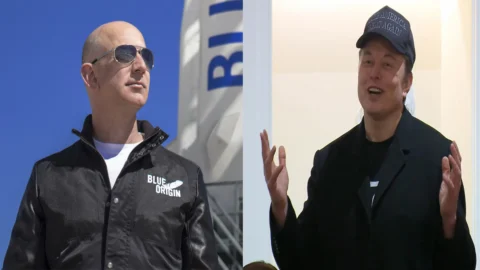
Who would have thought? After years of jibes, billion-dollar challenges, and dreams of space conquest, Jeff Bezos he had to knock on the door of his bitter rival. And Elon Musk, who never backs down from a challenge, or rather, a hefty bill, accepted. And here's the result: 24 Amazon satellites they flew into space aboard a SpaceX Falcon 9 rocket.
And so, while Amazon chases the dream of a constellation all its own, Musk collects the payment… and raises the stakes.
Behind the maneuver there is also a change of climate around Elon Musk. After the break with Donald Trump and the political tensions that followed, including the possibility of found a new personal party, Musk now seems to be looking for new allies. Even on a symbolic level, an alliance with Bezos (always perceived as closer to the liberal and institutional world) can help redefine its positioning.
Because, today more than ever, space is also geopolitics.
Amazon aims for the sky, but it needs those who already live there
The protagonist of the story is the Kuiper project, the constellation of over 3.200 satellites with which Amazon aims to bring fast internet in the most remote places on the planet. An idea launched in 2019, but still struggling. To date, only 78 satellites are actually in orbit. While Starlink – the rival twin created by Musk – is already a reality with approximately 8.000 active satellites e 5 million customers worldwide.
The race, however, is not against Starlink but is against time: by July 2026Amazon will have to have at least 1.600 of them operational. Otherwise will lose his license of the Federal Communications Commission. An unforgiving countdown.
Bezos entrusts his satellites to Musk himself
The launch which took place on the morning of Wednesday 16 July is the third operational mission of the Kuiper Project. But it is also the first to be performed by SpaceX, that is, from the company of the direct competitor. A choice that until a few months ago it seemed unthinkable, but which today is the result of a forced strategy.
At the beginning, Amazon had excluded SpaceX from launch contracts, focusing everything on Blue Origin (Bezos's own space company), Arianespace, and United Launch Alliance. But between unfinished rockets, chronic delays, and legal pressure from shareholders, in the end Bezos had to backtrack. And sign a contract at least three throws right with Elon Musk.
Musk-Bezos: a "paid" alliance
It's not love, it's business.Amazon pay SpaceX to use his rockets. Musk, for his part, cashes in and raises the stakes. For now, the two haven't shaken hands; they've only exchanged contact information and invoices.
After all, the Falcon 9 rocket is today the most reliable vehicle in the world to put satellites into orbit. And ignoring it on principle would have been commercial suicide. According to analysts, Bezos will spend this year $150 million per launch and over 1,1 billion for satellite production only by 2025.
Overall, Project Kuiper could cost up to 23 billion dollarsA titanic, but potentially profitable investment: the satellite internet market is destined to exceed 40 billion by 2030, and if Amazon could grab even just 30%, it could generate over 7 billion a year.
Blue Origin? Still on the bench
And Blue Origin? Bezos's personal space company, supposedly created for projects just like this, it's still far from the playing field. Its heavy rocket, the New glenn, has only performed one launch and has yet to demonstrate the ability to carry Kuiper satellites continuously. This delay weighs, even politically, on the Amazon founder's ambitions.
So, while his rocket remains on standby, Bezos is forced to buy passes from the fleet of the man he once called “a Tony Star wannabe” with a cult of chaos.