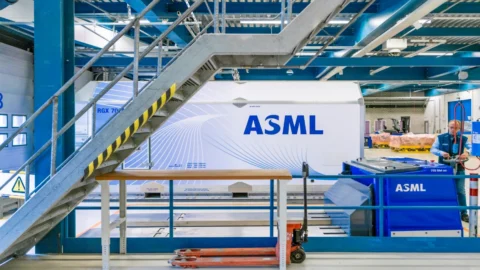
There is also a Europe that is a protagonist in the frantic race towards artificial intelligence, and it has its own hub in the Netherlands. While tech giants invest in data centers and seek ever more powerful semiconductors, ASML consolidates its role at the heart of the global chip supply chain. Samsung e Tsmc confirmed plans to adopt its most advanced lithographic machines, alongside Intel, which already uses this technology.
For the Dutch group, only manufacturer in the world of systems for extreme ultraviolet lithography, thus strengthening the commercial prospects of the new generation of equipment. And ASML also responds to the growing demand on the industrial level, starting near Eindhoven the construction of a hub which will be able to accommodate up to 20.000 workers.
Samsung and TSMC are focusing on $400 million machines.
Technology is at the heart of the producers' commitments High Na Euv, developed to engrave circuits on silicon wafers with even finer details. These devices can cost up to $400 million each and represent a crucial investment for those who want to produce the next generation of semiconductors.
Samsung plans to introduce them in large-scale DRAM memory production by 2028. The agreement with ASML expands an already established collaboration and includes the development of technologies capable of improving production process efficiency. TSMC, on the other hand, aims to use High Na systems in the large-scale production of the most advanced chips by 2030. The Taiwanese group's decision is particularly significant for ASML. The manufacturer, which produces semiconductors for clients such as NVIDIA and Apple and generates approximately 16% of the Dutch company's revenue, had until now maintained a cautious stance, especially regarding the cost of the new machines.
TSMC's membership, along with Samsung's, broadens support for a technology already used by Intel and strengthens ASML's position in the AI-fueled industrial competition.
Larger photomasks to overcome production limitations
The collaboration also concerns another crucial step, which is destined to mature further in time. Asml and its partners are working on the transition from 6-inch photomasks to a new 12-inch format, with the aim of increasing productivity and containing costs. Photomasks contain the circuit designs that the lithography system transfers to the silicon. With current masks, High Na machines face constraints in producing the larger chips required for some of the most complex applications in data centers.
To overcome these limitations, stitching is a technique that involves dividing the design and reassembling it with extreme precision. This process adds complexity to the process. Larger masks would remove these constraints and better utilize the capabilities of new equipment.
According to the technology manager of Asml, Marco Pieters, productivity improvements could reach 40%. The path remains long and requires the development of dedicated technologies and infrastructure. The goal is a pilot line by 2031, followed by full-scale production in 2033.A timetable distinct from that of the adoption of High Na machines by Samsung and TSMC.
A new hub in Eindhoven to support growth
The technological challenge is accompanied by theplant expansion. Asml has work on the Bic North project has started, which will occupy approximately 35 hectares near Eindhoven Airport, seven kilometers from the headquarters and main production sites in Veldhoven. "The growing global demand from the semiconductor industry requires continued investment," said CEO Christophe Fouquet.
The new hub will be able to accommodate up to 20.000 workersThe first phase, scheduled for completion by 2029, will include offices, logistics facilities, and a clean room—the controlled environment needed to produce specialized equipment. The "Flow Factory" model also aims to make the construction and assembly of lithography systems faster and more efficient.
The move reinforces the Netherlands' role in the group's strategy. In 2024, ASML had raised the possibility of locating new production abroad, seeking answers from the authorities regarding permits, traffic conditions, and connections to the electricity grid.
Artificial intelligence fills orders and supports the stock
The expansion is based on already significant demand. In July, ASML had indicated that Almost all EUV production capacity was booked until the end of 2027.
Customers such as TSMC, Samsung, SK Hynix, Micron, and Intel are increasing capacity to meet the computing needs of companies like NVIDIA, OpenAI, Anthropic, Google, and Amazon. ASML is thus benefiting from investments in artificial intelligence through the equipment needed to manufacture advanced processors and memories.
Asml's rise is also evident on the stock market, with the stock up 126% in the last twelve months.