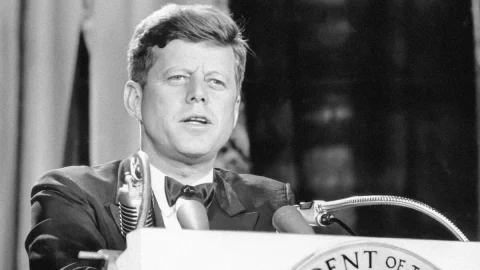
Le elezioni prezidenziali of the United States in 1960 were the 44th quadrennial presidential election and were held on Tuesday 8 November. In a hotly contested election, John Fitzgerald Kennedy, young Democratic senator from Massachusetts, won the presidential elections and became the 35th president of the United States. Kennedy, defeated the incumbent vice president, the Republican Richard Nixon, With one of narrower margins of the history of US elections.
His victory was determined by a number of factors, including his young age and charisma, his promise of a new beginning for America, and his support from young people and minorities.
The presidential elections of November 8
The 1960 election was the first election in which 50 states participated, marking the first participation by Alaska and Hawaii, and the last in which the District of Columbia did not participate. The threshold for victory was 269 electoral votes. It was the first election in which a sitting president – in this case Dwight D. Eisenhower – was ineligible to run for a third term due to term limits established by the 22nd Amendment.
Election day Richard Nixon watched the results from the Ambassador Hotel in Los Angeles, while JOhn Kennedy followed them from the Kennedy Compound in Hyannis Port, Massachusetts.
At first, Kennedy took a strong lead in popular and electoral votes as results came in from large urban centers in the Northeast and Midwest. That changed as results came in from rural and suburban areas of the Midwest, the Rocky Mountains and the Pacific Coast, and Nixon began to close the gap. Kennedy managed to win in many large cities and triumph in several areas, but lost some Southern cities. The outcome of the elections in states such as California and Hawaii where there were recounts was also in the balance. Nixon, however, was defeated, officially admitting defeat only the following day.
0,17%: Kennedy's margin over Nixon
Kennedy he won the election with 303 votes versus Nixon's 219. In the popular vote, Kennedy achieved a slim margin of 112.827 votes, corresponding to 0,17%, obtaining 49,72% of the votes, against Nixon's 49,55%. Fourteen unpledged electors from Mississippi and Alabama voted for the senator Harry F. Byrd, as did a faithless voter from Oklahoma.
Kennedy's popular vote margin was second closest in presidential history, surpassed only by the 0,11% margin of the 1880 election and was the lowest ever achieved by a Democratic candidate. The popular vote was so close that a shift of 18.858 votes in Illinois and Missouri, both of which Kennedy won by less than 1 percent, would have left both Kennedy and Nixon short of the 269 electoral votes required to win, thus forcing a contingent election in the House of Representatives .
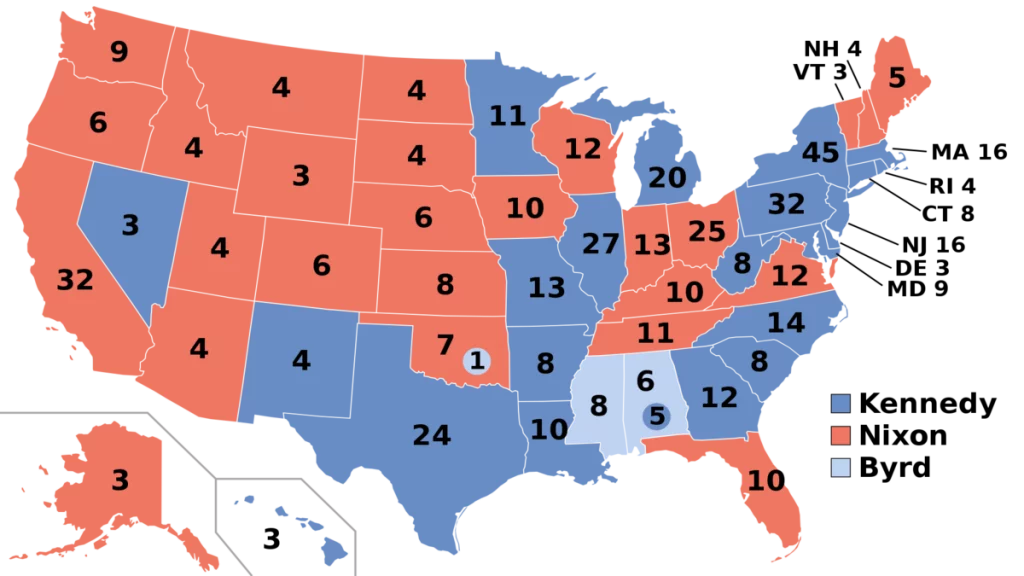
Kennedy nevertheless managed to win the very heated competition against Nixon, becoming the youngest president elected at 43 (only Theodore Roosevelt was younger, but he became president taking over from William McKinley after the latter's assassination). But his victory was historic also because it marked the first democratic victory after 12 years and above all led to the election of first Catholic president in the history of the United States.
The election campaign
The 1960 election campaign is also remembered as one of the most intense and competitive in American history.
Kennedy had won the Democratic primary pitting himself against figures such as Hubert Humphrey, Lyndon B. Johnson and Adlai Stevenson. After emerging victorious in important key states, he was officially nominated for president on 13 July 1960. For the Republicans the choice instead fell on Richard Nixon, vice-president of the outgoing Dwight D. Eisenhower.
The electoral battle against Nixon took place on three main issues:
- Religion: As Kennedy was the first Catholic presidential candidate, he had to overcome concerns about anti-Catholicism among some Americans, which Nixon and his supporters exploited.
- Cold War: As the Cold War took hold, Kennedy promised to meet the Soviet threat with firmness and diplomacy.
- Civil Rights: The civil rights movement was growing in the 50s and 60s, and Kennedy pledged to support the movement
The first television debate
The 1960 election campaign was also marked by one of the best-known shows in the history of political communication. The September 26th Kennedy and Nixon, in fact, challenged each other in first televised debate between presidential candidates in the United States.
The 1960 televised debate between Kennedy and Nixon marked a turning point in American presidential campaigns and political communication in general. It highlighted the power of television to shape public opinion more impactfully than radio, changing the way election campaigns are organized and managed in the United States.
That evening he demonstrated thecrucial importance of preparation for aspiring leaders on television, including image care, mastery of movements, body posture and facial expression. Kennedy surpassed Nixon in each of these categories, presenting himself as a well-prepared and charismatic candidate.
Kennedy was smiling, tanned and maintained eye contact with the camera lens, appearing casual and appearing to communicate directly with viewers. In contrast, Nixon looked pale, exhausted and distressed, avoiding the camera's gaze. Unlike the election results which saw him win by a small margin, in this case the challenge was clearly won by Kennedy.
The beginning of Kennedy's presidency
The Kennedy presidency began on January 20, 1961, when he was officially sworn in as president of the United States. During his term he initiated a series of important changes, including the launch of the Apollo space program, the signing of the Geneva Treaties on the denuclearization of Europe, and his commitment to civil rights. Kennedy remained in office until his assassination on November 22, 1963.