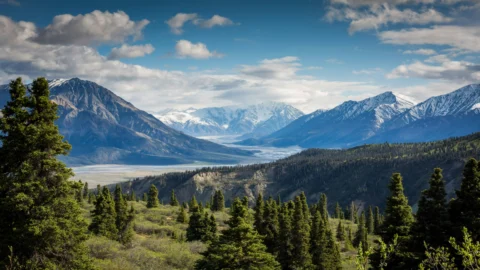
It was the August 16, 1896. In the remote Yukon Territory (in present-day Western Canada), three men, George Carmack, Skookum Jim Mason and Tagish Charlie they were going up Rabbit Creek, a tributary of the Klondike. They were looking for salmon, they found nuggetsA handful of gold in the sieve, and the frozen silence of the North exploded in news destined to inflame the world. That torrent was renamed Bonanza Creek, and never was a name more appropriate. It was the beginning of the legendary Yukon Gold Rush.
La news spread quickly between the mining camps, but it took nearly a year to cross the border into the United States. In July 1897, two ships, theExcelsior in San Francisco and the Portland At Seattle, they docked with their holds full of gold.
The “yellow fever” that set the North on fire
La Klondike Gold Rush attracted over 100.000 adventurers from the United States, Europe and even Australia. Solo 30-40.000 Some people, however, managed to reach the Yukon, braving grueling journeys through ice, passes, and storms. The others got lost along the way, overwhelmed by storms and shattered dreams.
The most legendary passage was the Chilkoot Pass: a staircase of 1.500 steps carved into the ice, to be climbed over and over again with total loads of up to a ton of food and tools. And precisely for a matter of survival, the lCanadian law He imposed on every prospector a year's supply, to avoid famine.
In 1898, Dawson City exploded From a village of 500 souls to a bustling city of 30.000. But those who arrived late found all the best veins already claimed. And yet, the race continued. The hope of a nugget It was too tempting and was enough to push men and women to brave the Arctic winter.
Dawson City: Gold, Vice, and Madness in the Ice-Cold Wild West
Dawson became an extreme city. I 24-hour saloons, $5.000 poker games (of then), champagne for $60 the bottle, and floors that could literally be swept to recover the fallen gold dust.
La gold fever He made fortunes quickly and went bankrupt just as quickly. Alex McDonald, the “King of the Klondike”, died in poverty. Swiftwater Bill He spent fortunes on eggs just out of spite. Luxury coexisted with winter famines, scurvy, and insane prices; an egg could cost as much as a day's wages.
From the Klondike to Scrooge McDuck
The Yukon epic he left adeep imprint on popular culture. Jack London he drew from it The Call of the Wild e White Fang. Charlie Chaplin he made it the silent masterpiece The gold rush. In Disney comics, Scrooge McDuck built his first nest egg there., armed with sieve and determination.
Today Dawson City it is half open-air museum, half living city, while Skagway lives mainly on tourist cruises. The the rest of the Klondike has gone silent again, broken only by modern mining excavators.
Gold today: just one click away
What about gold? More than a century later, remains a safe haven in the marketsIn 1898 an ounce was worth 16 dollars. In 2025 it exceeded 2.895,61 euros per ounce (over $3.000), driven by geopolitical tensions and the demand for financial security. Back then, it was expensive to climb mountains and survive at -50°C; Today just one click is enoughBut no digital transaction will ever match the adrenaline rush of that summer day in 1896, when the water of Bonanza Creek turned gold.