La NATO is moving. A few days after violation of Polish airspace on the part of the Russia, the Alliance launches a new mission – Eastern Sentinel – to secure the eastern flank. With "traditional" military capabilities, such as more jets, but also "elements designed to address the specific challenges associated with the use of drones." Not only that. According to allied diplomatic sources, consideration is underway for the possibility of creating a buffer zone – a sort of small-scale no-fly zones – between Poland and Ukraine. Because if the Russian drones were to return, the idea is to shoot them down before they enter NATO territory.
Ukraine, NATO launches Eastern Sentinel
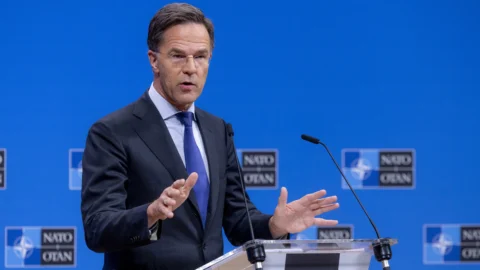
“It is one of the options that are being evaluated,” a source explains toHandle stressing that at the moment there is not yet the necessary consensus: on the one hand because the US has not yet lifted its reservation, on the other because the Polish operation was judged "a success" by US General Alexus Grynkewich. Therefore, at the moment the Secretary General Mark Rutte He outlined the political framework within which the Alliance is operating. "Whether the attack was intentional or not, Russia has violated NATO airspace on an unprecedented scale," Rutte criticized at a press conference. "Therefore, we as NATO must clearly demonstrate our determination and our ability to defend our territory: and this is precisely the purpose of Sentinel East."
The operation promises to be huge. “While our immediate focus is on Poland, this situation transcends the borders of a single nation: what affects one ally affects us all,” Grynkewich said, promising a strengthened deployment. “from the Baltic Sea to the Black Sea to the Mediterranean”. The allies have therefore already begun to announce the deployment of forces and capabilities.
For now, we only know that the operation will be "flexible and agile, guaranteeing a even more targeted deterrence and defense exactly when and where needed" and which will include "further enhanced capabilities, integrate air and ground defenses, and increase information sharing between nations." Moscow, is the message between the lines, should think very carefully about what it does from now on.
La Denmark will contribute with two F-16s and an anti-aircraft frigate, the France with three Rafales and the Germany with four Eurofighters. Also the UK expressed his willingness to provide support.
Trump: "Patience is running out with Putin."
“My patience with Putin is rapidly running out.” After initial reactions marked by ambiguity, Donald Trump seems to be back in line with the Allies' positions on the incursion of Russian drones into Poland. Moreover, the massive violation of NATO airspace came in a context of total stalemate in peace talks, as well as in the wake of the increase in Russian attacks on Ukraine. In short, this is not the time to loosen support for Kiev and, to demonstrate this clearly, several EU government officials have gone to Volodymyr ZelenskyThe National Security Advisors (NSA) of the E4 (Italy, France, Germany and the United Kingdom) also arrived in the Ukrainian capital, where they met with their counterparts from Kiev and with the US Special Envoy for Ukraine, Keith Kellogg.
EU: We will target Russian oil and banks
The High Representative for Foreign Policy, Kaja kallas, announced that the nineteenth package of sanctions will be finalized in the next few days. “We will hit Russian oil, ghost tankers and banks”Kallas anticipated, having discussed measures to reduce Moscow's oil and gas revenues with US Energy Secretary Chris Wright on Thursday evening. In this regard, securing the support of G7 coordination could be crucial for the EU. This will be worked on in the coming days, before the package is submitted to the Permanent Representatives' meeting on Wednesday.
Russia and Belarus flex their muscles
In the meantime, however, Putin's Russia and Lukashenko's Belarus have launched new joint military exercises: new maneuvers that will continue for five days and in which thousands of soldiers are estimated to participate. These exercises—although long-planned—come at a time of great tension.
The Kremlin seems to have found in these maneuvers another opportunity to flex its muscles.According to Minsk forces, they plan to rehearse the "planned use" of Russian tactical nuclear weapons and the new Oreshnik ballistic missiles. No "live-fire exercises" with these weapons, the newspaper assures. Meduza, according to which Russian and Belarusian troops will instead focus "on decision-making procedures related to the movement and potential use of nuclear warheads." But such an announcement certainly does not go unnoticed in international politics, especially given that already in 2023 Putin ordered the deployment of tactical nuclear weapons in Belarus and then promised to deploy on Belarusian territory as well. Oreshnik hypersonic rocketsRussian and Belarusian militaries will train in the Baltic and Barents Seas, in the Russian coastal exclave of Kaliningrad, and in Barysaw, 70 kilometers northeast of Minsk. In other words, not far from NATO's borders.