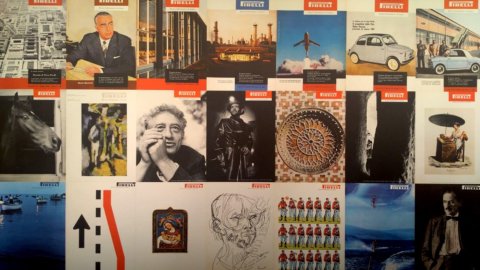
A volume of over 500 pages that collects 24 years of history of the Pirelli Magazine, in the years between 1948 and 1972, i.e. from the post-war reconstruction to the industrial boom that transformed Milan and Italy. The volume, which is no coincidence it's called "Industrial Humanism", was presented in the Lombard capital, at the Parenti Theater, on the initiative of the Pirelli Foundation, in the presence of the CEO Marco Tronchetti Provera: it contains essays, articles, illustrations and covers of the magazine which has gone through very important years in the construction of Italy today, hosting the signatures of giants of the twentieth century.
In fact, the collection of articles proposed by the publication sees the signatures of big names in business, journalism, literature and the intellectual, scientific and academic world, to underline the solid link between the country's industrial development, which the tire company founded in 1872 in Milan has played the absolute protagonist, and the social and cultural one. Among others, the speeches by the lawyer Gianni Agnelli, by prof. Umberto Veronesi, by Giuseppe Ungaretti, Gino Valle, Umberto Saba, Gio Ponti, Salvatore Quasimodo, Alberto Ronchey, Alberto Mondadori, Gillo Dorfles, Umberto Eco, Corrado Augias, Pier Paolo Pasolini. And, of course, of Leopoldo Pirelli, president of the Italian group from 1965 to 1992, as well as his wife Giulia, the writer Giovanni Pirelli (who writes in the family magazine under the pseudonym Franco Fellini), son of Alberto, second son of the founder Giovanni Battista Pirelli and also a contributor to the magazine.
The presentation was the occasion for a debate with Tronchetti Provera, the director of the Pirelli Foundation Antonio Calabrò and the writer Gian Arturo Ferrari, interspersed with some songs that referred to the Milan of the golden years, masterfully interpreted by the eternal Ornella Vanoni, and from the reading of some passages of the selected articles, recited by the actress Anna Ammirati. The quote chosen to open the evening was a hymn to normality, to everyday life, giving an idea of the theme of the book through the words of the Argentine writer Jorge Luis Borges (taken from the poem “The righteous”):
“A man who cultivates his garden, as Voltaire wanted.
Who is happy that there is music on earth.
Who discovers an etymology with pleasure.
Two clerks playing chess in silence in a café in the Sur.
The potter who premeditates a color and a shape.
The typographer who composes this page well, who perhaps he doesn't like.
A woman and a man reading the final tercets of a certain song.
Who strokes a sleeping animal.
Who justifies or wants to justify an evil that has been done to him.
Who is glad Stevenson is on earth.
Who prefers that others are right.
These people, who ignore each other, are saving the world."