In 1271 Marco Polo mentions them in his Milione"sovereign carpets in the world and the most nice” were exported for centuries by Venetian and Genoese merchants to European courts and noble palaces, so much so that they were reproduced in many Renaissance paintings. From these reproductions originates the custom of remembering them with the name of the painters who immortalized them: Holbein, Bellini, Ghirlandaio and Lotto as well as with the name of the cities where they are produced. The wide selection of the exhibition offers thirty specimens of carpets.
The Ushak from the name of the city in western Anatolia where they are produced, characterized by graphic references ranging from sequences of stars, to grids, to floral decorations to the pendants that decorate the central medallions. They are decorations that sometimes recall the elements of Byzantine classicism and iconographic and technical elements of the carpets of Persia and Armenia filtered by the sensitivity of the Ottoman workshops attentive to the iconographic and anaconistic prescription of never depicting the human figure and even more so the divine one.
“A carpet is a painting that aims to depict God".
Each carpet chosen by Mirco Cattai is different from the other while having common characteristics. Each craftsman wove a design without ever seeing it in its entirety until the work was finished. He relied on the experience and imagination that gave originality, harmony and genius to every single product. All the elements that contribute to making this exhibition extremely interesting not only for collectors but for all those interested in the history of carpets and the history of humanity.
The most successful Anatolian “Classic” category, with the largest number of surviving examples, is the so-called “Lotto” named after the Venetian painter Lorenzo Lotto (1480-1556), who represented him twice: in The alms of St. Anthony (1542, Ss. Giovanni e Paolo, Venice) and in the family group (1547, The National Gallery, London). However, he was not the first to represent this type of carpet.
“Lotto” is a repeating motif, featuring golden-yellow interlocking arabesques, usually on a red ground, which probably appeared in the late XNUMXth century. The origin of this design is still an open question: Since the beginning of the 14th century, carpet scholars have described it as being of plant origin (hence the term Teppich mit Rakenmüster). Recent theories (Jon Thompson) account for similarities to carpets shown in 15-XNUMXth century Persian miniatures, which suggest that the “Lotto” pattern derives from the Timurid tradition and was further developed in workshops near the Ottoman court.
The earliest examples, usually large or medium-sized with a kufic edge, are attributed to the urban Ushak workshops; later, at the end of the 1000th century, medium-sized carpets with a number of knots around 1200-XNUMX became very popular. During the 800th century a large number of small format “Lots” with broad borders and coarser texture (XNUMX knots/sqm or less) were produced in different centers of western Anatolia, mainly for export. The pattern remained fairly unchanged until the early 18th century when it was abandoned.
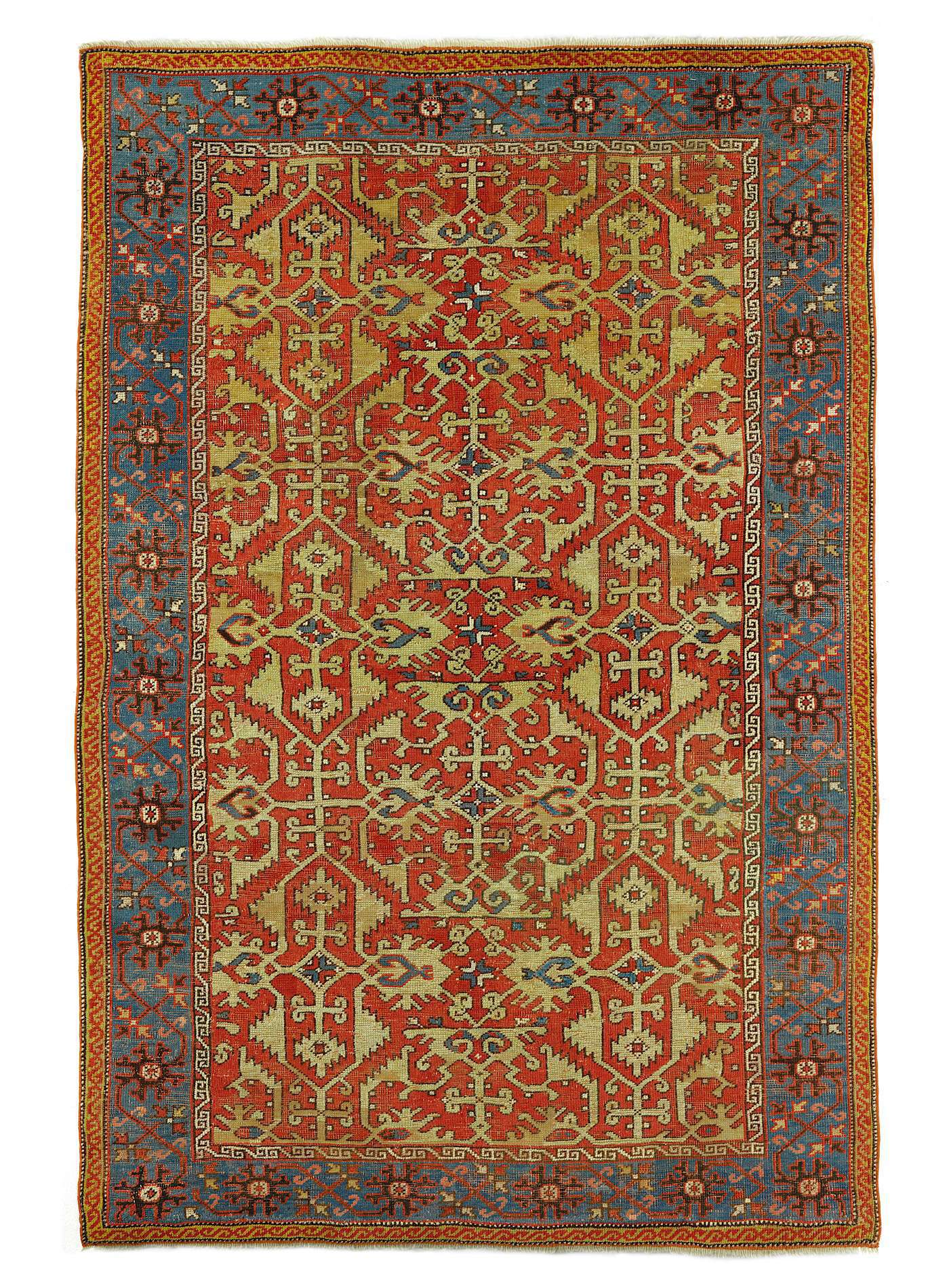
This lot (image below) is probably the oldest; by virtue of its proportions and fine design it can be assigned to the early XNUMXth century. The yellow arabesques on the red clay, outlined in black, show the stepped elements typical of the "Kilim" style. Occasionally there are small blue or white motifs, which enliven the composition. The field has two columns of three cruciform elements, a compositional pattern that is seen in some other examples, such as Ballard's "Lotto" in the Saint Louis Museum of Art (Denny 2016, pp. 80-81).
The border of the rose window and the meander, flanked by the smaller edges of the “S” chain, is typical of the “Lotto” carpets, but can also be seen in the Selendi carpets (Ionescu 2007, Cat. 67). The border here is particularly elegant due to the rare, if not unique, medium blue ground colour. A Lotto carpet with a similar rosette border is depicted in Lady Margaret Douglas, Countess of Lennox of 1572, (English school). The vertical edges are slightly off-balance and there is no corner solution, which is not unusual for Anatolian rugs, which have been woven from memory rather than a full cartoon.
Historical notes:
Saxon Lutheran churches, parish warehouses in Transylvania and Roman museums still hold some 400 carpets (including large fragments) dating from the early XNUMXth and XNUMXth centuries. They constitute the richest and best-preserved corpus of small-format carpets from the Ottoman period outside Turkey, as well as a fully representative cross-section of Anatolian carpet production intended for export. At that time the textile art, under the patronage of the Ottoman dynasty, was at its peak.
However, trade was the means by which the people of Transylvania came into contact with the abundant Turkish production: carpets and kilims but also kaftans, silks or other fabrics. The extent of this trade can be estimated from the cited vigesimal register of 1503, which states that over 500 carpets entered the city of Braşov (as final destination or transit point) during one year! South and north of the Danube, the Balkan regions and the Romanian principalities were also crossed by this trade and oriental carpets were also highly appreciated there. However, nothing comparable to the Transylvanian "miracle" occurred in any of those areas.
In the 500th century, with the advent of the Reformation, which celebrated its XNUMXth anniversary in Transylvania, the number of figurative images inside churches drastically reduced as people seriously followed the ten commandments: “You must not make yourself a carved image . .., you will not bow to them or serve them … ”The frescoes in the former Catholic churches were whitewashed or destroyed and the newly converted parishioners thus perceived the church as a large, cold and empty space that needed heating up. In this situation Anatolian carpets, a symbol of prestige and wealth, were used to adorn the walls of the church, to cover the pews or donated in memory. They entered the property of the Reformed Churches, mainly as pious donations from parishioners, benefactors or guilds. The parishes have never bought carpets and there is no record of traders making such donations to the church. These fabrics, in the spirit of the Sunni Islam of the Ottoman Turks, with delicate colors and patterns showing floral, geometric or calligraphic motifs (and never animals or human beings like the Persian carpets woven by the Shiites), have become suitable and decent decoration, compatible with the rigors of the Lutheran church. This is a unique and quite surprising phenomenon in Europe considering that the Ottoman Empire heavily dominated the region at the time.
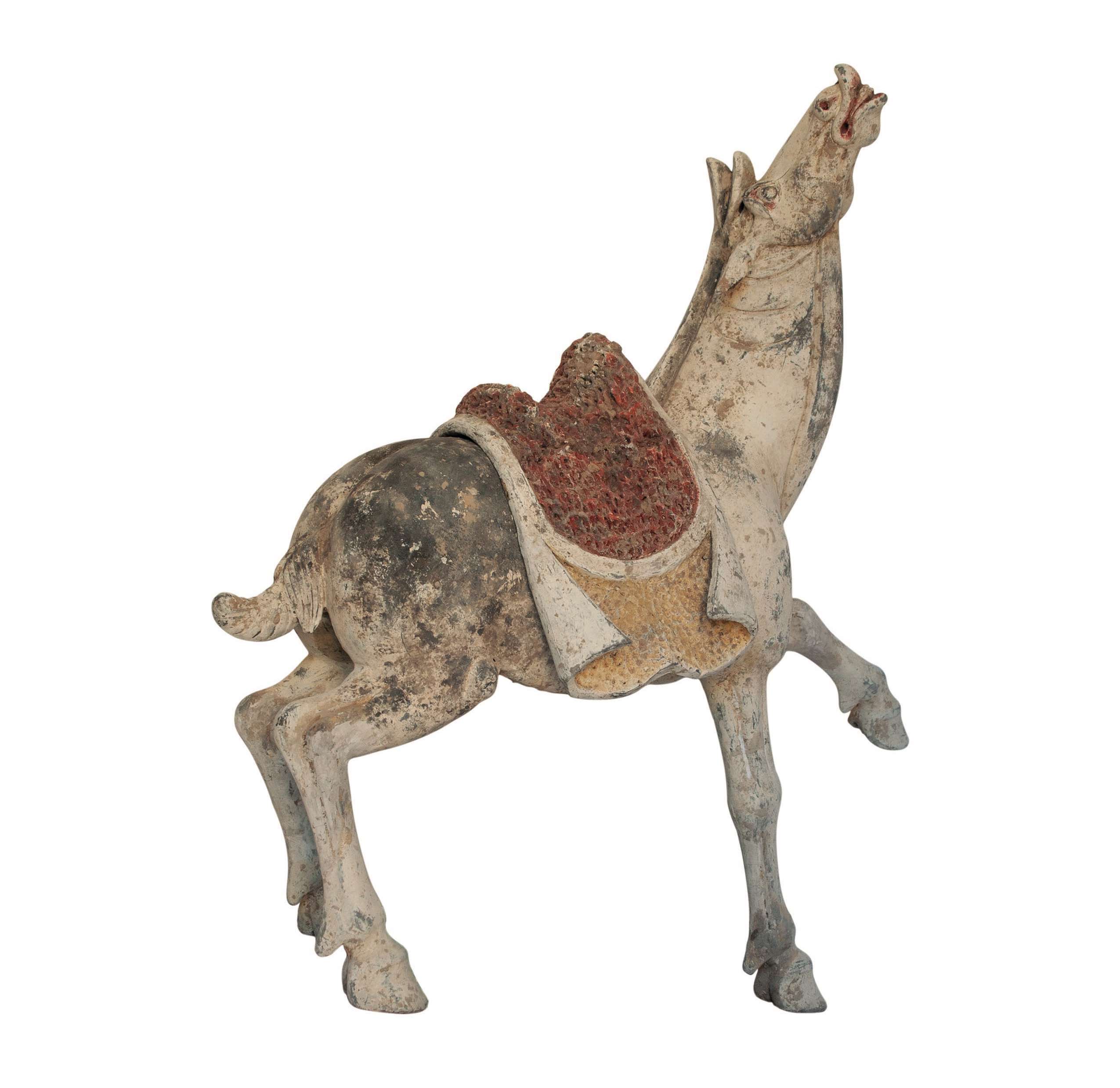
The Florentine exhibition will be completed by a series of Chinese sculptures from the Han and Tang dynasty including Central China Horse Shaanxi – Tang Dynasty (618-907 AD) – Gray terracotta with polychromy on white slip – dimensions cm. 58×58
The horse with the left leg raised is well modeled, the cropped mane leaves the neck free and enhances its twist, the tail is knotted according to the taste of the time and the movable saddle covered with a tawny fur is placed on a yellow cap with the corners folded on each side to underline the dynamism of the sculpture. The long powerful neck completely raised is turned to the right, while the head turned upwards has the mouth open, the large and protruding eyes and the ears stretched out.
The plasticity of this horse demonstrates the high refinement and skill of the artists of the time in modeling steeds with a marked realistic sense, typical of the Tang period, emphasizing the dynamism and gestures of the animal. The Arcadia thermoluminescence test certifies the declared age.