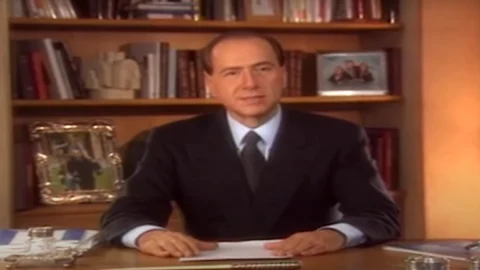
"Italy is the country I love”. With these words, 30 years ago, on January 26, 1994, Silvio Berlusconi announced his entry into politics. The "descent into the field” of the Cavaliere, already a protagonist in the business world and in the media scene with his Fininvest empire, occurred through a television message pre-recorded, nine minutes long, broadcast on all national television networks. The announcement marked the beginning of a rapid and unprecedented rise in politics for the former entrepreneur who renounced all social positions to run, culminating with the victory in the political elections of March 1994.
Its electoral rise was a unique phenomenon, with some analysts initially considering his entry into politics to be late, but later having to recognize his ability to shape and direct public opinion. Silvio Berlusconi, the businessman turned political leader, had officially taken command of his new venture in Italian politics.
Debatable or not, Berlusconi's entry into politics changed Italian politics and gave rise to the so-called “Second Republic”. He was an undisputed protagonist of the last thirty years of Italian history until his death last June.
The first steps and the doubts of the allies
Berlusconi, in reality, had been working on this step since the summer of 1992 and its possibility had become part of the political debate since July 1993. His first real political step began in November 93, when he announced, surprising all of Italy , his support for the candidacy of Gianfranco Fini as mayor of Rome.
On the ruins of Tangentopoli, which had left an unprecedented political void, Berlusconi, meanwhile, began to build his centre-right party: Forza Italy.
Berlusconi's choice to enter politics was not without uncertainties and fears, mainly linked to the possible accusations of conflict of interest that he could face. In reality, the real push for Berlusconi to enter politics was the aim of saving his companies and his media empire which had many problems. On his descent into the field there were divisions even within the narrow circle of the Knight. A group, called “doves” and led by Fedele Confalonieri and Gianni Letta, with the support of Maurizio Costanzo, Indro Montanelli and Federico Orlando, believed that the choice to enter politics was an unfortunate one. A second group, known as “hawks” and composed of Marcello Dell'Utri, Ennio Doris and Cesare Previti, instead supported the need for Berlusconi's direct political involvement. Others, such as Paolo Berlusconi and Adriano Galliani, maintained a neutral position. Berlusconi himself remained uncertain for a long time about what to do. A decision that was definitively resolved with his speech.
Victory in the 1994 elections
Just two months after "taking to the field", at leader of the new party, Berlusconi won the political elections of 27 and 28 March, after a tight electoral campaign. Historic it was clash on TV with Achille Occhetto, then secretary of the PDS, in a face-to-face meeting on TV hosted by a young Enrico Mentana. The first Berlusconi government, however, was short: in December of the same year, Umberto Bossi's Northern League (ally of the prime minister) went into opposition, presenting a motion of no confidence. On 22 December 1994, Berlusconi resigned by going up to the Quirinale and handing his resignation to President Oscar Luigi Scalfaro.
Successive Berlusconi governments
After the first experience, Berlusconi has led three other governments: Berlusconi II (2001-2005), the longest in Italian republican history, which began with the signing of the famous "Contract with the Italians" on TV; Berlusconi III (2005-2006); and Berlusconi IV, which began in May 2008 and ended in November 2011, amid the great sovereign debt crisis that brought the Italian spread to a historic level of 585 basis points and Italy to the brink of default. Before entering Parliament, Berlusconi was overwhelmed by the financial markets which had no faith in him.
“I don't want to live in an illiberal country”
Below is a extract of the message by Berlusconi in 1994:
“Italy is the country I love. Here I have my roots, my hopes, my horizons. Here I learned my job as an entrepreneur from my father and from life. Here I learned the passion for freedom. I chose to take the field and to take care of public affairs because I don't want to live in an illiberal country, governed by immature forces and by men closely linked to a politically and economically bankrupt past. In order to make this new life choice, I resigned from all corporate positions today in the group I founded. I therefore renounce my role as publisher and entrepreneur to put my experience and all my commitment at the disposal of a battle in which I believe with absolute conviction and with the greatest firmness. I know what I don't want and, together with the many Italians who have given me their trust over all these years, I also know what I want. And I also have the reasonable hope of being able to achieve it, in sincere and loyal alliance with all the liberal and democratic forces who feel the civil duty to offer the country a credible alternative to the government of the left and the communists".