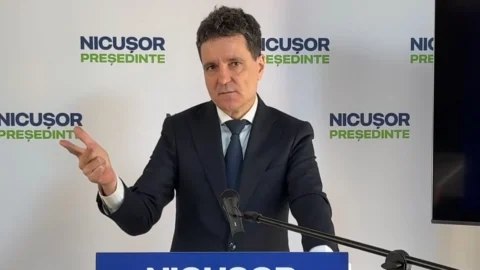
Romania has chosen Europe. With a final reversal and in clear contrast to the trend compared to the first round, Mayor of Bucharest Nicusor Dan ha won the presidential election runoff, clearly defeating George Simion, leader of the ultranationalist party AUR and a leading figure of the European far right. A turning point that could mark a turning point in the balance of power within the European Union: Romania goes from being almost “pro-Russian” and Eurosceptic to being remembered as the site of the first hard blow to the sovereignists in Europe.
The data is almost definitive: with 98% of the ballots counted, Dan got 54,3% of the votes against 45,6% of his opponent. A clear result, matured in two weeks where the pro-European electorate has united around the civic, centrist and liberal candidate, a former mathematician and current mayor of the capital.
In Bucharest, mthousands of people took to the streets in the night to celebrate with Romanian and European flags. Dan joined the supporters: “This is your victory. Our society has shown that it wants dialogue, not hatred,” he said, adding that “difficult economic times are coming,” but that the country has chosen a European, transparent and reformist future.
From the chaos of the first round to the record vote of the diaspora
Le Romanian presidential elections took place in a tense climate since last December, when the Constitutional Court annulled the first round due to alleged Russian interference in favor of the pro-Russian candidate Calin Georgescu. His exclusion from the electoral competition was denounced by Simion as a “coup d’état”. The sovereignist leader, also supported by some forces of the Italian and European right – including Giorgia Meloni and Matteo Salvini – has built his campaign on the opposition to Brussels, Macron and the European elites, presenting themselves as the standard-bearer of the return to national sovereignty.
But in the second round, despite having started from a clear advantage (over 40% in the first round against Dan's 20,9%), Simion saw his consensus crumble. The fundamental thing was the diaspora vote: over 1,6 million Romanians living abroad participated, the highest level ever in the history of democratic Romania. Traditionally closer to reformist and pro-European candidates, they gave a decisive contribution to Dan's victory.
Who is Nicusor Dan, the new president of Romania?
Nicosor Dan, 55 years old, is therefore the new president of Romania. Mathematician by training, with studies in Bucharest and Paris, is known for his integrity and for a long career as a civic activist even before becoming a politician. It was he, with his movement “Salvați Bucureștiul”, who brought to light numerous urban planning abuses in the capital, before entering national politics.
Elected Mayor of Bucharest in 2020 e reconfirmed in 2024, Dan led a difficult but effective effort of financial recovery and urban modernization. He focused on administrative transparency, digitalization of services and improvement of public infrastructure, earning a reputation as a competent and pragmatic administrator.
His election message has revolved around three-pillar: Europeanism, legality and responsibility. And it is also on this ground that he won. It is no coincidence that among the first phone calls received after the victory, there was that of the French president Emmanuel Macron, who congratulated him, underlining “the importance of Romania's stability and European commitment at a crucial moment for the Union”.
Brussels breathes, the radical right feels the blow
The result was greeted with applause.relief from the European institutions. “The Romanian people have chosen democracy, the rule of law and the European Union,” he wrote on X Macron.
"Romania is back“, rejoiced the Romanian MEP of the EPP Siegfried Muresan. A clear political reading also came from Renew Europe: "Giorgia Meloni and the far right have lost", declared Sandro Gozi.
The Romanian vote was seen as a test bed for the stability of the pro-European front in a Europe crossed by sovereignist pressures. Simion's defeat, in the face of ahigh turnout (64,7%, a record since 2000), seems to indicate that the pro-European message, despite being under pressure, maintains a strong rooting in the electorate.
The European “Super Sunday”: Poland and Portugal also vote
Not only Romania: it was a real electoral “Super Sunday” for Europe, with Poland and Portugal also vote.
In Poland, the pro-European will go to the presidential runoff Trzaskowski (31,2%) and the conservative Nawrocki (29,7%), with the ultra-right still at 15%.
In Portugal, the Democratic Alliance (centre-right) won the early elections with 32,7%, followed by Socialists (23,4%) and Enough (22,6%), the far right is on the rise. But no one has a majority: the prime minister Montenegro excludes alliances with Chega and the issue of governability remains.
Three countries, three different scenarios, but a common theme: the comparison between two visions of EuropeIn Romania, the one that looks to Brussels, not to Moscow, has prevailed.