Nor was he tender with the leaders of the Christian Democrats who took him to court and imprisoned him for defamation. Gaureschi's disposition has its roots only in the Lower Padania where he was born and educated.
Given these premises, not so exaltedly literary, it may seem strange and almost unbelievable to be told that one of the best known Italian writers on a global level, and for a certain period the best known overall, was Giovanni Guareschi. Few would believe it. With so many more prestigious and authoritative names filling the pages of post-war literary histories, do you think it was he who excelled in the book rankings? And instead it was just like this: with his Don Camillo he was for decades one of the most loved faces of our "literature", even if a large part of the credit goes to the film adaptations with the unforgettable Fernandel and Gino Cervi.
A global success…
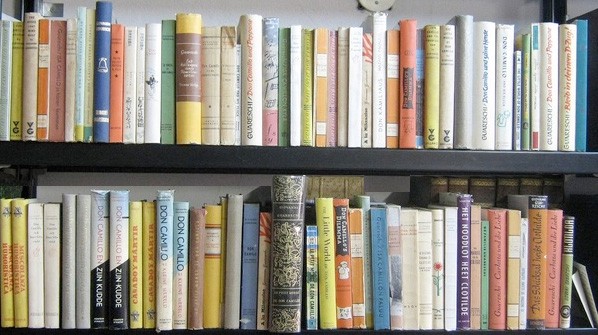
The first volume of the series, Don Camillo, it came out in March 1948 and was immediately a resounding success, one of the greatest that was given to see not only in those years, but also in the previous publishing history of the country. In a few months, reprint after reprint, 300.000 copies were sold out, leaving all the experts on the subject speechless, as well as the literary critics, who didn't know how to review a book with such unusual characteristics.
Then translated into over 20 languages, in two years it reached one million copies in France and America, half a million in Germany, 200.000 in England, Spain, Holland, as well as an infinite number of reprints in the rest of the world, which according to some would by Guareschi if not the most translated Italian writer ever, certainly one of the first. Or so.
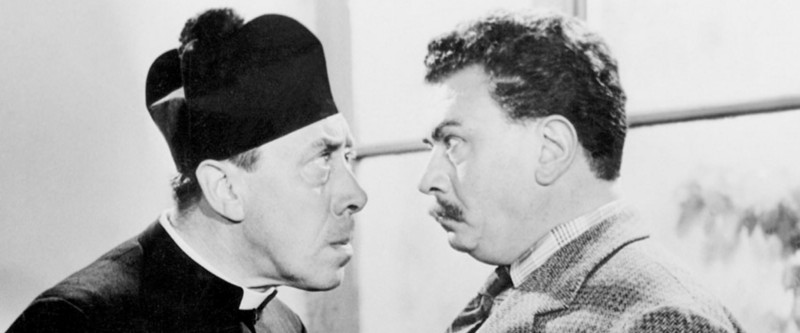
With the cinematic adaptations of his films, the diffusion of Guareschi's works went far beyond the phenomenon of the literary bestseller to become a true forerunner of the blockbuster.
…which repeated itself for a long time
Five years later, sales of the first volume had not yet stopped before the second came out, and the scenario already seen was repeated even more quickly.
"The fever grew with the release of the films that prompted millions of readers all over the world to buy Guareschi's books," said Gualazzini, a biographer of the famous writer. Even in the most remote countries, for many years that of Guareschi was the best known and most loved face of Italy. Even courses were held in universities and conferences between scholars and experts to explain a phenomenon that was rarely seen.
And that success did not end with the author's death in 1968 at the age of 60, but continued for a long time, albeit in a reduced form. In the early 20s, their children Carlotta and Alberto claimed to have sold over 2 million copies worldwide, of which 3–XNUMX in Italy alone. And they admitted that they were “default figures”. Today the sum of books sold is even higher, for a group that is difficult to quantify, but in the order of millions more worldwide.
In our times it is not uncommon to see Guareschi's works on the shelves of bookshops. And it is even more frequent to watch television again with the umpteenth revival of films based on his books and interpreted by the extremely popular, unforgettable and beloved pair of actors. With them we can witness cross-sections of that "small world" (this is the real title of the books, of which "Don Camillo" is the subtitle) which has now disappeared for decades, but which continues to exert a mysterious charm combined with a deep nostalgia, especially for older viewers.
The life
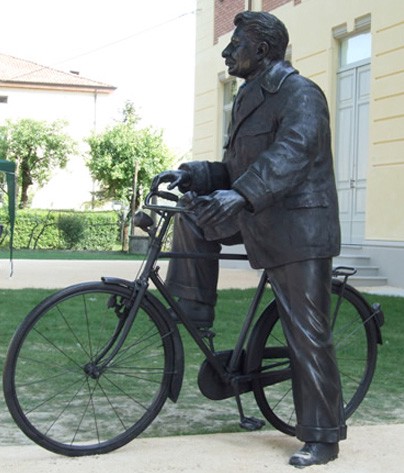
But who was the author?
Giovanni Guareschi was born in 1908 in a small village near Parma, Roccabianca, the son of a merchant and an elementary school teacher. As soon as he finished his high school studies he starts working to contribute to the family budget, put to the test by his father's financial collapse.
In 1931 he joined the "Gazzetta di Parma", first as a proofreader and then as a reporter. Cesare Zavattini calls him there, whom Guareschi had had the opportunity to meet in the high school he attended, where Zavattini, six years his senior, was a substitute teacher.
And it is always Zavattini, at the time the famous author of We talk a lot about me , a book that had an editorial history that sooner or later we will tell you about, which in 1936 offered him to collaborate on the "Bertoldo", a humorous periodical, one of the few together with the "Marc'Aurelio", tolerated by the censorship of the regime.
Zavattini has a long eye, it is known. He knows how to see in advance what readers like, in which direction people's tastes are going, and he knows how to identify quality and where it is hiding with great acumen. So Guareschi accepts the ex-substitute's invitation, leaves the provincial newspapers in which he cut his teeth, and enters the "Bertoldo". He will also occasionally collaborate with national newspapers such as "La Stampa" and "Il Corriere della Sera", with some articles, which at the moment, however, do not leave much trace of their author.
The entrance to the "Bertoldo"
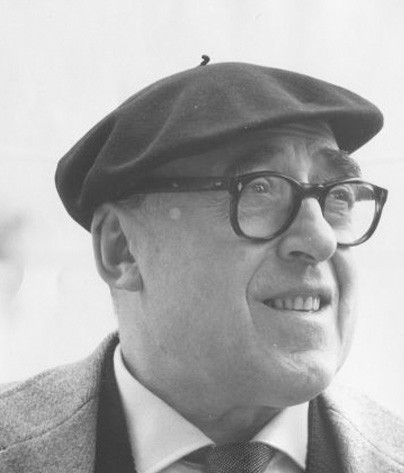
Al "Bertoldo", created to compete with the other satirical masthead of the period, "Il Marc'Aurelio", remained until it closed in 1943. Thanks also to his contribution, the magazine, which became a weekly, had an extraordinary circulation, which at its best it reaches 500–600.000 copies per issue.
The outbreak of the world war obviously takes away space from the humorous periodical: in wartime there is little to laugh about! Then following the bombings of 1943 the magazine had to close and Guareschi left for the front as an officer in the Italian army.
After 8 September, not wanting to renounce the oath of loyalty to the sovereign to join the Republic of Salò, he was arrested, like many other fellow soldiers, and taken to German concentration camps. He spends two years of very harsh imprisonment, which undermine his physique, when he returns he will weigh only 40 kilos, compromise his character and comic vein, but not so much as to completely exhaust him, as it might have seemed logical.
The return after the war
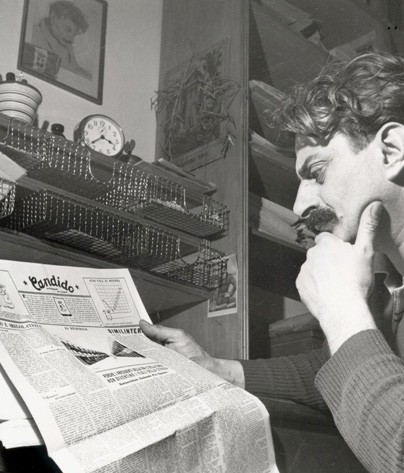
Returning to his homeland after the war, he founded with Giovanni Mosca, another author of moderate publishing success, and Giacinto Mondaini, the father of the future national-popular soubrette Sandra, the weekly "Candido", another satirical magazine characterized politically on the right. The publisher is the same as the "Bertoldo", Angelo Rizzoli, the same where his books and his films will later be released.
Guareschi participates in the new adventure with dedication and enthusiasm, first as deputy director, then from 1950 to 1957 as director. Some of the most prestigious names in journalism collaborate with him, including Indro Montanelli, Leo Longanesi, Oreste Del Buono, Carletto Manzoni, Walter Molino, Nino Nutrizio and others.
Political commitment
The monarchy-republic referendum of 1946 sees him fight on the front line and with great determination for the permanence of the Savoys, he who is of monarchist ideas. The subsequent elections of 1948 were a further occasion for political commitment, this time on the side of the DC against the social-communist Popular Front. In this bitter electoral competition Guareschi coined some of the slogans that later became famous, such as "In the secrecy of the voting booth God sees you, Stalin does not".
Don Camillo is born
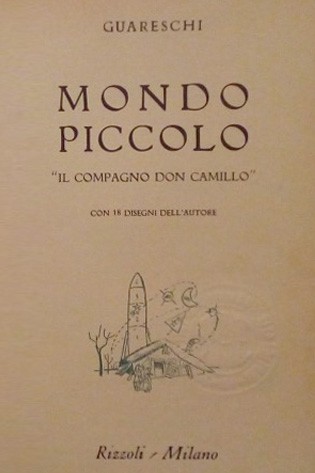
It is precisely from the columns of the "Candido" that the first story of the "Mondo Piccolo" saga came out in 1946, in which the figure of Don Camillo appears. In all there will be almost 350 stories of the famous parish priest who appeared in the magazine, later selected and merged into the volumes of the prior in constant struggle with the communist mayor.
Overall, the volumes derived from his stories will be 8, the first three, Don Camillo in 1948, Don Camillo and his flock and in 1953 Comrade Don Camillo in 1963, released while Guareschi was alive. The others after his death.
The release of the first book makes the writer a character of absolute popularity. However, he does not rest on his laurels, he does not flatten on the success finally achieved, he does not spare himself in the political struggle, nor does he tone down his polemic. He denounces DC's political line several times, accusing it of abandoning the ideals for which it was born, and continues to point the finger at those he believes have damaged the country.
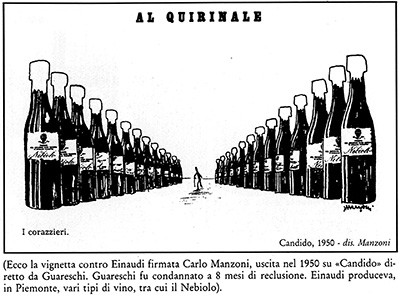
In 1950 he was accused of contempt of the President of the Republic Luigi Einaudi and was sentenced to 8 months, but having a clean record he avoided prison. He had published a cartoon drawn by Carletto Manzoni, in which the head of state reviewed two rows of wine bottles, as if they were cuirassiers.
Four years later, in January 1954, he "slips" on the "De Gasperi" affair. That is, he publishes two letters, considering them absolutely original, in which De Gasperi in 1944 allegedly invited the Anglo-Americans to bomb the suburbs of Rome to inflict a harsh lesson on the Nazi-fascist component of the country.
De Gasperi, until a few months before the head of the government, reacts immediately to this provocation, an absolute falsehood that he would never have even remotely thought of implementing, and denounces Guareschi for defamation.
The gallery
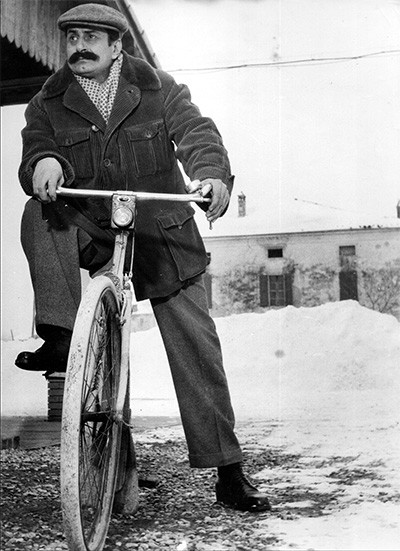
Guareschi will die relatively young, at 60, due to a heart attack. Imprisonment and subsequent judicial misadventures had weakened the writer's heart.
A process follows during which a graphic expertise on those famous letters is also requested, to verify their authenticity. It will not be carried out, considering it superfluous, given the blatant groundlessness of the accusation, and the trial ends with implications that leave some gray areas.
Guareschi is found guilty of defamation and is sentenced to one year in prison, to which are added the other eight months of the previous sentence, which at this point becomes enforceable. In the end, six months will be pardoned for good behavior, but in all he gets one year and two months in prison.
He does not appeal and will never ask for pardon, an event that would have allowed him to avoid imprisonment. But he, as a man of honor which he surely is, will say that if he is wrong in his accusations, it is right that he pays, thus showing a moral temper that today seems like the faded memory of an era that is hopelessly dead and buried.
Once his sentence has been served, Guareschi resumes his activity as a journalist and writer, continuing his battles. However, health problems, especially of the heart, lead him to reduce his exposure, especially from 1961 onwards when the "Candido" closes and suffers a heart attack. And of a heart attack he died seven years later, in 1968 at the age of 60.
The Fortune of Don Camillo
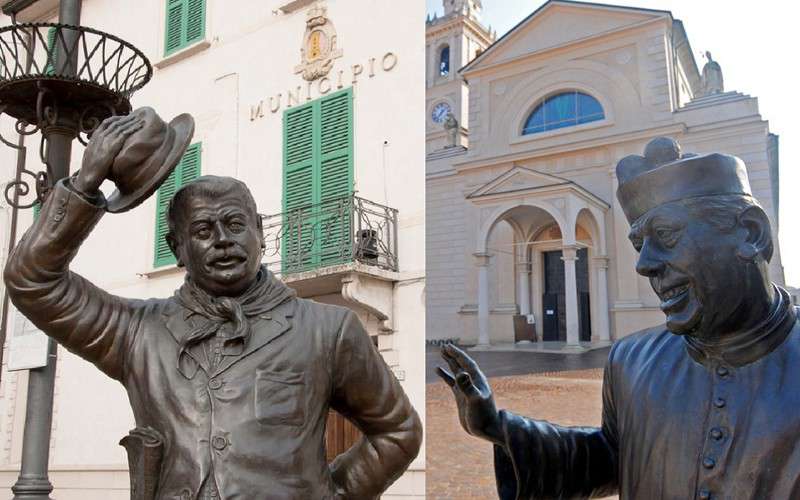
In the meantime, the fame of his books and above all the film adaptations with Gino Cervi and Fernandel, five in all, continue to establish him as one of the most popular figures in the country. Criticism and the world of intellectuals snubbed him, partly because of right-wing political positions, which he always supported with irreducible firmness and never denied, in a period in which the left-wing cultural matrix was clearly prevalent in the country; partly for the simplicity of the narration and language. Furthermore, his stories outline a "small world" that is difficult to define and frame in the cultural and ideological schemes of the period.
It almost seems that the culture with a capital "C" is unable to catalog it, to give it a classification, to attribute reference parameters to it; nor can he explain the reason for the extraordinary success that books and films continue to enjoy.
Fernandel's disappearance in 1971 prevented the release of the sixth film already in production. Other reductions were attempted, with new actors, even prestigious ones, such as Gastone Moschin and later Terence Hill, but none of these was even remotely able to erase the two great protagonists of the saga from the hearts of the spectators.