
The future seen from the present…
The present is the shell that encloses the seeds of the futureDifferent seeds for different futures. In the plant world, a rose will grow from the seed of a rose. In the human world, a recession could blossom from the seed of an economic recovery; and vice versa. So many are the variables competing and determining the path of the hesitant pace of supply and demand, which all policies impact. Perhaps for having dared to foresee the inscrutable future, Dante hunts fortune tellers and impostors in the fourth pit of the eighth circle of Hell; fortunately the category of economist-forecasters had not yet been invented… (In the image, detail of the right wall of the Strozzi Chapel of Mantua in Santa Maria Novella in Florence, depicting the damned in the VIII circle of theInferno Dantesque, frescoed by Nardo di Cione in 1351-57).
…still promises moderate growth
Let's examine, with a grain of salt, the economic seeds we can observe today. The first seed says that the global economy is ending 2025 in accelerated growth compared to the summer and spring. There are two qualities of this growth that suggest it will continue into the first part of 2026, and perhaps beyond: the chorality and the involvement of the orders. Collaboration ensures that there are no black holes swallowing up the energy of other people's demand. Today's orders are, as we know, tomorrow's production (unless they're cancelled, as happened at the end of 2008).
All good, then? First glances can be deceiving. In fact, USA Growth is estimated to be robust in the third quarter (3,6% annualized with data as of December 11) and could also perform very well in the fourth, so much so that the Fed has revised its 2026 GDP growth forecast from 1,8% to 2,3%. But there is a conundrum that has analysts and policy makers scratching their heads: lack of job creation. Once upon a time we would have spoken of jobless recovery, counting on the fact that the recovery It would have been there anyway. Instead, the doubt now, fueled by the two-month delay in the release of employment statistics, is that the halt in the increase in employment slow down consumption, which are the largest part of domestic demand, and therefore drag down growth. If then the Layoffs announced translate into higher unemployment, that slowdown could translate into a reverse, taking into account the regressive effects of budgetary and tariff policies that lower the propensity to consume. Good news for employment is that the federal agencies They have begun to rehire, after the cuts imposed by the DOGE, which was in turn cut by the White House. Furthermore, consumers, despite their low confidence, continue to flock to make purchases: in long Thanksgiving weekend there were almost 203 million buyers, a new record and +3% on the same period in 2024.
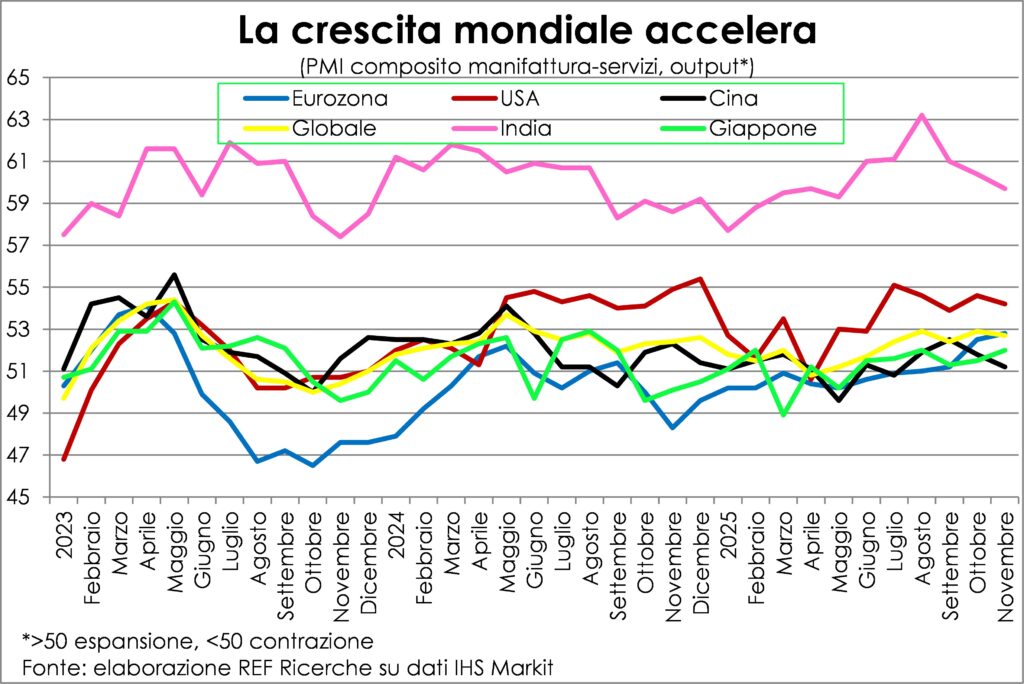
Others two risks for the continuation of American growth are linked to the AI boomOn the one hand, if the return on the massive investments turns out to be lower than expected, the stock market prices would suffer, reducing the wealth and the desire of families to spend; on the other hand, one wonders for how long their strong contribution The increase in GDP will be replicated. It certainly will be by 2026, and that's already a good starting point.
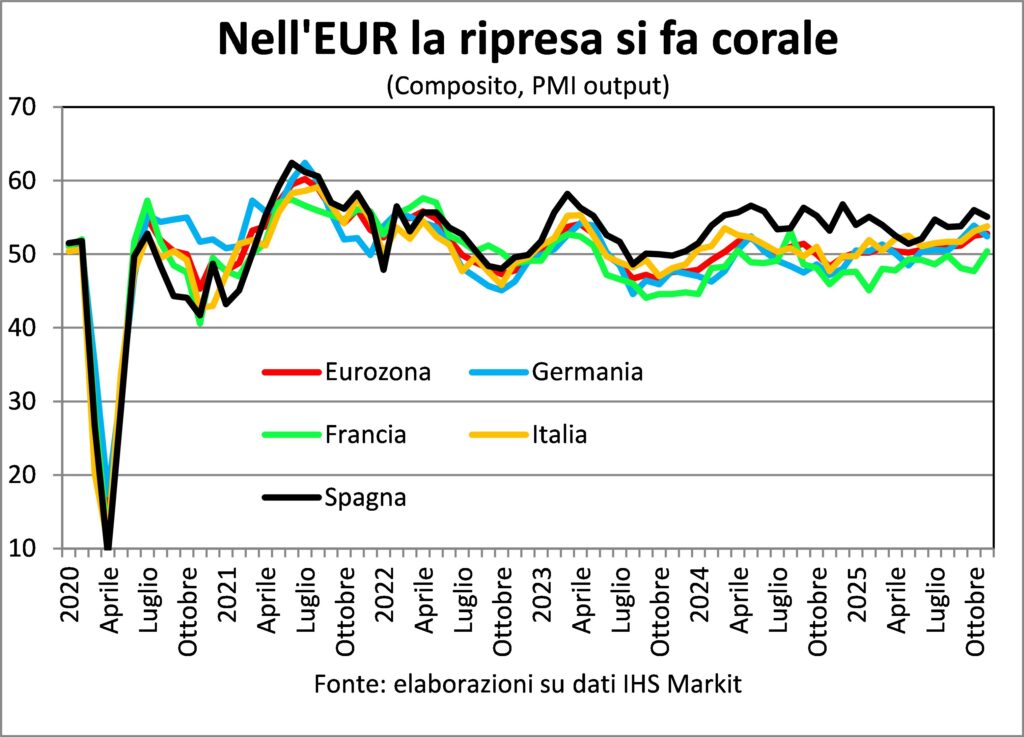
In 'Eurozone There are no doubts of this kind, but others. Meanwhile, we underline that the qualitative indicators show a marked improvement in autumn, domestic production and orders are rising, with output increasing at a rate not seen in two and a half years. Again, chorality is rewarding, even more than at a global level, given the close intertwining of demand and supply chains in the Old Continent. Even the France, where the tug-of-war in Parliament over the 2026 budget continues, has resurfaced on the side of increased activity. On the side of strengthening the current trend, there is the German expansionary fiscal policy, which more than compensates for the restrictions of others.
The doubts are of two kinds: the first is that the need for push domestic demand, also through wage increases (among those most stubbornly opposed are Italian entrepreneurs); the second is that the new global order It pushes the EU into a corner, as only by acting together can it save the characteristics of its own economic and social model.
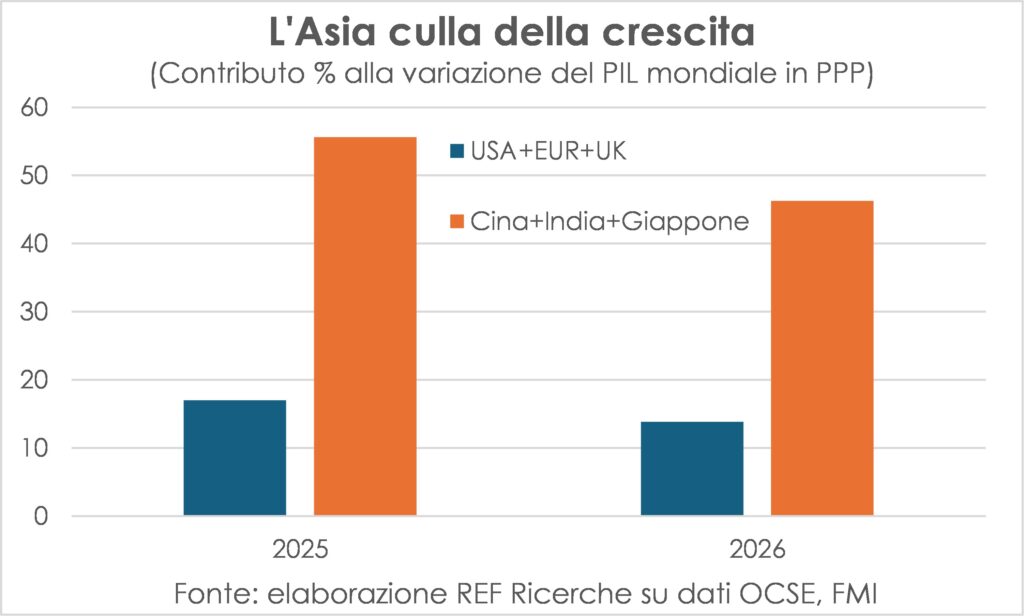
It's not just the USA and Europe. In fact, the the center of gravity of development is Asian. China+India+Japan They accounted for 56% of global growth in 2025 and will account for 46% in 2026. Their performance at the end of this year reflects what was observed in previous months, with the China which does not shine but grows, theIndia which remains in great expansion (just a little less strong) and the Japan which is surprising for its solidity (obviously compared to what has been experienced in recent decades).
Inflation? OK, that's right.
It will not be more like before. Maybe. Anyway, better today than then. The dynamics of the consumer prices it went down, yes. And even in the USA the hump generated by the duties is less humped than feared and more diluted, so that the peak is passing in these months of late 2025 and early 2026 without affecting he waited for them in the long term (at least those in the bond markets, while consumers continue to perceive higher current and future inflation) and reassuring the FED.
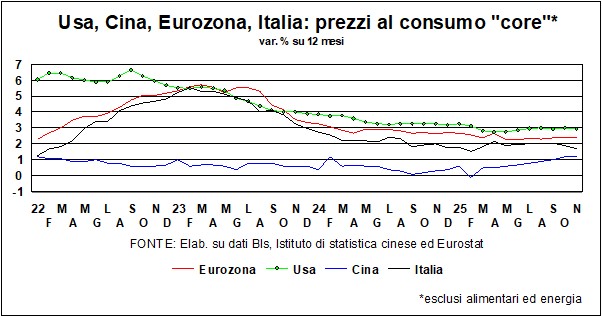
“Before” we were in land of deflation, i.e. negative price variations (taking into account the upward distortion in statistical measures of 1-2 percentage points), a more dangerous condition because it increases the real value of debts and pushes the economy into recession, worsening deflation itself; and makes it difficult for central banks to combat it by setting the lower bound on rate cuts.
Today, however, economies are growing (see above) and, historically, the the job market is for the seller: the demographic glaciation that dries up the working age cohorts and the barriers to immigration (physical barriers as in the USA or of another nature as in Europe) mean that employable people are in short supply. This will tend to keep the wage dynamics a little higher and will push for process innovations that will increase productivity (AI is well suited to this).
Other factors will act as in the past: the competition from emerging countries (called so by convention, since China has emerged), exacerbated outside the USA by Trump's tariffs, and the price transparency increased by online trading.
In short, inflation has fallen or will fall (in the US case) to where it needs to be and will remain there for the foreseeable future. The risks? The rush to spending on armaments tends to take resources out of the production of consumer goods and therefore tends to be inflationary, as is theexaggerated energy absorption of data centers that are the physical backbone of AI, a drain that weighs on electricity bills in the US.
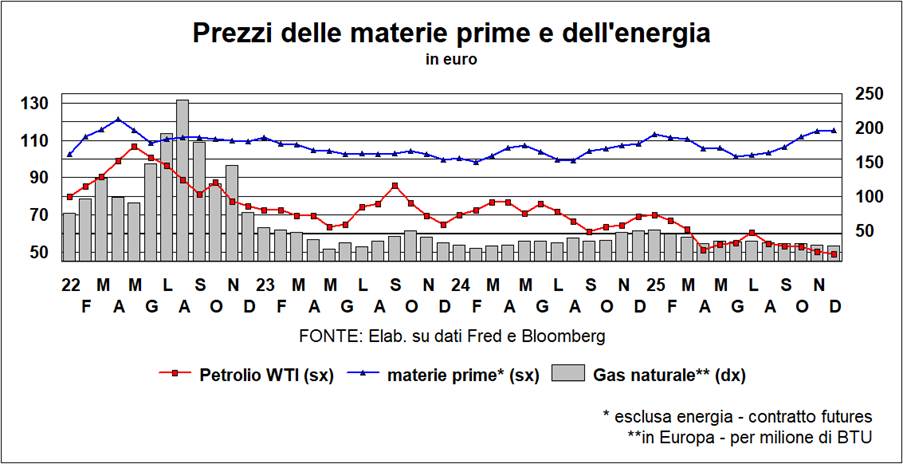
Pressure on long-term rates in 2026
They are called 'guide-taxis'They're supposed to set the tone for the markets, waving their baton like a conductor. But it doesn't always work. Yes, central banks know full well that their baton guides and sets the tone only for short-term interest rates: beyond 6-12 months, the market prevails, and does not hesitate to play other symphonies. But the Central Banks also know that, if they put their mind to it, they can also influence the long rates, as they did, first during the Great Recession and then during the pandemic, with the quantitative expansion of money, buying up long securities en masse with newly minted liquidity.
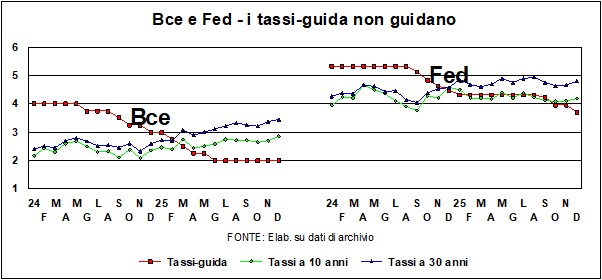
We're now in a situation where conductors see that market musicians are playing on their own, and perhaps, as we'll discuss below, they're right. The graph shows how, over the past two years, the substantial reduction in key rates, on both sides of the Atlantic, was accompanied by an increase in rates on government bonds 10-year rates (Bunds and T-Bonds) and an even greater increase for 30-year rates (Bunds and T-Bonds). This is a gap that deserves explanation.
The first thing to note is that, At the beginning of the period, key rates were well above long-term rates (In technical language, the yield curve was inverted.) Now, in a normal economy, the opposite should be true: the sacrifice of liquidity and the risk associated with long maturities should be remunerated at a higher level than those associated with short maturities.anomaly of early 2024 it is explained by the fact that theinflation was higher then – was still feeling the effects of the sharp price increases following the disruptions of the pandemic and the war in Ukraine, and key rates were forced to counteract this. While long-term rates were still marking the echo of the massive expansionary measures taken to address the global Covid crisis. So, what today seems like disobedience by the musicians to the conductor's directives could simply be a return to normal: as you can see, the yield curve is now in the right place, with short-term ones – both in Europe and America – lower than long-term ones.
But there is also another reason behind the increase in long rates, and it lies in the growing need for financing public budgets. As mentioned in the past, there are pressing calls for spending around the world, for infrastructure, digital and climate transitions, not to mention defense spending (Aside from Germany's large allocations, the latest news concerns pacifist Japan which, after disagreements with China, is equipping an archipelago – Ryukyu, a chain of 160 islands and islets – with missile batteries, radar towers, ammunition depots, and installing an F35 base on Kyushu, the southernmost of Japan's four main islands).
So, what What 2026 has in store for us for ratesAs mentioned, structural pressures are pressing on long-term rates, while the short-term rates remain dilemmaOn the one hand, the real economy would like to be supported by lower rates, but on the other hand, core inflation remains above the 2% target (2,4% in the Eurozone and 3% in the US), and would like higher rates. The dilemma is more acute for the US than for the Eurozone. The conflicting pressures could cause short-term rates in 2026 to fall like Buridan's donkey. will remain stable, within a range of +0,5 and -0,5The extra half point is worth the Eurozone, where the real key rate is negative and lower than the GDP growth rate, and the half point less applies to the Usa, where the real Fed Funds rate is positive (admittedly, it is also lower than the growth rate of an economy that is also showing some fragility). In short, the normalization of the yield curve, which began in the year just ending, will continue into 2026 (aside from the 'usual unknowns', such as new pandemics or world wars...). consecrating a turn towards a well-tempered curve.
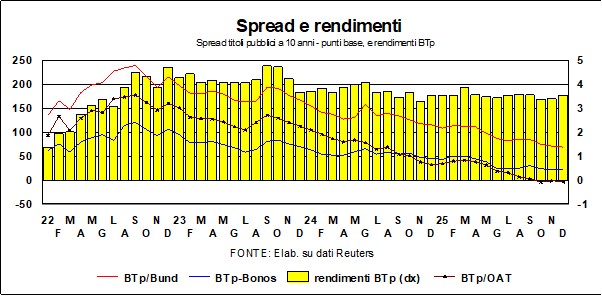
Our spreads are falling
The upward trend in long-term rates used to be accompanied by a worsening of the Italian spread, given our reputation as a clay pot and the damage of an increase in interest rates for countries with high public debt. But, as proof of a more than justified change in the markets' opinion on our public finances, the rates on our 10-year BTPs have not changed much, and the spread (on Waist) has fallen to its lowest levels in 17 years (8 years ago compared to passes Spanish, and always in this part compared to the OAT French).
The Yen Puzzle
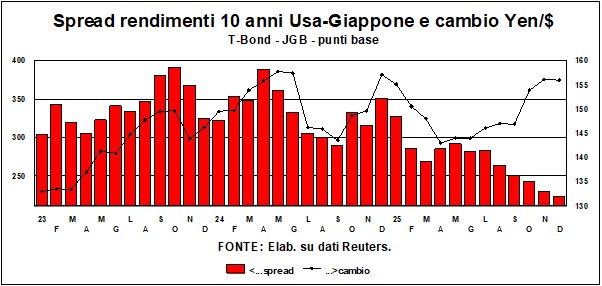
On the changes, the dollar remains weak (and will remain weak): it has touched 1,17 and goes against the euro and 7,06 against the other antagonist currency, the yuan. For the sake of yen, the situation is not clear. Usually – see graph – the Japanese currency is highly correlated with the US interest rate differential versus the Japanese one (spread between T-Bond and JGB yields). If US bond yields are more attractive than Japanese ones, the yen will emigrate and the yen will depreciate. But in the second half of the year the opposite happenedThe yield spread has narrowed significantly (due to rising JGB rates), while the yen has weakened sharplyThis anomaly is robust, in the sense that it holds true even if we look at real yield differentials or the nominal effective exchange rate rather than against the dollar. Looking ahead, if the above correlation were to return, the yen would have room to strengthen: JGB yields have no reason to fall, Japanese inflation has now abandoned deflation, and is at Western levels (3% for the dynamics of 'core' consumer prices). But that's not necessarily true: the yen has always been a difficult currency to handle, and there have been long periods in the past (for example, from 2009 to 2012) in which that correlation did not exist – or, if it existed, it was the opposite…
The stock markets, between bubbles and hopes
The world economy, in the year of grace 2025, has been shaken by two deus ex machina: the duty war (let's forget about the other bloody wars that have been going on for a longer time), and explaining Artificial Intelligence (AI).
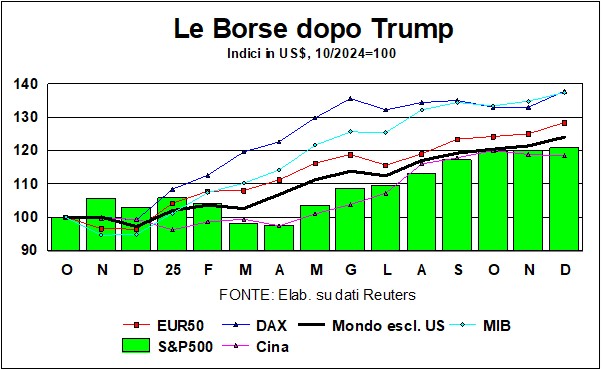
The trade war should have been negative for the stock markets, given the massive doses of uncertainty it was injecting into the global economy. While AI could only be positive, given the more or less revolutionary promises linked to new ways of producing and consuming, and to the huge investments that it was triggering, hic and nuncLooking at what happened in the year it is clear that markets shrugged off tariffs (which, in fact, did not prevent the International Monetary Fund from raising its estimates for world trade, even beyond what was expected, pre-tariffs, for 2025). And they instead fervently believed in the magnificent and progressive fortunes linked to the advent of AI. And it is true that AI is a revolution. But, like all new and promising things, at the beginning there is a race towards the bright futureAnd in this case, unlike the dot-coms of the early millennium, the rush was also there for the massive investments that AI requires. A rush that leaves a few question marks in its wake. Investments in AI have been enormous: Most of the GDP or domestic demand growth in the first three quarters of 2025 in America is due to two spending categories: computers and related equipment (Information Processing Equipment) and software. There will be a adequate return for these huge investments? And it is worrying that these investments are financed not only by the fat profits of high-tech companies, but also with the recourse to debt. The word 'bubble' it's starting to spread…
It is worth reiterating, however, that There must be other reasons for the effervescence of the stock marketsAs can be seen from the graph, outside America, stock markets have risen as much as, if not more than, Wall Street (Germany and Italy in the lead...). The weakness of the dollar has helped in this comparison, but even in local currency things don't change much. The 'Hands' long-standing recommendation in favor of equity investment is confirmed. With the advice of a geographical diversification of the 'little garden'.