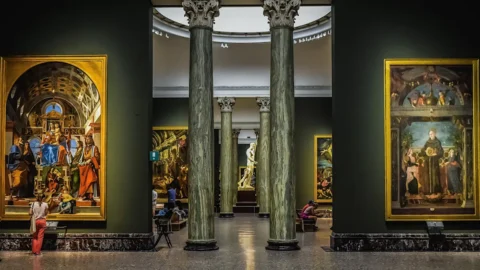
Il September 23 in Paris, at Christie's, the sale of the collection of Graziella Patiño de Ortiz Linares, one of the most important private collections dedicated to ancient paintings and 18th-century French decorative arts. The result was 38.736.120 euros for 59 lots, well above the initial overall estimate of €23-33 million. Sixty-four percent of the lots exceeded their high estimate. This wasn't just a financial achievement. Above all, it confirmed the market's impact on the quality of a collection built over time with knowledge, selection, and a precise understanding of taste.
A collection born in Paris
Graziella Patiño de Ortiz Linares was the daughter of Simon Iturri Patiño, Bolivian industrialist and financier who built one of the great fortunes of Latin America thanks above all to the mining sector. In 1926 Graziella and her husband Jorge Ortiz Linares purchased theHotel Blumenthal, at 34 Avenue Foch. It was here that, over the course of more than forty years, they built a collection focused primarily on Régence and the reign of Louis XVPaintings, furniture, silver, porcelain, and art objects were gathered together in the rooms of the residence according to a coherent collection project. A significant part of that collection is now preserved in institutions such as the Getty Museum, the Louvre and the Palace of Versailles, a testament to the quality and importance achieved by the collection.
Fragonard and Watteau: Two Million Emotions
The most spectacular result came from painting. Jean-Honore Fragonard, with L'Instant désiré ou Les Amants heureux, has reached 10,6 million euro, more than triple its high estimate. The work became the second most expensive Fragonard ever sold at auction and set a new French record for the artist. Almost on par Antoine watteau with The Enchanted Island, awarded to 10,37 million euro, also a new French record for the artist. Two works, two figures exceeding ten million, which alone account for more than half of the total sale result.
Ingres's record
Another particularly significant result concerns Jean-Auguste-Dominique Ingres. The Portrait of Julius Caesar, commissioned during the reign of Napoleon III, was awarded for 2,362 million euro, more than three times the low estimate, setting a new world auction record for the artist. Also Hubert Robert, with The Vegetable Nef, has far exceeded expectations, reaching 1,28 million euro.
Not just painting: the return of the decorative arts
The peculiarity of the Patiño collection, however, lies in its ability to place painting, furniture and decorative arts on the same level. The result of the four three-light candelabra made by Thomas and François-Thomas Germain for the service of the kings of Portugal: 3,399 million euroA rare silver-gilt ewer basin from Nicolas Delaunay, goldsmith of Louis XIV, reached 768.000 €, while four candlesticks by Pierre Massé were sold at 268.000 €. The furniture also achieved significant results. A pair of black lacquered corner units by Bernard II van Risenburgh, associated with a commission intended for Madame de Pompadour for the castle of Crécy, has reached 1,1 million euro, more than four times the estimate.
When the museum goes up for auction
Then there is a particularly significant passage. A couple of Louis XV royal appliques, attributed to Jacques Caffieri, was purchased by the Musée national du Château de Versailles through the right of pre-emption, for 384.000 €It's an episode that shows how the market can also become a place for reconstructing heritage. A work goes through auction, but can also return to a public collection and thus to collective enjoyment.
The collector's value
The Patiño sale thus reveals a dimension of the art market that goes beyond price. Each work arriving at Christie's brought with it a provenance, a history, a taste, and a specific idea of collecting. This is also why large private collections continue to hold particular weight in the international market. The Paris sale also demonstrates a renewed interest in a sector that in recent years has often been considered more specialized than contemporary art: Old Master paintings and, above all, the decorative arts. The Patiño result cannot, of course, be interpreted as a measure of the entire market. But it clearly demonstrates how strong demand can be when museum-quality works, with significant provenances and part of a historically recognized collection, arrive on the market.
Image @Christe's