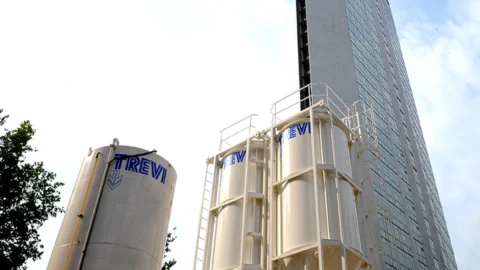
La challenge for Trevi comes to the heart of the matter. On one side there is theWebuild takeover bid at 4,50 euros per share, entirely in cash; on the other hand the relaunch of Icop, which raised the exchange ratio to 0,165 shares for each Trevi stock. But, according to Kepler Cheuvreux, the point of the match is not more just the priceFor the Cesena-based company's shareholders, the choice also involves cashing in and exiting the investment or remaining involved in the group that would be created from the Icop operation and participating in its potential development.
The Webuild takeover bid starts today, September 28th, and will remain open until November 20th, subject to extensions. Just before the launch of the offering, Icop significantly improved its proposal, increasing the exchange ratio by 24,1%, from 0,133 to 0,165 Icop shares for each Trevi share.
Based on the reference price of June 26, the new proposal values Trevi at €5,165 per share, 14,8% more than the €4,50 offered by Webuild. But it is the comparison with the prices More recent figures provide a clearer picture: at market prices on September 25, the implied value of Icop's offer was €5,05 per share, approximately 12% above Webuild's cash offer and 4,3% higher than Trevi's closing price of €4,84. At today's prices, however, the exchange value drops to approximately €4,97 per Trevi share, considering Icop's price at €30,10. This remains higher than Webuild's €4,50 offer, but slightly below the €5 Trevi is trading at today.
Trevi: Two offers, but two different projects
This is precisely where, according to Kepler Cheuvreux, the focus shifts. The Friulian group's relaunch reduces much of the valuation disadvantage that Icop had accumulated following Webuild's entry into the competition, but above all, it refocuses attention on the industrial structure that would result from the two deals.
In fact, it is not just a question of two different counterparts, but of two projectsIcop is aiming for a horizontal consolidation among companies specializing in the underground construction sector; Webuild, on the other hand, would bring the Cesena-based company into a large general contractor through vertical integration.
For Trevi shareholders, the difference is concrete: accepting the offer Icop means receiving titles of the new group and remain shareholders, participating in its possible growth; accepting that of Webuild instead it means collecting 4,50 euros per share in cash and exit the investmentThis is, essentially, the crossroads identified by analysts.
The new share swap also changes the structure of the transaction. The issuance of new shares for the offering would represent approximately 25% of the company's post-transaction capital on a fully diluted basis. According to the European broker's calculations, the free float would improve significantly, from the current 16% to approximately 40%.
The broker has also revised its EPS forecastsFor 2027, the estimated increase drops from the previous +7% to +2%. Looking ahead to 2030 and including €55 million in EBITDA synergies, equal to the lower end of the range indicated by Icop between €55 and €75 million, the estimated EPS growth drops from the previous +39% to +32%.
Synergies, the market, and Trevi's customer issues
Also on the front of synergies differences emerge between the two operations. Icop's goal, between 55 and 75 million of euros, is based on horizontal levers linked to the integration between specialized companies: equipment, supplies, investment optimization, business costs and commercial and geographical complementarities. Webuild's target it's more ambitious, 80-90 million euros, but according to Kepler it would depend more on the ability to reorient Trevi's activities within the vertical value chain without compromising its ability to work for third-party clients.
This is an important point because the Cesena-based company operates as a specialized supplier in the infrastructure market and also serves general contractors competing with Webuild. The group led by Salini emphasized that Trevi would continue to operate according to free market logic, but Kepler highlights a possible risk: belonging to one of the world's largest general contractors could make some competitors less inclined to entrust it with strategic contracts in the foundation sector.
The question, therefore, is not only how many synergies can be generated, but also how they will be achieved and what effect they could have on Trevi's commercial positioning.
Will Webuild relaunch?
Then there remains the variable of the Webuild's responseAfter the improvement of the competing offer, Kepler considers a new raise possible and takes as an example a move from 4,50 to 5,50 euros per share. An increase of this type would mean for Webuild a additional cash outlay of approximately 60 million of euros, considering the approximately 5% stake already held in Trevi. A modest amount compared to the size of the group, but which would still have consequences on the debt: analysts at Kepler, the operation would determine an increase ingross debt of approximately 0,5 billion euros, in the opposite direction to the target of debt reduction, today around 3,3 billion.
Meanwhile, the financial analysis firm Icop values 34 euros per share on a stand-alone basis, compared to Friday's closing price of €30,6. Considering preliminary EPS growth of more than 30% by 2030, including EBITDA synergies of €55 million, and despite the 5,2% increase in the total number of shares, the valuation rises to €44 per share, representing a potential upside of 43,7% compared to Friday's closing price. This estimate, Kepler points out, also excludes the potential positive impact of the successful Ediltunnel deal, which could translate into an EPS impact of 4-5%, before synergies.
For Trevi, therefore, the competition has entered its decisive phase. The relaunch of Icop has reduced the economic gap between the two proposals, but above all, it has highlighted the difference between the two approaches: on the one hand, the guaranteed liquidity of the Webuild offer, on the other, the equity participation in an industrial project with further growth potential but also elements of risk. With both offers on the table until November 20thIt now remains to be seen whether Icop's relaunch will be sufficient to resolve the challenge or whether the group led by Salini will respond with a new proposal.