His mentors, those who most influenced his professional career, were Yuki Mamizuka, the great Japanese chef who inspired numerous young international talents, teacher and mentor to award-winning emerging chefs; Rocco De Santis (two Michelin stars in Florence), a longtime associate of Frenchman Georges Blanc in Vonnas; Philippe Chevrier, owner of the Domaine de Châteauvieux restaurant, who now oversees an empire of luxury restaurants in his home country; and Eric Pras, three Michelin stars with his Lameloise in Chagny.
Gabriel Collazzo, a thirty-year-old from San Miniato (Pisa), was awarded the title of "Chef of the Year Under 30 in Italy" at the "Grande Cucina Talent Prize." He gained experience in the prestigious kitchens of the five-star Ca' di Dio Hotel in Venice, which entrusted him with its entire culinary offering. He has now landed at the luxurious Borgo La Chiaracia Resort & SPA in Castel Giorgio (TR) to helm the Radici restaurant, where he demonstrates a vision that blends tradition with modernity. His cuisine is born from the encounter between the rural roots of Tuscia, the solidity of French technique, and Japanese influences: a dialogue between worlds that share restraint and essentiality. The heart of the offering is Umbrian, featuring seasonal produce from small, ethical supply chains, forgotten varieties, biodiverse crops, and homemade preparations. Classic French cooking provides precise and robust tools—browned stocks, emulsions, reduced juices, and slow cooking—that enhance the ingredients without overpowering them. It's a technique that refines, not overwhelms: at the service of flavor and harmony. The oriental aesthetic then becomes an integral part of the narrative, with dishes that seek balance and silence, where umami is the common thread and emptiness is the narrative space. Zero waste is transformed into a creative principle: peels, stems, and bones become broths, fermentations, powders, and snacks that enrich the depth of the dishes. Radical seasonality guides the menu, which constantly evolves following the natural rhythm, while the work ethic ensures an environment where the team finds balance, continuous training, and sharing.
Built on land steeped in ancient and archaic spirituality, Borgo La Chiaracia Resort & Spa is located at the heart of a 14-hectare estate at 600 meters above sea level on the border between Umbria and Lazio. It comprises three farmhouses connected by underground passages, offering convenient access to historic towns in Umbria and Lazio, such as Acquapendente, Bolsena, Proceno, Orvieto, Castel Viscardo, and Castel Giorgio, once used by the bishops of Orvieto as a summer retreat. Fully respecting the estate's original purpose, the hotel has continued to cultivate traditional Umbrian produce, such as legumes, grains, nuts (walnuts, hazelnuts, chestnuts), red berries, and grape varieties. Some of the ingredients, grown on-site or purchased from renowned farmers like Urbevetus, are then transformed in the Borgo's kitchen into spreads, preservative-free cooked hams, wines, vermouths, and bitters. And always fully respecting the estate's original purpose, the Radici restaurant embraces an integrated sustainability philosophy. Raw materials are sourced almost exclusively from Umbria, prioritizing regenerative farming, extensive livestock farming, wild produce, and non-intensive methods that define an authentic pantry, where every ingredient is chosen with respect for the soil and biodiversity. The restaurant project stems from a desire to explore tradition with fresh eyes: a gesture of rootedness expressed through a simple aesthetic, ethical research, and profound attention to detail. Each dish is designed to be both memory and gesture, story and form.
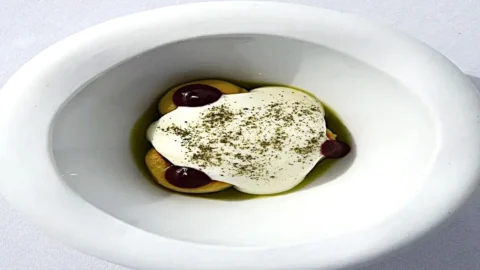
The story of these Umbrian gnocchi is particularly detailed and complex, requiring time, commitment, and perseverance, and clearly demonstrates the conceptual elaboration behind quality cuisine. But it's worth trying Collazzo's recipe to discover new sensations in the kitchen.
The recipe for gnocchi in Umbria
Ingredients for gnocchi
• 1 kg of potatoes
• 250 g of flour
• 15 g of salt
• 50 g of Parmesan cheese
• 15/20 g of starch
• 2 egg yolks
Method
Cook the potatoes in iced water and mash them while still warm. Add all the other ingredients and knead. Let the dough rest overnight. Roll out and fill.
Pecorino Foam “12+ months Alfina”
Ingredients
• 500 g of grated pecorino cheese
• 200 ml of water
• 100 ml of milk
• 20 g of gelatine
Method
In the Thermomix, combine the pecorino, water, and milk. Heat to 70°C until it becomes a fondue. Then add the previously soaked gelatine and cook for about 1 minute. Strain and pour into a siphon.
Sweet and sour onion
Ingredients
• 1 kg sweet red onion
• 300 g of sugar
• 150 g of Red Port
• 400 g of red wine
• 150 g of apple cider vinegar
• 50 g of balsamic vinegar
• 3 bay leaves
• 8 juniper berries
• 8 cloves
• Salt
Method
Finely chop the onions. Add them to a pan with a pinch of salt and sweat. When they are translucent, add the sugar and let it dissolve. Deglaze the pan with port, red wine, apple cider vinegar, and balsamic vinegar, raising the heat. Add the spices and herbs. Cook until the liquid has completely evaporated, resulting in a semi-candied compote. Season with salt.
Sage oil
Ingredients
• 1 kg of sage (leaves only)
• 1 liter of grapeseed oil
Method
Blanch the leaves in boiling salted water for a few minutes. Cool immediately in ice water. Blend with the oil in a Thermomix. Transfer to a saucepan and heat at about 80°C for 30 minutes, stirring with a whisk. Strain through a fine sieve.
Genoese pork
Ingredients
• 1 pork belly
• 3 kg of sweet white onion
• 75 g of carrot (or 75 g per piglet)
• 3 bay leaves
• 300 g of white wine
• 50 g of apple cider vinegar
• 75 g of celery
• 4 juniper berries
• 1 sprig of rosemary
• 1 sprig of thyme
• 3 cloves of garlic
• 1 kg of pork bones
• 300 g of red wine
• pork stock to taste
• Salt and pepper
• 100 g of red onion
• 30 g of tomato paste
• 5 cloves
Method
Thoroughly clean the pig's belly and scraps.
Leave to dry overnight in the refrigerator.
Prepare a base by toasting the bones with the carrot, red onion, and celery in a brunoise sauce.
Brown everything, add the tomato paste and then the red wine.
Cover with ice and cook for about 1 hour.
Strain the broth.
Vacuum-pack the pig with:
• juniper
• rosemary
• thyme
• salt
• pepper
• crushed garlic
Cook at 68°C for 12-15 hours.
Once cooked, gently shred the meat, keeping the cooking juices aside.
Meanwhile, finely slice the onions.
Arrange the ingredients on the plate and garnish with the pecorino foam.