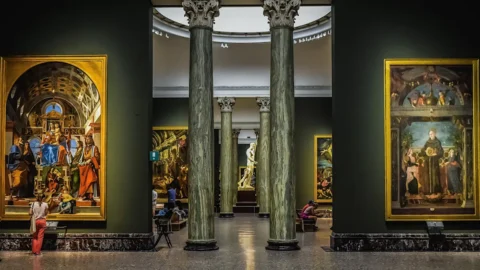
Le European Heritage Days, which will take place on Saturday, September 26th, and Sunday, September 27th, involving museums, archaeological sites, historic buildings, libraries, archives, and cultural venues throughout Italy. The initiative, promoted by the Council of Europe and the European Commission and coordinated in Italy by the Ministry of Culture, represents one of the continent's largest cultural engagement opportunities.
The history of the European Heritage Days begins in 1985 in France, with the extraordinary opening of monuments normally inaccessible to the public. In 1991, the initiative took on a European dimension and over the years has evolved into an event capable of connecting heritage, citizens, and territories. Forty years later, the formula retains that same intuition, but the question has become more complex: how can we protect heritage in an era of climate, social, technological, and environmental transformations? The theme chosen for 2026, Protecting Heritage. Renewing, Resisting, Reinventing., invites us to consider conservation not as a simple preservation of the past, but as a responsibility towards the future. The richness of the Italian edition emerges above all from its territorial dimension. There is no single geography of heritage: alongside the great museums of art cities, there are archaeological sites, archives, historic homes, landscapes, scientific heritage, and lesser-known places that take center stage for two days.
Rome: from antiquity to scientific heritage
In the capital the program crosses different eras and languages. Archaeological Park of the Colosseum offers guided tours, special openings, and digital initiatives dedicated to the theme of heritage protection. National Etruscan Museum of Villa Giulia, instead, the GEPs become an opportunity to enter the museum's storage rooms and discover works not normally visible, alongside visits and workshops. On Saturday evening, the museum offers a special opening until midnight with admission for one euro. Pantheon The program features a guided tour of “Wonders of the Rotonda,” while the National Museum of Musical Instruments focuses on a different heritage: musical culture.
Florence: the Vasari Corridor
In Florence one of the most significant events is the opening of the Vasarian Corridor, the famous path that connects Palazzo Vecchio to Palazzo Pitti, passing over the Ponte Vecchio. Access, available on both days, is by reservation and as part of a visit to the Uffizi. It is one of the most striking examples of how a historic site can become, through new ways of enjoying it, part of a broader policy of heritage enhancement.
Genoa: its maritime and industrial heritage
In Genoa the GEPs also bring attention to a less conventional heritage: that linked to the history of the port and maritime culture. Among the events are the opening of Royal Palace, the initiatives of the University Library and the extraordinary access to the Dry Docks of Genoa, a place where industrial heritage, labor history, and port identity meet.
Naples: the stratification of history
Naples participates with a comprehensive program that includes museums, palaces, libraries and places of memory. From Royal Palace From the Pignatelli Museum to the State Archives to the MANN, and the archaeological heritage of the region, the city offers a particularly clear representation of Italy's cultural stratification. But the Days don't stop in the capital: the program also involves Pompeii, Bacoli, Somma Vesuviana and other places in Campania.
Puglia: heritage as experience
In Puglia the program includes Special openings, concerts, guided tours, screenings and educational workshops in regional cultural sites. This is a significant example of how GEPs have progressively transcended the simple museum visit model, building a true cultural experience around heritage.
Basilicata: Venosa and its archaeological heritage
In Basilicata, among the events reported by the national program, there are the extraordinary openings of theRoman Amphitheatre of Venosa and Paleolithic Park of NotarchiricoTwo very different places, both of which tell the story of the temporal depth of Italy's heritage: from prehistory to Roman times.
Calabria: Scolacium and the possibility of reinvention
In Calabria, at Scolacium National Archaeological Museum and Park, the initiative "Rebuilding to Understand: A Creative Journey Through Archaeological Heritage" interprets the theme of the 2026 edition in a particularly direct way. Archaeological heritage thus becomes not just something to observe, but a material to be understood through new tools and new forms of participation.
A Night at the Museums
One of the most anticipated events is this evening's, Saturday September 26, when many Italian state museums will exceptionally open their doors in the evening. Entrance, where applicable, is set at the symbolic cost of 1 €, excluding free admissions required by law. The program includes guided tours, concerts, screenings, workshops, and other initiatives. This is perhaps one of the most interesting aspects of the Days: change the museum's time tooEntering a museum in the evening, crossing an archaeological site after sunset, or accessing a normally closed building means changing the usual relationship with heritage.
Preserving is not enough
The real issue posed by the European Heritage Days is therefore broader than free access or special openings. Heritage thrives when it is known. And it is passed on when it speaks to the present. "Protect," "renew," "resist," "reinvent" are four verbs that define a collective responsibility. Conservation remains essential, but it cannot be separated from knowledge, research, education, and the ability to build new forms of engagement with cultural heritage. Italy, in this sense, represents a special case: a country where heritage is not concentrated solely in large cities of art, but is scattered throughout the regions, small towns, landscapes, archives, homes, places of production, and traditions. This weekend, therefore, let us be guided by curiosity. Let us open a door, walk down a street, enter a museum, visit a village. Heritage is not only what we have received: it is what we choose to understand, protect, and pass on.