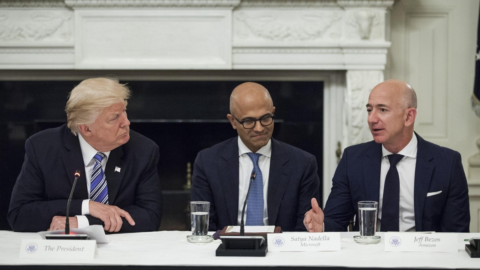
The White House lunch between Donald Trump and some of the main protagonists of Artificial Intelligence and technology has produced a first concrete result: a voluntary agreement on AI safety and control principlesThe CEOs in attendance were Mark Zuckerberg of Meta, Elon Musk of Tesla, Dario Amodei of Anthropic, Jensen Huang of Nvidia, Jeff Bezos of Amazon, Sundar Pichai of Google/Alphabet, Satya Nadella of Microsoft, Lisa Su of AMD, Hock Tan of Broadcom, Alex Karp of Palantir, Nikesh Arora of Palo Alto, Bill McDermott of ServiceNow, and Sanjay Mehrotra of Micron.
After the meeting, Trump and House Speaker Mike Johnson announced that the big tech bosses had an agreement was signed to establish common standards for risk managementTrump has defined the agreement “morally binding”, thus underscoring the nature of the agreement as a political and industrial commitment rather than a legally binding obligation. Reuters confirmed the announcement, while Axios provided some details on the agreement's content.
Among the points foreseen there would be internal risk reviews of artificial intelligence systems and the use of external auditors. Companies should review their internal controls, identify any vulnerabilities, and subject their procedures to independent audits. However, one important issue remains: the full text of the agreement is not yet public, and the mechanisms through which the commitments would be enforced are still unclear. Mike Johnson presented the agreement as a declaration of principles, standards, and voluntary commitments, not as a new federal law.
Trump insists on self-regulation
The result is particularly significant because it comes as the Trump administration continues to reject the idea of federal regulation of artificial intelligence, which, according to the president, could slow the development of the sector. The White House's public stance is that leave ample space for companies, relying on self-regulation and the tools already available to federal authorities.
Trump specifically pointed out the role of agencies such as the Department of Justice and the FBI in the event that illegal behavior or abuse emerges. The compromise announced after lunch therefore seems to be halfway between the absence of common rules and actual legislative regulation: companies accept standards and audits, but no new law has yet been introduced.
Data centers, energy and local communities
A second topic that emerged from the meeting was the expansion of data centers, which has become one of the most sensitive issues related to the growth of artificial intelligence. Trump said that The CEOs present agreed to collaborate with local communities To make the construction of new infrastructure more acceptable. Among the options offered are financial contributions to schools in the affected communities and measures to contain energy costs.
The Associated Press also reported the president's statements on the possibility of companies contributing financially to the communities that host data centers and participate in efforts to reduce the impact of new installations on energy bills. This is a significant point because the expansion of AI requires enormous amounts of electricity and new computing facilities, creating tensions with residents and local governments over infrastructure costs, network usage, and environmental impact.
Trump considers ten-person committee
Another new development that emerged after lunch concerns the possible creation of a new supervisory body. Trump said he was considering a committee composed of ten people tasked with overseeing the Artificial Intelligence sector. However, this is not a final decision at this time.
Meanwhile, according to Axios, Trump is expected to choose his own "AI czar" in the next three or four days, the person in charge of coordinating the administration's artificial intelligence policy. Before making his choice, the president is expected to consult with Mike Johnson and Senate Majority Leader John Thune. The possible appointment of the AI Czar and discussions by a ten-person committee indicate that, while opposing regulation deemed too invasive, the White House is considering a more defined structure to track the rapid development of the sector.
Zuckerberg, Amodei, and their differing positions on security
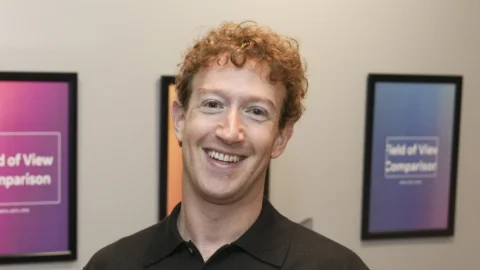
The picture that emerged after the meeting also shows significant differences between the protagonists. Mark Zuckerberg talked about internal controls and external auditors, a formula that seems directly reflected in the principles of the agreement announced after lunch. Dario Amodei and Anthropic, however, are approaching the meeting with a more cautious public stance on the risks of artificial intelligence. The Associated Press recalled the company's previous positions on the need to slow development if adequate levels of security cannot be guaranteed.
Sam Altman, speaking separately to CNBC, said that OpenAI is actually slowing down some activities when it fails to build a sufficiently robust security case. This adds concrete evidence to the debate on the possibility of reconciling development speed and controls.
The positions, therefore, are not perfectly superimposableOn the one hand, the White House wants to avoid a regulatory system that could stifle innovation; on the other, some of the sector's leading companies recognize the need for internal procedures and independent risk assessments.
The point that is still missing: no real leak from the room
Despite the new information, the true background to the lunch has not yet emerged: an account attributed to a person present or to a source "familiar with the discussions" who can detail what happened behind closed doors. In the information published so far by Axios, Reuters, and the Wall Street Journal, there are no verifiable references to a specific private exchange between the participants, nor any details about any individual requests or concessions made during the luncheon.
What is available so far are mainly the statements made publicly after the meeting and subsequent information on the voluntary agreement. Axios also emphasizes that the actual scope of the agreement remains to be determined: the full text has not been published, and it's not yet clear what the actual enforcement system will be. Therefore, at the moment, it's more accurate to talk about a political-industrial outcome announced after lunch than a true leak of the private conversation.
What remains to be verified
The next few hours will be important above all to understand three aspects: the full text of the security agreement, the complete list of companies that have signed it and the methods by which external audits will be carried outIt will also be necessary to verify whether the ten-person committee will actually be established and who Trump will choose as AI czar.
For now, then, The White House luncheon produced public engagements on AI safety, independent audits, data centers, and relationships with local communities. But the long-awaited behind-the-scenes look at the room, detailing disagreements, personal requests, or negotiations between Trump and the CEOs, has yet to arrive.