The Cloisters of S. Eustorgio, the new museum and monumental center resulting from the merger between the Diocesan Museum and the Sant'Eustorgio complex.
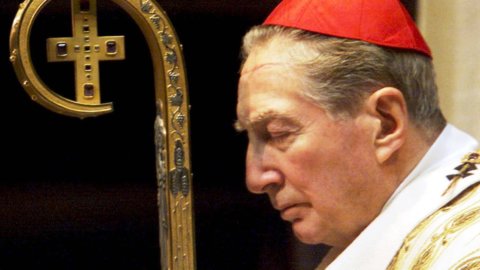
It was Cardinal Angelo Scola himself, after having thanked the former director Paolo Biscottini "for the work done in recent years", to underline how much the dedication to Carlo Maria Martini "seemed the choice, as well as more reasonable, more significant, not only because the Museum was born from an idea forcefully proposed by Martini who began to give life to this place by bringing here some of the paintings from the episcopal picture gallery to make them available to everyone, but also to pay homage to the versatility of his figure who knew how to communicate with all the worlds of culture. We will work together with the Carlo Maria Martini Foundation to celebrate this anniversary in the best possible way".
The Museum's future programs were unveiled by Luca Bressan, Episcopal Vicar of Culture of the Diocese of Milan who recalled how the celebration of the XNUMXth anniversary will be an opportunity for the Museum to confirm the project lived up to now with some further steps, such as the birth of the new museum and monumental center with the merger between the Diocesan Museum and the Sant'Eustorgio complex.
“The place where the Museum is located – declared Luca Bressan – was certainly not chosen by chance by Cardinal Martini. Following this happy intuition, we want its being part of the convent complex of S. Eustorgio – the cradle of Christianity in Milan according to the Tradition – not to be a merely logistical fact, but to become the starting point of a spiritual and cultural proposal to the city. Basilica, Portinari Chapel, Paleochristian cemetery, Diocesan Museum of Milan constitute a whole of rare beauty that must be presented and offered in its unity and uniqueness through common visits and cultural activities that already see us engaged at the planning level in offering to the faithful and to the whole city".
In this regard, Cardinal Angelo Scola underlined how "two great potentials come together to give life to something beautiful for the whole city".
“For the ancient fathers of Christianity – commented the Cardinal – beauty was the splendor of truth. For this reason, the Church has never remained extraneous to art and beauty, as can be seen by touring Italy in particular. I'm always very impressed by the long lines of people waiting to enter an exhibition. I believe that the conscious or unconscious reason that moves so many people lies in the ability of art to always manifest something that goes beyond the present object, the plus mentioned by the Jesuit theologian Bernard Lonergan. A masterpiece, when it is authentic, is always, like the liturgy, an anaphora that pushes us upwards”.
For his part, Ugo Pavanello, President of the Diocesan Museum announced the scientific committee which will have the task of conceiving and building the multi-year cultural program of the "Cloisters of S. Eustorgio". Coordinated by Pavanello himself and by Luciano Formica, cultural manager of S. Eustorgio, the scientific committee will be composed of Sandrina Bandera, former Superintendent for the historical, artistic and ethno-anthropological heritage of the Lombardy Region and former Director of the Pinacoteca di Brera, by Natale Benazzi, writer and essayist, by Carlo Capponi, director of the Cultural Heritage Office of the Diocese of Milan, by Giuseppe Frangi, journalist and art critic, by. Giovanni Iovane, professor of contemporary art history at Brera, by Antonio Paolucci, director of the Vatican Museums and by Nadia Righi, curator of the Diocesan Museum of Milan. Pending the appointment of the new director, the head of the cultural project will be Gabriele Allevi, former director of the Diocesan Museum of Bergamo and consultant to various cultural institutions in Italy and abroad.
Sandrina Bandera, member of the Scientific Committee of the Diocesan Museum, said that "merging two important spaces into one is an ambitious project that will necessarily lead to the creation of a network that dialogues and collaborates with the various institutions of the city. We are already preparing a vast program with the scientific committee which will include a series of initiatives specifically designed for a younger audience and which can translate the tradition of which the museum is the spokesperson into new contemporary languages".
Antonio Paolucci, director of the Vatican Museums and member of the scientific committee of the Diocesan Museum, also wanted to make his closeness to the project felt, with a letter to Cardinal Angelo Scola in which he assured that "the Diocesan Museum of Milan can always count on the friendship , on the contiguity, more on the fraternity of the Pope's Museums".