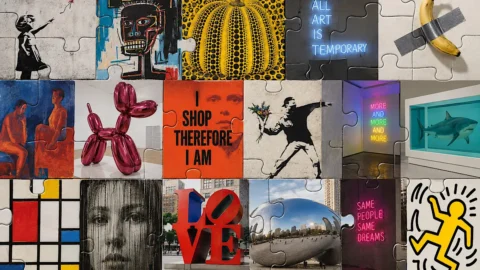
The contemporary art market is undergoing a transformation that is redefining purchasing methods, valuation criteria, and the relationship between culture and investment. After contracting in previous years, the global art market is expected to recover in 2025, with sales estimated at $59,6 billion, up 4% from the previous year, according to the Art Basel & UBS Global Art Market Report 2026. This result, however, does not reflect uniform growth: demand remains selective, and value tends to concentrate on works and artists with greater recognition and market strength.
The scenery
In this scenario, contemporary collecting cannot be interpreted solely as a purchasing practice driven by personal taste or the pursuit of future economic appreciation. The collection is gradually becoming a patrimony that combines knowledge, cultural identity, relationships, and the potential for valorization. Indeed, a work of art is a unique asset: it possesses an aesthetic and symbolic dimension that cannot be reduced to its price, but can also acquire economic significance within a market governed by demand, the artist's reputation, the work's quality, and its provenance. The first transformation concerns precisely how value is created. In a market characterized by the speed of digital communication and the growing visibility of artists, fame does not necessarily guarantee financial stability. For the collector focused on the medium to long term, coherence of artistic research, the quality of the works, institutional presence, documentation, and the ability to distinguish fleeting interest from more established recognition become crucial. Selection requires expertise and, increasingly, the support of professionals capable of integrating historical and artistic analysis, market analysis, and documentary verification.
What changes with digitalization?
Digitalization is expanding access to artworks and information, changing the relationship between galleries, collectors, and auction houses. Online platforms, digital archives, and new certification technologies can foster transparency and traceability, but they are no substitute for verification of authenticity, provenance, and the rights associated with the work. Artificial intelligence and digital art also introduce unprecedented questions about creative authorship, preservation, and the distinction between digital assets and their accompanying rights. Technology, therefore, represents a tool for transformation, not an automatic guarantee of value.
Why collect contemporary art?
The benefits can be manifold. On a cultural level, a collection provides a path to understanding and engaging with contemporary art forms. On a relational level, it creates opportunities for dialogue with artists, curators, institutions, and other collectors. On a financial level, it can contribute to the diversification of an asset base, provided that the risks of illiquidity, conservation costs, commissions, and the uncertainty of future prices are considered. Research on the relationship between art and finance has analyzed the potential role of high-end works in portfolios, but the results depend on the samples, time horizons, and valuation methods adopted. Art does not typically generate a periodic income, and its eventual appreciation is not guaranteed. It is precisely this distinction that necessitates a more informed approach to cultural investment. Buying a work with the sole aim of reselling it at a higher price exposes risks that are not always adequately considered. A collection, however, can be built according to a long-term approach, in which economic value is accompanied by the quality of research, the care of the heritage, and the possibility of transmitting it. Provenance, certificates, catalogs, photographs, and archives are not secondary elements: they constitute part of the asset's history and can contribute to its proper management and valorization.
The documentary heritage linked to art is also taking on an increasing importance
Correspondence, historical catalogs, photographs, and documents can be resources for research, provenance reconstruction, and memory preservation. Given their rarity, authenticity, and demand, some of these assets can also acquire economic significance. Their valorization, however, must be based on a documented assessment and not on generic market expectations. The future of contemporary collecting could therefore be interpreted through a broader concept of investment: not just capital earmarked for potential appreciation, but cultural, cognitive, and relational capital. In an economy where intangible heritage, reputation, and the quality of skills are increasingly important, art can represent a meeting point between creativity and value. The true challenge lies not in predicting which work will increase in price the most, but in developing selection criteria capable of recognizing the work's value over time, while simultaneously protecting the person, the artist's research, and the heritage to be preserved and passed on. Thus, the culture of collecting, when accompanied by knowledge and responsibility, can become a form of investment in the future: economic, cultural, and human.