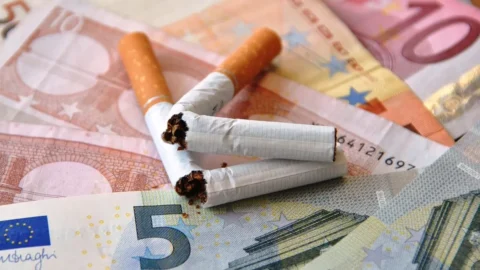
Le cigarettes risk becoming a luxury. The European Commission is working on a review of Tobacco Excise Directive (Ted), which could revolutionize the taxation of the entire sector of products containing nicotine. According to what was reported by the Sun 24 Hours and other European newspapers, the initiative, promoted by the European Commissioner for Climate Action, the Dutch Wopke Hoekstra, look at strengthen “own resources” of the Union in view of the new multiannual budget, burdened by the costs of the Recovery Fund and the growing spending needs in the defence sector.
The rThe assumed charges are heavy: we are talking about a 139% increase for traditional cigarettes, from the 258% for rolling tobacco and beyond the 1.000% for cigars and cigarillos. But the blow would not stop at classic products. Even alternatives such as heated tobacco, the electronic cigarettes and nicotine sachets would fall within the new harmonized scheme, with significant and uniform increases at European level.
Cigarette price increase, here's why Brussels wants to tax more
In addition to the need to balance the books, Brussels justifies the crackdown with public health objectives. Fifteen member countries, led by France and the Netherlands, have called for a revision of the legislation for combat tobacco use and alternative products, especially among the younger ones. Currently the taxation is very uneven between Member States, which encourages evasive practices and market disparities.
The review therefore aims at a harmonized regulatory framework. But not everyone agrees. Italy, Greece and Romania oppose to the idea of equating traditional products with alternative ones, asking for separate tax regimes to avoid damage to local supply chains.
The impact of price increases in Italy: 1 euro more per package
In our country, the hypotheses under study would translate into a increase of approximately 1 euro per package, equal to a price increase of over 20% for cigarettes and heated tobacco products. An unprecedented leap, which goes in the opposite direction to the policy of fiscal stability pursued so far by Rome.
The Minister of Economy himself, Giancarlo Giorgetti, has already expressed in Brussels its willingness to protect the investments made in the tobacco sector in Italy and not to compromise a strategic sector for employment, production and exports.
Risk of smuggling and inflation
One of the main ones side effects of the EU proposal could be the smuggling boom. Italy is currently among the countries with the lowest rate of illicit trafficking of cigarettes (1,8%, against an EU average of 10%) thanks to a stable tax regime. On the contrary, countries like France (38%) and Netherlands they have seen the phenomenon explodes following sharp tax increases.
Then there is the inflation questionAccording to the Commission's own estimates, the revision of excise duties alone could to drive up eurozone inflation by more than half a percentage point. A counterproductive effect, considering the efforts underway to contain it.
Tobacco, an Italian supply chain at risk
The tobacco industry in Italy represents a important economic asset. Our country is one of the main tobacco exporters heated in Europe, with a annual value close to 2 billion eurosThe hypothesized increases, up to +250% in the destination countries, risk compromise the entire sector.
The concern also extends to the tobacco growing, which could be hit by a new excise duty on raw tobacco. According to the Commission, this would lead to a increase in costs management costs estimated at tens of millions of euros, with serious effects on the competitiveness of Italian companies.
Le associations Italian industrial, agricultural and trade union sectors have already expressed strong concern to the government. The Brussels line is seen as a direct attack on a supply chain built with years of investment and innovation, which employs thousands of people and supports the economy of entire territories. The fear is that the new directive could destroy, in the name of fiscal rigour, a strategic production system that the EU seems to ignore.