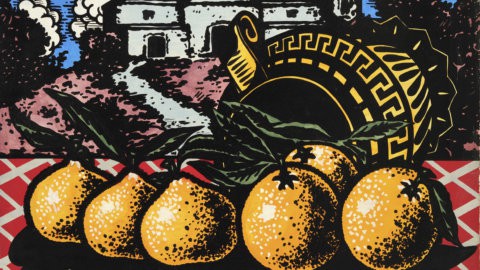
Almost fifty years after the symbolic date of the "Sessantotto", a major exhibition aims to investigate all those artistic expressions that in Italy have clearly been inspired by political protest, revolutionary hope, libertarian impulses, and which have developed in starting from 1965, with the first protests for the Vietnam war, and then continuing at least until the mid-seventies.
Cristina Quadrio Curzio and Leo Guerra, artistic directors of the Credito Valtellinese galleries, welcomed the project conceived by Marco Meneguzzo who, behind the emblematic title of “Rebel art. 1968-1978 Artists and groups from Sixty-eight", intended to analyze the attempt to build a "political" and "popular" artistic language at the same time. The proposed exhibition thus presents a fairly small group of artists, essentially working between Milan and Rome, comparing so-called "high" languages (painting on the one hand and "conceptual" and behavioral art on the other) and "low" (the illustration of magazines and fanzines, such as "Re Nudo" and others), who in those years tried to build a real expressive language that was both innovative and accepted by the great masses, where the comparison between art and illustration, between art and what was once called "propaganda", despite both being ideologically on the same side, is one of the most interesting reasons.
“If France – affirm the two directors – celebrated its “Figuration Narrative” with an exhibition at the Center Pompidou (May 2008), it seems appropriate to us that Milan – the heart of the Italian student and working class protest – does the same with artists and also with the simple illustrators, who were active witnesses of that season, and who constituted an important, lasting and linguistically second to none example in Europe at that time”.
Hence, precisely, the "Rebel Art" Project which from 11 October, precisely in Milan, at the Credito Valtellinese Group Gallery in Corso Magenta, will lead to a large and highly selected retrospective on the protagonists, on the art front of that historical moment and social. The curator has selected around eighty works for this exhibition – some of large dimensions – and a large series of illustrated documents, as well as photographic evidence, centered not so much on the events, but on the customs of the time.
The catalog that accompanies the exhibition is a fundamental tool for understanding the art and figurative imagery of the period: an in-depth essay by the curator, a series of unpublished interviews with the protagonists, essays dedicated to single aspects of the period, – compiled by Alberto Saibene, Enrico Morteo, Francesca Caputo, Matteo Guarnaccia, a strong iconographic apparatus will make this volume an updated point of view on the subject.
The great Milanese exhibition will have a correspondence in Fano (not in perfect temporal synchrony, but certainly a thematic coincidence) at the Galleria Carifano in Palazzo Corbelli, where that important national project will experience a monographic declination. To be proposed at the Galleria Carifano is an original investigation on Cesare Marraccini, "the smiling prophet", protagonist, in his role as collector and friend of many artists, of that Italy of art between the Sixties and Eighties which is the object of the great Milanese exhibition.
For the first time, 50 works, the best of his fundamental collection, are presented in an exhibition. To be "unveiled" in Palazzo Corbelli are works by artists such as Paolo Baratella, Giuseppe Guerreschi, Sergio Sarri, Ercole Pignatelli, Luca Alinari, Titina Maselli, James McGarrell, Gerard Tisserand, Rod Dudley, Carlos Mensa, Sergio Fergola, Augusto Perez, Renzo Vespignani, Valeriano Trubbiani, Antonio Recalcati, Giacomo Spadari, Umberto Mariani, Guido Biasi, Sergio Vacchi.
To demonstrate how Rebel Art was not a movement limited to the big cities but also fascinated the provinces, naturally the most lively and curious.
Cover image: Ercole Pignatelli: Doppioni, 1966, oil on canvas, 80 x90. Ph: Fabrizio Stipari