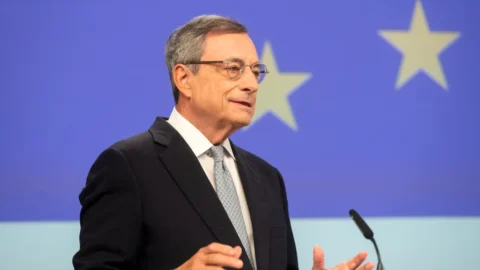
Mario Draghi returns to talk about Europe and he does it from Zurich, at tenth Karl Brunner Distinguished Lecture Organized by the Swiss National Bank. His speech focused on the relationship between monetary policy, public debt, and growth. For the former ECB president, the euro's architecture has withstood crises, but today the central bank can no longer indirectly shoulder the burden of European growth.
"A generation ago, Europe established a monetary constitution that has withstood every crisis since," Draghi said. "It rests on an independent central bank with a clear priority on price stability and fiscal discipline. That framework remains the right one." But the stability of this system, according to Draghi, also depends on ability of governments to ensure sufficient growth. “Brunner’s condition still holds: a central bank can keep the currency stable only if governments keep debt under control.”
“The ECB cannot take responsibility for growth”
This is where Draghi identifies the main change compared to the past. During the sovereign debt crisis, monetary policy had to intervene to prevent the divergence between growth and debt costs from becoming destabilizing. But that solution, he warns, cannot be made permanent. "A framework in which the central bank takes charge of growth is not sustainable, and today it is no longer viable."
The priority of monetary policy must therefore remain price stability. “The first priority is to keep inflation under control”Draghi explained, adding that the ECB must avoid weakening growth "more than necessary." Monetary policy, he emphasized, can ensure that "the path of key interest rates is not higher than necessary to stabilize inflation over the medium term." But responsibility for development must return to politics. "Growth should become an explicit objective shared by all governments."
The problem is the European scale
For Draghi, individual national reforms are no longer sufficientThe scale of new technological, energy, and industrial investments requires a greater level of integration. "Europe's usual response, with each country acting independently, will not be sufficient in the world it faces today." And again: "National reforms remain important, but they cannot provide the scale on which technology and, therefore, growth now depend. Only integration can do it.".
A comparison with the United States highlights the problem. According to the data cited by Draghi, between 2008 and 2023 the gap between the value of American listed companies and that of European companies has increased from approximately 3.000 trillion to 34.000 trillion dollars. The phenomenon, he observed, is particularly evident in young companies and in sectors characterized by strong economies of scale.
“One hundred billion for artificial intelligence”
For Draghi, artificial intelligence is one of the clearest examples of the need for action at the European level. Europe currently has a small share of the world's computing capacity dedicated to AI, and risks not fully benefiting from the new technological wave. “Secure access to computing capacity benefits all Europeans, yet the supply is insufficient when each country acts alone.”
Draghi then indicated the possibility of using approximately €100 billion from the next European budget to reduce the risk of investing in the infrastructure needed for artificial intelligence. "That sum is fully within our reach." The issue is not just about AI"Supranational reforms have become the most important lever for growth," Draghi said, indicating the European roadmap on competitiveness as the path to follow.
“Lawmakers must take responsibility for growth”
Draghi's final message returns to the relationship between growth, public finances, and central bank independence. If the economy grows too slowly compared to the cost of debt, the sustainability of public finances becomes progressively more difficultFor this reason, according to the former ECB president, the answer cannot be left to monetary policy again. "For the Constitution to last, legislators at the national and European levels must now take full responsibility for growth as a Union objective." And the conclusion is equally clear: "If they do so, they will put Europe on the path to renewal."