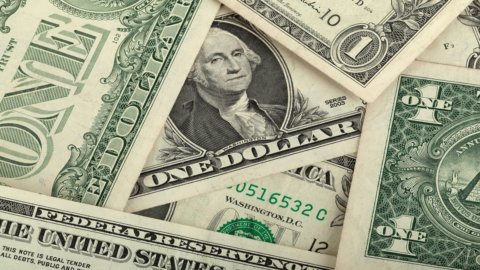
After the resounding declarations of war on trade between the US and other countries hit by President Donald Trump's tariffs, silence seems to have fallen: in reality, as in every war, the time has come to study tactics and diversionary maneuvers and one of these is that of move the war front from trade to the currencies, starting from Asia. From Thai dollar, the movement has moved on Hong Kong, the yuan and malaysian ringgit, with central banks intervening in several cases. Today the dollar strengthened slightly, but the seismic movement worries analysts. At the end of the Golden Week of vacation, the asian bags are mostly positive, while markets are banking on a thaw between the US on one side and China and India on the other. European stock futures are pointing to a weak opening, with markets taking their time ahead of the monetary policy decision of the Federal Reserve tomorrow.
Trade war becomes currency war
The silence of the trade war, after Trump's shouted declarations and ferocious threats against partner countries for decades, is only apparent: in the background other troops are moving, wearing the uniform of the Asian local currencies. In the last few hours the movement has slowed down and the dollar is taking a breather, but big underground movements are taking place.
In the lead is the Taiwan dollar which has seen a surge in recent sessions fueling speculation about a possible revaluation of regional foreign currencies to obtain trade concessions by the United States. Its rise suggests a major reabsorption is underway and highlights one economy among many where years of large trade surpluses have created large long dollar positions among exporters and insurers that are now being challenged, creating no small amount of anxiety, analysts say.
The situation today she moved on Hong Kong: The Hong Kong Monetary Authority (HKMA), the city's central bank, has intervened for the third time in four days to maintain the local currency's peg to the U.S. dollar. The HKMA sold a record HK$60 billion ($7,74 billion) of local currency overnight and bought $7,8 billion at an exchange rate of HK$7,75 per U.S. dollar as the local currency strengthened to the upper limit of its band for the fourth time this month, the authority said in a statement.
“The real action today is in the Asian currency market,” says Charu Chanana, chief investment officer at Saxo in Singapore. “If these currencies continue to strengthen sharply, it could trigger fears of a ‘reverse Asian currency crisis,’ with potential knock-on effects in the bond market as Asian institutions reconsider their unhedged exposure to Treasury holdings.”
In China continental, the yuan offshore strengthened and surpassed the 7,2 level against the US dollar, for the first time since November. This morning the Taiwan dollar settled at 30 per U.S. dollar, not far from a near three-year high of 29,59 hit on Monday, up 8% in two days. The renminbi's recent gains have largely been driven by expectations that the U.S. and China will soon begin negotiations, said Xu Tianchen, senior China economist at the Economist Intelligence Unit, adding that working-level engagement may have already begun, or be about to begin. "We can reasonably expect the two countries to reduce some of their tariffs against each other, as they are excessive and unsustainable," he said. Encouraging signs have come from Washington, in fact, where U.S. Treasury Secretary Scott Besent, he declared to the CNBC that he expects to see progress in U.S.-China trade talks in the coming weeks. President Trump also assured over the weekend that trade talks are underway with several countries, including China, with the goal of reaching a fair deal with Beijing.
Like a long wave, the currency maneuver is moving to other Asian areas. The Malaysian Ringgit, for example, rose nearly 1,5% on Monday, hitting its highest since October. It has since weakened, but remains near its baseline.
Asian stocks rise after Golden Week
Some Asian markets reopen after celebrations for the Golden Week, the holiday period around May Day. The stock exchanges in Japan and South Korea are still closed.
The market is also rising China internal: index of 300 of the price lists Shanghai and Shenzhen +1%, while the Hang Seng +0,7%. On the occasion of the much-felt Asian spring holiday, between the first and the fifth of May, in China between entries and exits the travelers have reached 10,9 million, the National Immigration Administration announced last night. Inbound and outbound trips by foreigners have reached 1,1 million, an increase of 43,1% compared to last year. Instead, theservice activities in April. Caixin China's services purchasing managers' index fell to 50,7, the lowest level in seven months, Caixin and S&P Global said on Tuesday, versus expectations of 51,8. Last month, "the spat between China and the United States limited market gains," Wang Zhe, senior economist at Caixin Insight, wrote in the statement. Equity markets on par of India and Singapore.
Il Petroleum rebounds from lows, Brent +1,5% to $61 a barrel. Gold +1% to $3.365 an ounce, up 2,8% yesterday.
India proposed zero tariffs on steel, auto parts and pharmaceutical products on a reciprocal basis up to a certain amount of imports, in the context of trade negotiations with the United States, it was reported. Bloomberg from sources familiar with the matter. Above that threshold, imported goods would be subject to normal tariff levels. The offer was made by Indian trade officials visiting Washington in late April, with the aim of accelerating negotiations for a bilateral trade deal expected in the fall.
Wall Street closes slightly lower ahead of Fed verdict tomorrow
Caution prevailed at the close on Wall Street yesterday, as investors shifted their attention to the meeting of the Fed tomorrow. The Dow Jones closed the session with a slight decrease of 0,24% and along the same lines, it moved downwards'S&P-500, which lost 0,64%, closing at 5.650 points. Slightly negative was the Nasdaq 100 (-0,67%); on the same trend, in red the'S&P 100 (-0,82%). Apple's losses are worth noting, with a loss of 3,15%, Nike suffering a decline of 2,12%, and Starbucks at -3,58%.
Expectations for the monetary policy moves of the Fed They are mostly about keeping interest rates unchanged, at 4,25-4,50%, but the statements of President Powell will be particularly followed after the numerous attacks on the independence of the central bank by Trump.
European stock markets little changed. At Piazza Affari to watch: Intesa Sanpaolo and Banco BPM
European stock markets are expected to open around parity, with the EuroStoxx 50 futures at -0,1%. Data on the agenda PMI April for France, Germany, the United Kingdom and the Eurozone.
Intesa Sanpaolo will report its first-quarter results. Analysts expect net profit of 2,43 billion. Revenues of 6,7 billion. Net interest income (NII) is expected at 3,66 billion, while net commissions, which derive from managed savings, are expected at 2,42 billion.
Mediobanca, Generali Bank. Generali Chairman Andrea Sironi believes that the next Board of Directors meeting of the company scheduled for tomorrow will also discuss the takeover bid launched by Piazzetta Cuccia on the subsidiary of the Trieste group, Banca Generali, last week.
Ferrari, Diasorin, Amplifon will publish the results of the quarter.
Unicredit, Banco BPM. The Italian government is not willing to soften the conditions imposed on UniCredit in the takeover bid for Banco Bpm, which could lead the institution led by Andrea Orcel to withdraw the offer, according to Bloomberg News.
Stellantis. Ford withdrew its 2025 forecast due to tariffs, the impact of the trade war is worth about $1,5 billion on adjusted operating profits. John Elkann and Luca de Meo, respectively chairman of Stellantis and CEO of Renault, spoke together to the French newspaper Le Figaro, in order to push for a profound review of the European industrial strategy towards decarbonisation. If this change of approach does not happen quickly, Europe will definitively lose its status as a manufacturing producer and will become a mere market for others, unlike all other leading nations, the two said.