
Suppose you have saved up some money and are preparing to invest it in a mutual fund (or SICAV or unit-linked, or other “managed” product). How do you choose it?
Follow the herd
Intuitively, good past fund performance would be indicative of an asset manager's management skills. Common sense, in fact, having recently achieved positive results and being in the top positions of the rankings should count for something in discriminating good managers from goats, right? Very reasonable.
And so, if you're like most people, or you hire a financial advisor with the professionalism of a coconut salesman, you're likely to end up investing in a fund that's a top performer in the most recent rankings. or that he won some award for outstanding performance in the previous year.
Unfortunately, this is a bleak and unforgiving world: reasonable intuitions often mislead. The data tells another story.
The word to the data
I take my cue from a very recent study by S&P Dow Jones which analyzes the persistence of the "top performers" over the years, answering the question with facts: does past performance matter?
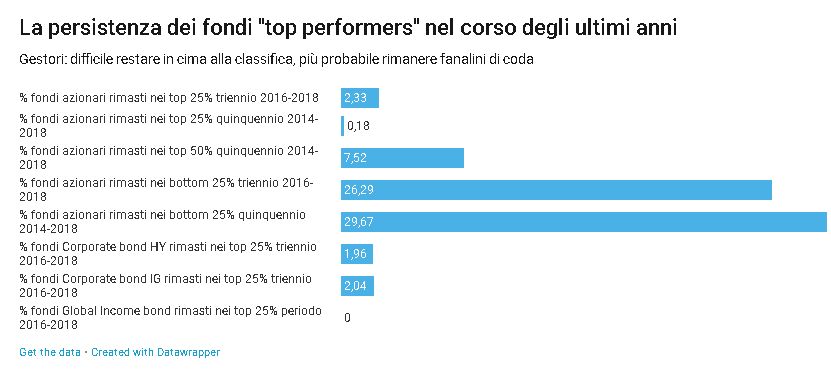
In short: (In Italian only)
- of the 557 equity funds that made up the top 25% in 2016, only 2,33% were still in the top 25% in 2018;
- of the 571 top 25% equity funds in 2014, only 0,18% were still in the top 25% five years later, in 2018;
- even softening the issue, and analyzing who was able to stay in the top 50%, the top half of the ranking, only 7,52% of funds were able to do so in the five-year period 2014-2018;
- on the other hand, those who were in the bottom 25%, i.e. at the bottom of the rankings, remained in the bottom positions in 26,29% of cases in the three-year period 2016-2018 and in 29,67% of cases in the five-year period 2014-2018;
- on bonds, in the most numerous categories, i.e. Corporate High Yield, Medium Term Corporate Investment Grade and Global Income, the percentage of funds that remain in the top 25% in three years are respectively 1,96%, 2,04% and 0 % (zero cut, yes);
- extending the time horizon to five years for the same categories, the percentage of funds that remain in the top 25% are respectively 0%, 0% and 0% – a nice trio of zeros, there's nothing to say.
To avoid making you doze off more than necessary, I'm not copying all the data, which you can read yourself in the report. I think the moral of the story is clear anyway: very few funds manage to stay at the top, and the undertaking is all the more difficult the more the time horizon lengthens.
It has to be said that the percentages do improve somewhat for more illiquid and technical asset classes, such as municipal bonds (we'll see shortly that there's a good reason). Losers, on the other hand, have a much better chance of remaining losers. It's a cruel world.
The study in question relates to the main world market for asset management, the United States. But, if you think that things are different elsewhere, I'm sorry, the evidence is similar.
In fact, reality is even worse. In one of the most authoritative works on the topic of persistence of performance, Mark M. Carhart of the University of Southern California concludes that:
“The only meaningful persistence is concentrated in the strong underperformance of the worst funds. There is no empirical evidence of superior skills or information from portfolio managers, in the aggregate. In short, the best do not stay that way for long, but the worst tend to remain among the worst, because there are very few management wizards around. Consequently, it is the realm of chance.
But what madness is this? What happens on the financial markets?
The reason
All of this is absolutely normal. And rational.
The reason managers' performance is dominated by chance is not, as one might easily conclude, that (in the aggregate) they are a bunch of jackasses. It's the exact opposite: the investor community is very good at incorporating information into the prices of stocks, bonds, commodities and other assets. So it is very difficult to do better than others.
It's like a large group of cyclists traveling full throttle: practically impossible to break away and break away. This phenomenon is known as the ability paradox (Paradox of skill): the more the skills grow uniformly in a competing group, the less they are decisive and the more weight the case assumes. That's why in asset classes where there is less crowding of managers, skills emerge more easily.
So, gentlemen, welcome to the world of reality - a parched moor. However, aware of the fact that when reality is unpleasant, realists tend to be unwelcome, I also tell you that from all this you can draw useful practical indications for investing your savings, however few or many.
Some saver-ninja rules
- Avoid the losers
Try not to get fooled by asset management products with consistently bad historical performances, for years: we have seen that on average they still tend to perform badly. - Be skeptical about “glamorous” bottoms
The best performers of the year will continue to attract media attention and win self-referential prizes: I hope that facts and numbers have convinced you that, for the future, this matters very little. - Mind your own business
Invest in products in line with your economic and financial objectives and needs, consistent with your risk profile and the rest of the portfolio. Don't follow trends. - Watch the costs
Commission costs have a direct negative impact on the performance of your investments: I think you know how to adjust accordingly (it's not difficult). - Look at the investment process
In an environment dominated by chance, it is important to make decisions systematically, making the most of the information available: this is what a good management team does. So focus on the investment process – how managers select investments and manage risk, how disciplined they are, how they react to the unexpected, and so on. Those who have a good method are more likely to succeed. I know that judging an investment process is a difficult if not impossible feat for many savers, but asking your financial advisor, “What is the investment process?” and seeing how he responds can provide important clues. For example, your interlocutor starting to stutter, or stories too good to seem true, or completely incomprehensible theories, well, they're not a good sign. Remember: a good investment process usually has a solid and understandable idea behind it, at least on an intuitive level.
Moral of the story
The message of the story is clear: historical performance, fund rankings and glittering awards have little predictive value. This is the crux of the matter.
So, when it comes to selecting an asset management product, the difference is simply wanting to believe (in performance), or looking at facts and numbers with full awareness of the role of chance. What is not pleasant: as Qohelet says, "whoever increases knowledge, increases pain".
From the blog of Advise Only.